
Demand Drivers and Capacity Questions at Regional Fiber Connect Workshop
The Fiber Broadband Association's Kansas City workshop brought together more than 320 attendees to discuss AI, streaming, and cloud applications.

Max Hahn
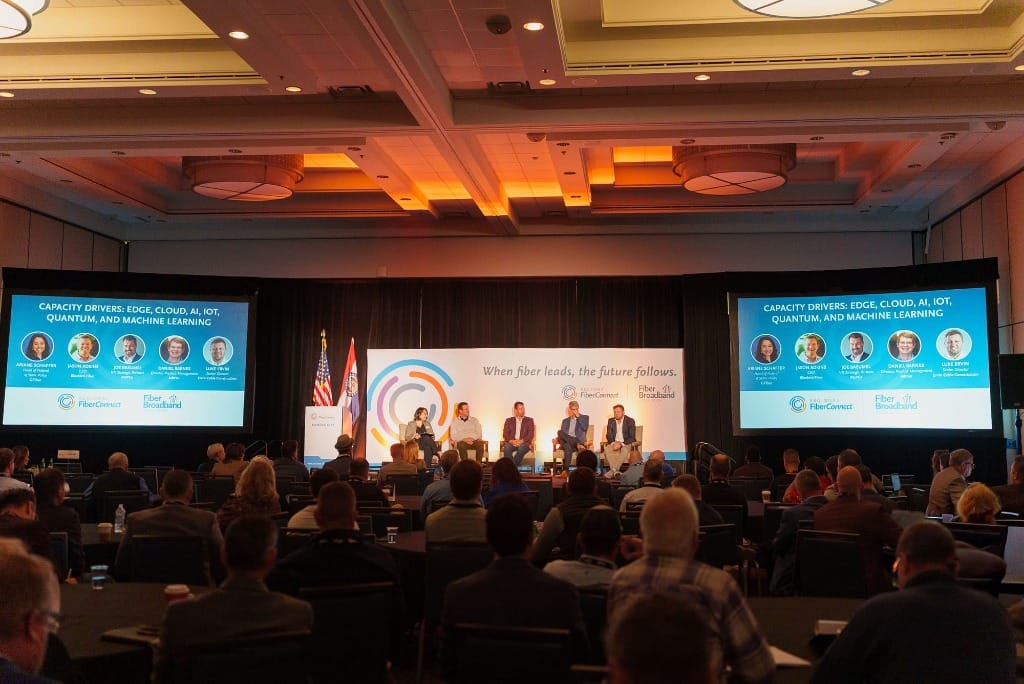
As the Fiber Broadband Association (FBA) wrapped up its seven-part Regional Fiber Connect Workshop series in Kansas City on November 11, the focus of the day was on the demand drivers that create the need for higher capacity infrastructure. Speakers discussed everything from smart homes to artificial intelligence to public safety services, diving deep into not only the capacity requirements but latency concerns, energy needs, and what happens when communities don’t have access to the potential fiber can underpin.
The crowd of over 320 attendees shared insights, networked over Kansas City barbeque and strong coffee, and helped frame the challenges ahead and possibilities to unlock.
Of course, innovation without a positive economic impact doesn’t really deliver a benefit to the bargain when planning the future prosperity of U.S. communities. To help frame the impacts of fiber connectivity, and its lack within communities that will be relegated to bargain technologies, Jeremy Hill, assistant vice president and regional executive at Federal Reserve Bank of Kansas City, explained the challenges of balancing labor supply and demand and the role productivity plays in economic growth, citing research that mapped the economic impact of fiber connectivity, as well as AI’s role in increasing efficiencies and reducing labor costs in the region.
History is often our best teacher and to avoid the mistakes of the past, GFiber (formerly Google Fiber), who famously brought the idea of Gig Cities to the mass market with its 2014 RFP and announcement in Kansas City, provided a retrospect on the process and a recap of how far the company and the industry has come over the past decade.
Joining GFiber’s Rachel Merlo was former mayor and current president and CEO of the Greater Kansas City Chamber of Commerce Joe Reardon, former assistant city manager at Kansas City Rick Usher, and managing director at KC Digital Drive Aaron Deacon. The panel highlighted the importance of public/private partnerships and community engagement as new cities and towns look to add fiber broadband to the mix, as well as the ongoing need for infrastructure investment and education to ensure digital equity.
Demand for capacity is being felt far beyond the home, and the rise in data centers, the emerging Edge data center market, and growth in Interexchange Carrier (IXC) facilities are testament to how fiber plays a key role in keeping everything connected. Fiber has the ability to change lives, and with that responsibility comes a need for great power. The capacity for scale depends on two key factors: access to energy and the capacity to transmit the data created and shared in our digital economy.
Serial entrepreneur and investor Hunter Newby shared his insights into this evolving market and the realities of creating secure, scalable facilities for carriers to connect. With more data being created and consumed in rural communities, the need for IXCs has become increasingly critical for services to scale, services that deliver the experience both consumers and business demand.
Within the home, key demand drivers include the rise of 8K streaming, the shift from Wi-Fi 6 to Wi-Fi 7, and the importance of future-proofing networks. Operators that are delivering Gig service are seeing 10% customer base growth, 41% bandwidth utilization increase, and 29% per-user usage growth. This growth dictates the need for resilient fiber networks, efficient power management, and customer education on network capabilities, especially in rural areas that have been traditionally underserved.
The demand is increasing for high-capacity networks to support AI and cloud-based applications, particularly in rural areas that are increasingly relying on technology and connectivity for education, healthcare, and agriculture.
In a panel led by Kara Lowe, CEO, KC Tech Council, the group shared stories about fiber broadband’s profound impact on rural communities in Missouri and Kansas. Thomas Garrett, vice president of business development at IdeaTek, shared how his company has been successful leveraging funds from the Capital Projects Fund, delivering last-mile improvements and expanding their services to about 1,000 locations in western Kansas.
Many of the locations served are feed yards. “That's huge in Kansas. We have a lot of GDP that's created by those feed yards,” explained Garrett. “These feed yards partnered with us to fund the expansion, and they are leveraging the bandwidth to watch the markets and make better real-time decisions on how they buy and sell their product.” Garrett shared that with fiber connectivity, they now have everything they need to be successful in the global market and reach further and negotiate better deals than they were before they were connected.
Darren Farnan, general manager of United Fiber, shared that many rural communities have voiced frustration, wondering why other communities have been invested in while they remain unconnected. “One of the questions we get from city council officials as we enter a new market is ‘how many jobs is this going to create?’” said Farnan. “And it's kind of a tough question, honestly, because we build fiber because it's low cost to maintain, low cost to operate, you don't have to add a bunch of headcounts to keep the thing running. So we have to say, ‘I'm not going to come in and hire a bunch of people in the community, but what we do bring is the ability for people to work remotely, and that's how you can bring in jobs to your rural community,’ and that’s been a huge incentive to local leaders.”
Angie Kreider, Director of Business Development Rainbow Telecom, echoed that benefit, “We are very rural, most of our town populations are around 500 people and it's important for us, not only to support the cities and the counties for their economic development and to keep that infrastructure underneath our current businesses, but it really boils down to what kind of quality of life can we provide.”
Rainbow Telecom, Kreider added, concentrates on economic development for businesses and helping communities attract new businesses, both that establish a presence in the community and those that allow people to live in a rural community and work remotely.
“We honestly have it really good out in rural USA. We're able to connect to all the amenities when we have fiber, but can still live out in the country, and still have our chamber of commerce tree lightings and all the fun things that we do in our little towns. And I just recently figured out Walmart will deliver to my house. I am crazy excited about that, so just in time for the holidays,” said Kreider with a laugh.
During the afternoon keynote, Adam Thorp, program manager for BEAD in the Missouri Office of Broadband Development, shared the results of his agency’s BEAD submission and expectations as NTIA reviews the proposal. The state of Missouri received the third largest allocation of BEAD funding in the country, $1.7 billion, to serve more than 200,000 locations. Thorp shared that it’s been an interesting process to get to the point of announcing provisional awards. One of the key issues the broadband office is working on is how it can leverage the unused deployment funds to help people connect safely.
Thorp shared details on how his office worked through the recent changes to the BEAD program and how it kept its focus on delivering the best networks for the communities that will be impacted. “When making our priority broadband determinations, we looked at the capabilities of the proposed networks, and we looked at characteristics of the area that was getting served. We looked at density and looked at areas that were growing very quickly, areas with significant tree cover on the theory that in these areas, other technologies might struggle to provide the quality of service that we're hoping to see at the end of the BEAD program, and decided we could put in a bit more of an investment into those areas.”
Throughout the day, sessions explored the fact that demand drivers for applications and services we use today dictate a fiber first approach. As for the needs of tomorrow, it was clear that the operators that spoke felt that communities that have been relegated to less reliable or less scalable technologies will be left behind, likely for decades to come.
Max Hahn is a B2B marketing professional with nine years of experience in the broadband industry. He is also an expert in team management, communications, content creation, and digital marketing with a focus on driving new revenue opportunities. He considers himself a lifetime learner specializing in understanding technical concepts and translating concepts into approachable content. This report is exclusive to Broadband Breakfast.





Member discussion