
Holistic Approach Is Needed to Solve Energy Bottlenecks, Panel Says
Permitting is a good start, but other changes and incentives are needed to solve energy challenges, INCOMPAS panel says.

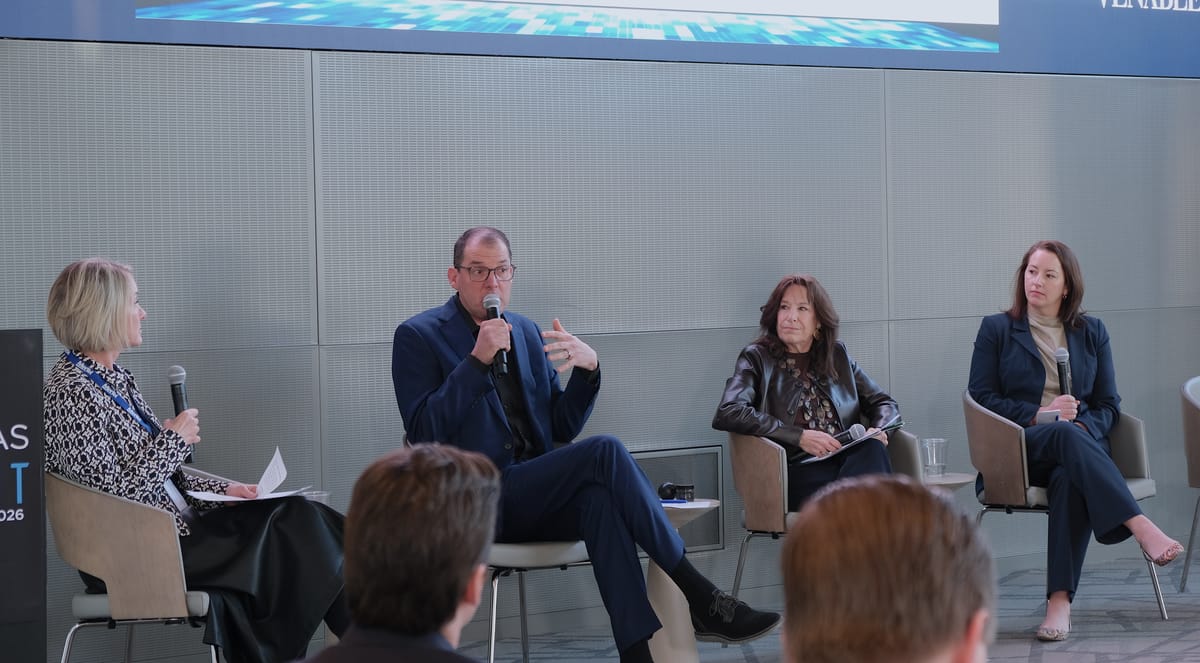
WASHINGTON, Feb 7, 2026 – A panel of industry experts representing nuclear power, transmission and data center infrastructure providers argued for community engagement, financial incentives, and AI implementation as some of the best ideas on resolving bottlenecks during a panel at the INCOMPAS Policy Summit on Thursday.
While panelists agreed that it would be good to tackle permitting reform from a practical perspective, they also argued that there were more substantive moves that needed to be made in tandem.
“Candidly, [permitting reform] is not enough” said Steve Haro, founder of consultant Haro Solutions.

After power is generated, it needs to be transmitted, and transmission line projects can take up to 12-17 years to be built, according to Haro. As a result, capital from investors can be held in escrow for the duration of a project’s cycle, decreasing incentive for these projects to get off the ground.
Changes to permitting regulation could “shave off years.” But providing financial incentives within the tax code, reducing litigation windows, and coordination between all stakeholders are also needed to lead to increased transmission capacity.
Carol Lane, vice president of government relations at X-energy, a company building small and modular nuclear reactors, added that data centers themselves can be stood up quickly—but have to wait on power generation and transmission to come online. That can take years.
A focus on communities
As data center construction has consumed public interest and concern, Brianne Miller, senior director of energy and infrastructure policy at Microsoft, urged industry to put forward a community-centric approach to educating the public on the economic benefits of data centers.
To that end, Microsoft announced a “Community First AI Infrastructure Initiative” in January, a framework for local hiring, financial support for grid upgrades, support for local education and job training.
The company also directly addressed concerns around water usage and price increases.
“It all starts in that local community, and so being present there and listening to what they want and need and responding is really important,” Miller said.
Microsoft’s data centers run on close-looped water systems, so water is not being constantly run in and out, Miller said. She added that on-site “front side of the meter” local power generation can cover data center usage and resell additional availability to the grid, which in turn drives prices down.
“The reaction has been really positive… but we have to prove it now,” Miller said.
AI can be part of the solution
All panelists agreed that AI tools could be used to speed up some of the process such as application writing, reviews, approvals and coordination. Miller said that AI could be utilized to respond to long and onerous forms, and to submit them to the appropriate agency.
Miller also saw a future where AI could coordinate between agencies who have overlapping jurisdictions, but require different things for approval.
“While we all have self interest and want a return on our investment, we do need each other to move forward,” said Haro. “We’re not as coordinated enough [in] talking to policy makers, saying, ‘you need all of us to make this work’.”





Member discussion