
U.S. Official to Europe: Align With U.S. on AI or Fall Behind
European Union's participation in a State Department effort to secure global AI supply chains remains uncertain.

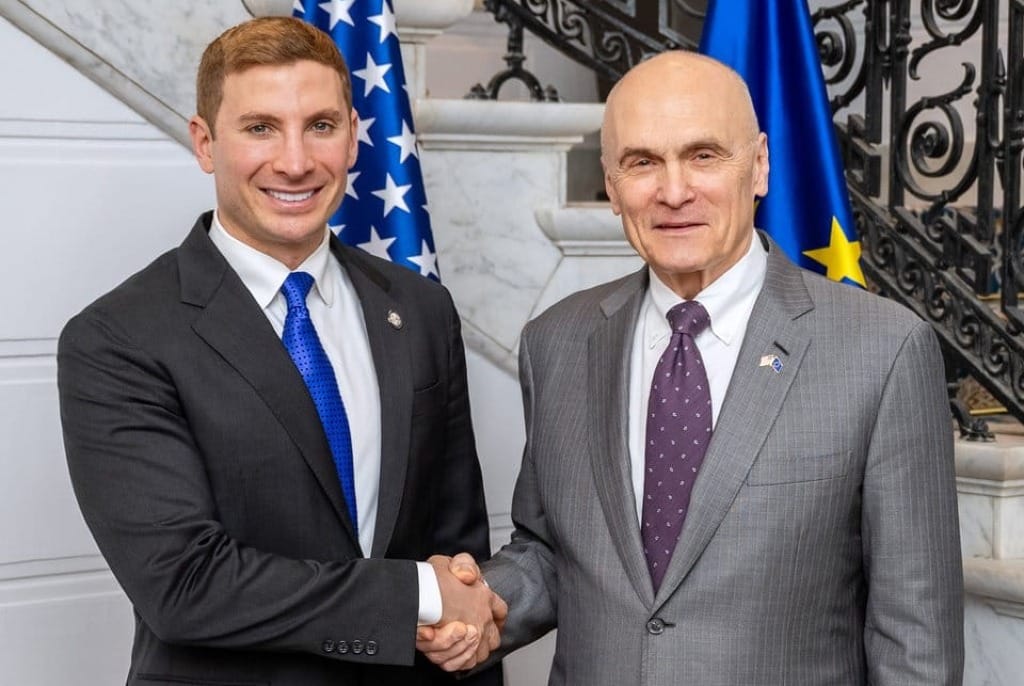
April 2, 2026 – U.S. Under Secretary for Economic Affairs Jacob Helberg labeled the removal of the European Union’s Digital Markets Act as a remedy to “90 percent of issues” in accelerating U.S.-EU artificial intelligence leadership and competitiveness.
By restricting how companies like Google, Microsoft, and Meta combine user data across services, prioritize their own products, and distribute software, the EU law could limit how U.S. companies train and refine modern AI systems.
“The biggest source of what we view as unfair treatment of American companies in the form of fines, most of them have come out of the DMA,” Helberg remarked Wednesday, regarding how Europe and the U.S. can prevent fragmentation and jointly shape global AI standards.

Helberg, who advocates for U.S. economic and foreign policy priorities in his role at the State Department, has been increasingly vocal on digital trade and AI competitiveness. His remarks Wednesday came at an event hosted by the German Marshall Fund in Brussels. Helberg spent his early years in Paris and also lived in Brussels, where his mother worked for the European Commission.
In his remarks Wednesday, Helberg similarly took aim at the EU AI Act, calling it “a sweeping regulatory framework for an industry Europe does not yet have” and arguing it risks putting the region at a “structural disadvantage in the most consequential technological race of our lifetimes.”
The EU AI Act establishes obligations for providers and users depending on the level of risk of AI systems. Under the law, generative AI, like ChatGPT, will not be classified as high-risk, but will have to comply with transparency requirements and EU copyright law.
Helberg remarks come amidst a broader trend of U.S. officials expressing concern over European tech regulations and how they affect transatlantic companies.
One effort the State Department is using to address these challenges is Pax Silica. The initiative, described as the Department’s flagship program on AI and supply chain security, aims to build a new consensus on economic and technological security among allies and trusted partners.
So far, Australia, Greece, India, Israel, Japan, Qatar, South Korea, Singapore, Sweden, the United Arab Emirates, and the United Kingdom have formally signaled support for the initiative.
“Europe and the United States basically have no choice but to work together if the West is going to stay techno-economically on top in the 21st century,” Joseph Coniglio, senior counsel and director of antitrust and innovation at the Information Technology Innovation Foundation, said last year during a Broadband Breakfast Live Online event.
Helberg detailed the work of the initiative as a country-uniting force to pour resources into infrastructure projects. The major goal is to, “rebuild a new geography for our supply chain,” he remarked.
Current negotiations surrounding EU participation in Pax Silica are ongoing. When asked for further updates on the matter, Helberg declined to comment.







Member discussion