
WISPA Says BEAD Contracts Risked Driving Providers Away
The Wireless Internet Service Providers Association said restrictive clauses could stall broadband construction timelines.


WASHINGTON, Nov. 26, 2025 – State broadband offices were urged by a leading trade association on Tuesday to avoid contract terms that could cause providers to abandon their Broadband Equity, Access, and Deployment awards.
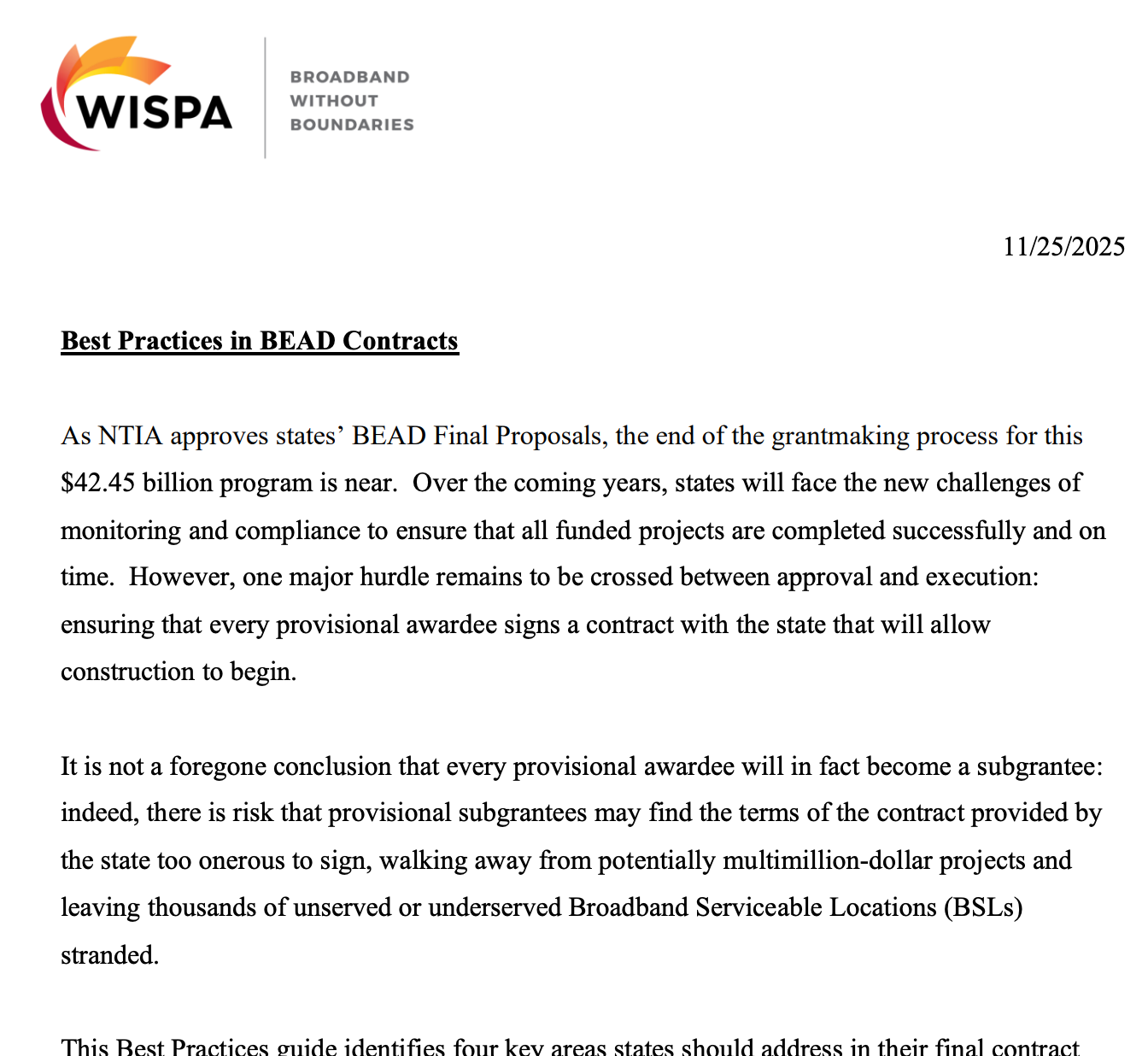
Join the Breakfast Breakfast Club to access this document.
The Wireless Internet Service Providers Association said the next major hurdle after NTIA approvals is converting provisional awardees into signed subgrantees. Steven Schwerbel, the group’s director of state advocacy, warned that restrictive agreements could prompt providers to walk away from multimillion-dollar projects and leave unserved locations without planned service.
The memo identified four areas where WISPA said contract language is most likely to deter participation. First, states should allow providers that won multiple project areas to consolidate them under a single agreement. Schwerbel said a unified contract would reduce reporting burdens for awardees and streamline review workloads for state broadband offices.
Second, he said contracts should emphasize compliance and remediation before enforcement. WISPA recommended that states include a clear period of at least 30 days from written notice and extend it when corrective action is underway. Termination, the group said, should be reserved for situations where remediation fails.
Third, Schwerbel urged states to adopt termination provisions that avoid broad or discretionary exit clauses. He said awardees need assurance that contracts cannot be ended for convenience or general public-interest claims unless required by law.
Fourth, WISPA said definitions of non-compliance must be tied to materiality and any state discretion should be qualified as reasonable. Schwerbel said unclear standards create the perception of arbitrary enforcement and may deter participation, particularly among smaller providers.
Schwerbel said WISPA’s recommendations draw on reviews of draft agreements in all 50 states and input from providers preparing to build BEAD-funded networks.







Member discussion