
California Activates Nation’s Largest Middle-Mile Network, Connecting Tribal, Rural Areas
The Bishop Paiute Tribe is the first to access the state’s $3.2 billion broadband effort spanning 8,000 miles of fiber.

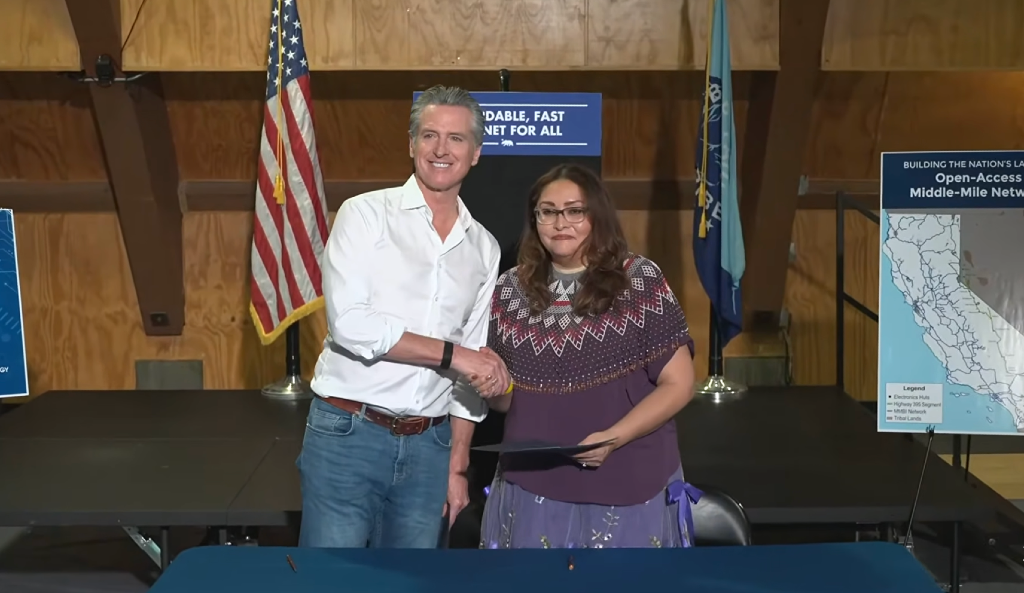
April 3, 2026 – California just activated the nation’s largest open-access middle-mile network, bringing it one step further in closing the digital divide.
On Thursday, the California Department of Technology (CDT) announced that after five years of planning, building, and promising access, the state’s $3.2 billion Middle-Mile Broadband Initiative (MMBI) is now operational. The high-speed network connected the last mile to the state’s first customer, the Bishop Paiute Tribe, a Native American community in Inyo County.
This connection represents a key resource for places across the country that have been historically underserved or unserved, including rural and tribal areas. California Gov. Gavin Newsom said the MMBI plans to construct 8,000 miles of fiber across the state, and he hopes to get more than 5,300 miles completely built out by the end of 2026.

California’s MMBI milestone was celebrated by a ceremonial signing between CDT and Bishop Paiute Tribe leadership as well as a live network light up demo. As the switch was flipped, students and children were seen using computers with their new internet service.
“This day will be remembered for many years to come as a day that the Bishop Paiute Tribe took a huge step forward in advancing our people with technology and opportunity,” said Emma Williams, chairwoman of the Bishop Paiute Tribe. “We are the first tribe in California to connect to California’s middle mile broadband network.”
Though the Bishop Paiute Tribe is the first community to receive MMBI’s connection, the initiative will continue connecting last-mile efforts to the middle-mile infrastructure in the following months.
The MMBI started with Newsom’s Broadband for All Initiative, which prioritized closing the digital divide in all of California’s 58 counties, said Liana Bailey-Crimmins, the state chief information officer and CDT director. The need for this was driven by the COVID-19 pandemic, which revealed a stark divide in communities that lacked digital connectivity.
“And this is not just a milestone for the tribe,” Bailey-Crimmins said. “This is a milestone for the entire state.”
Several speakers emphasized the broadened access to resources that will result because of this broadband connection. Bailey-Crimmins highlighted the importance of telehealth services and economic opportunities that comes with connectivity, and Leviya Williams, Bishop Paiute Tribe Youth Council president, said high-speed internet “helps protect our cultural identity,” through sharing language resources, recording traditions, and online learning.
Williams said the journey to receiving broadband access started in 2009 when the tribe sent a letter of interest to the CDT. Leaders began looking for opportunities to increase connectivity, and in 2020, the tribe received fiber connection to the first tribal buildings, the environment building, the cultural center, and gas station.
Williams emphasized the opportunity MMBI gives the tribe workforce to operate and own their own tribal internet service provider. She said the new internet access will act as a “direct segue” for the tribe to serve their own broadband services to homes and communities.
“I’m deeply honored that we’re here with the tribe, here in Bishop, with the community, doing something that has not been done in the history of the state of California,” Newsom said. “The future officially has happened here first. You are California’s coming attraction. This is what we are now promoting and promising for other rural parts of the state.”
In addition to California’s progress on broadband build out, the state still has yet to receive approval for its $1.86 billion federal Broadband Equity, Access, and Deployment program allocation. California has been facing BEAD plan approval delays from the National Telecommunications and Information Administration (NTIA) for reasons that are unclear.
California, Illinois, and Oklahoma are the last three states that have yet to gain NTIA approval.




Member discussion