Carriers Push FCC for Extra Upper C-Band Spectrum

CTIA wants 220 megahertz of Upper C-Band for 5G; Congress only guaranteed 100 megahertz.

Carriers Push FCC for Extra Upper C-Band Spectrum
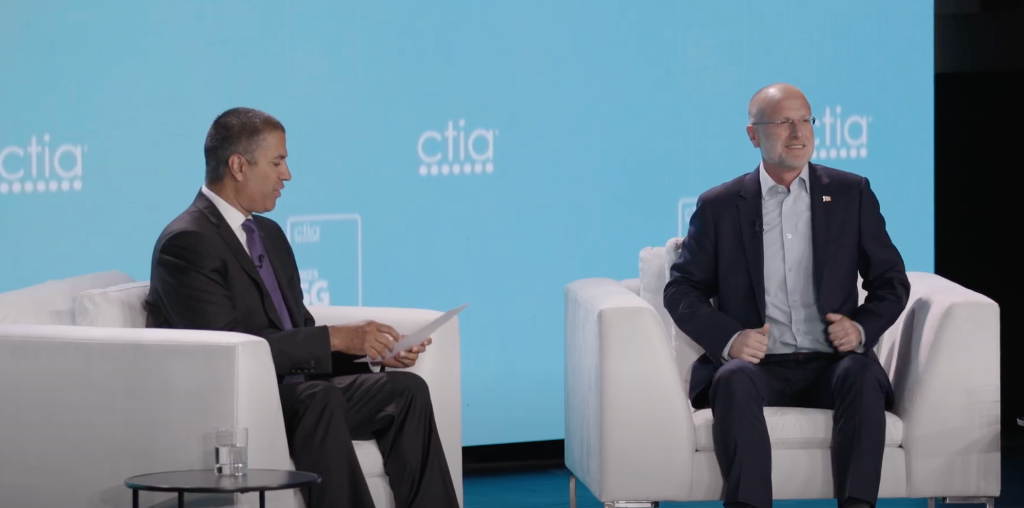
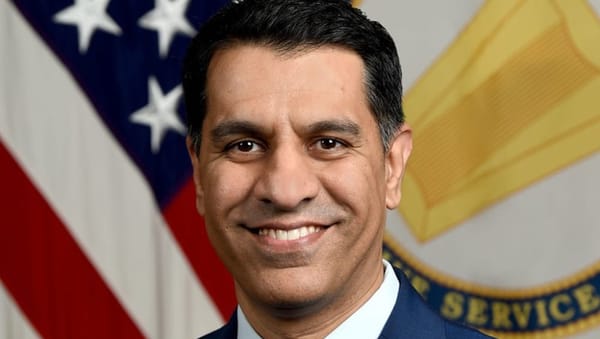
Screenshot of CTIA President and CEO Ajit Pai speaking with FCC Chairman Brendan Carr at the 2025 CTIA 5G Summit on May 6, 2025.

WASHINGTON, Oct. 1, 2025 – Wireless carriers are eyeing more mid-band spectrum than Congress promised.

A law enacted in July called for 100 megahertz of Upper C-band to be auctioned, but wireless industry association CTIA last week asked the Federal Communications Commission for more than double that.

In a Sept. 24 meeting with FCC staff, CTIA representatives urged the FCC to make “as much as 220” megahertz of Upper C-Band available for full-power terrestrial wireless use. They were joined by executives from AT&T, T-Mobile, and Verizon.

The One Big Beautiful Bill which President Donald Trump signed on July 4, directs the FCC to put 300 megahertz of spectrum up for competitive bidding within two years, with no less than 100 megahertz coming from the Upper C-band between 3.98 and 4.2 GigaHertz (GHz).

FCC Chairman Brendan Carr signaled the agency’s interest in expanding the Upper C-Band when, in February, the Commission adopted a notice of inquiry on whether spectrum between 3.98 and 4.2 GHz should be opened for more intensive use.

CTIA urged the FCC to “mov[e] quickly to adopt the proposed rules,” highlighting “the favorable

characteristics of mid-band airwaves,” and saying that  “Upper C-band spectrum will deliver more of the capabilities and capacities that C-band frequencies enable today.” 

In 2021, the FCC reallocated 280 MHz of the lower C-band between 3.7–3.98 GHz for 5G terrestrial use, leaving the Upper C-band, 3.98–4.2 GHz, for satellite incumbents, bringing in more than $81 billion from wireless carriers.

Satellite incumbents, such as Intelsat and SES, still operate in the Upper C-Band. Carriers’ request would mean pushing those players to clear out more spectrum than Congress guaranteed.

CTIA argued that “the market-driven approach applied in the initial C-Band transition can be leveraged to put Upper C-Band spectrum to more intensive use,” and the FCC could “advance this proceeding consistent with that successful model.”

Mid-band spectrum is particularly valuable for 5G because it strikes a balance between wide-area coverage and high capacity. 

By contrast, low-band airwaves travel farther but deliver slower speeds, while millimeter-wave frequencies can provide ultra-fast connections only over short distances.

Member discussion

Popular Tags