Compromise Amendment Allows Satellite Bill to Clear Senate Committee

Concerns raised at the Feb. 3 markup hearing led to additional discussions and an agreement that moved the bill out of committee.

Compromise Amendment Allows Satellite Bill to Clear Senate Committee
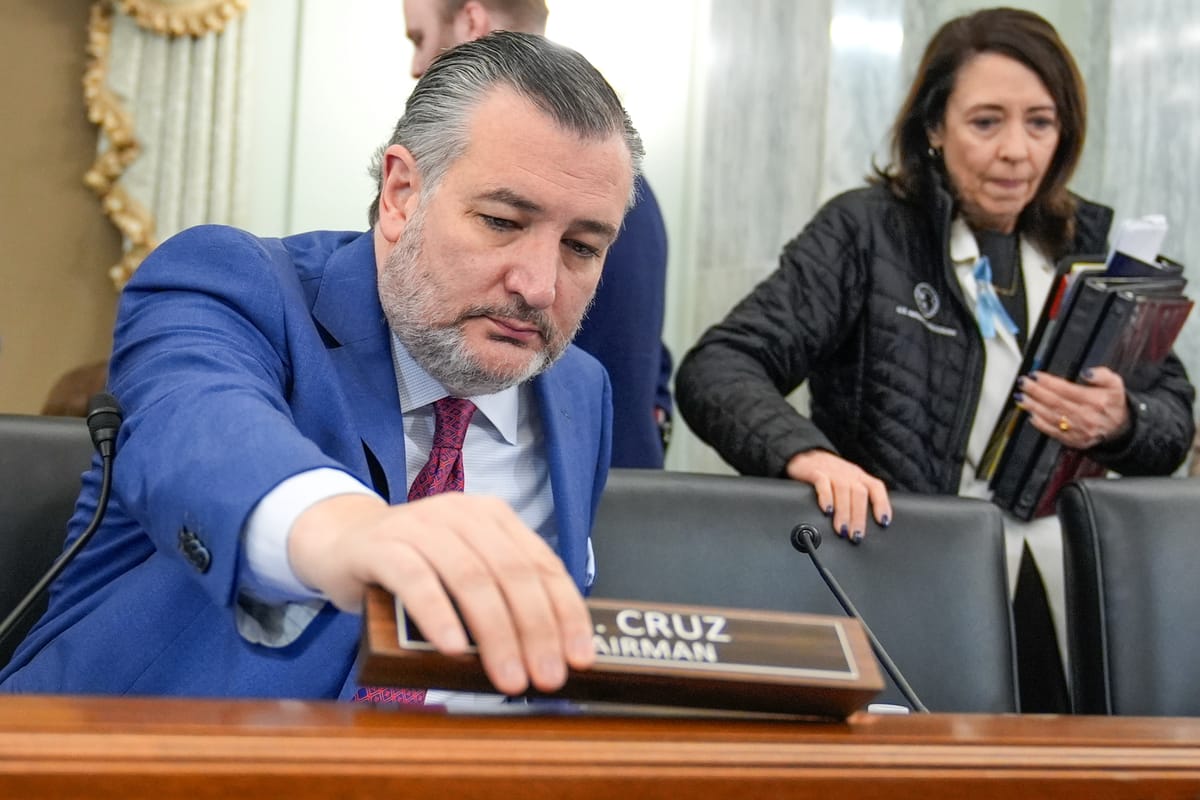
Photo of Sen. Ted Cruz, R-Texas, and Sen. Maria Cantwell, D-Wash., attending a Senate Commerce, Science, and Transportation Committee hearing on Thursday, Feb. 12, 2026, by AP/Mariam Zuhaib

WASHINGTON, Feb. 12, 2026 – The Senate Commerce, Science and Transportation Committee advanced the SAT Streamlining Act, the MAP for Broadband Funding Act and six bills on other topics out of committee on Thursday.

The two communications-related bills were secured with unanimous approval, after amendments were agreed upon by both Senate Commerce Committee Chairman Ted Cruz, R-Texas, and Ranking Member Maria Cantwell D-Wash. 

The amendment addressed Cantwell’s concerns around the "deemed granted” provisions. She was concerned that the prior version would have allowed for automatic FCC approval of satellite projects if the FCC took no action on an authorization request after a year and a half.


Instead, the bill now creates a framework that will require the FCC to consider the size of satellite constellations and what spectrum frequency it operates in, ensure it does not interfere with other users and review satellite designs. This accounts for what Cantwell described as “real world complexity” of large scale satellite constellations. 

“I'm glad we were able to come to an agreement that improves satellite approval processes so the U.S. can compete aggressively,” Cantwell said. “But no language that allows the FCC to ignore objections and let applications be approved by default is in the bill. The FCC must tell the numerous partners who care about interference – in aviation, weather and defense – what they are doing."

The revised language also includes assurances that satellite constellations do not operate within spectrum bands used by the National Oceanic and Atmospheric Administration and the Pentagon, expanded grounds for review process and increased interagency coordination. 

In a markup session on Feb. 3, Cantwell raised these initial concerns after an FCC submission by SpaceX for a “one million satellite constellation” for a space-based data centers, as evidence that FCC approval should not happen automatically without review.

A booming satellite economy

“The satellite economy is booming, and I want to keep it that way,” Cantwell said. “Fifty percent of all satellites [on] the market today are built in Redmond, Washington. If we think the FCC is too slow, let’s fix the process.” 

Cruz responded that the bipartisan bill addresses a real problem: A need to streamline due to increasing demand and considerable backlog.  

“If we’re going to continue to lead in space and in particular beat China we need to be able to be in the mood with speed and to be agile,” Cruz said. “Nothing in this bill limits the FCC’s ability to deny an application.”

Both agreed to continue to work on revised language. That language was approved quickly at the start of Thursday’s committee hearing. 

The MAP for Broadband Funding Act, a bill that would “modernize and improve the Broadband Funding Map in order to promote the most efficient use of Federal funds for broadband deployment,” saw approval after minor changes. 

The amendment softened the original “overbuilding” language to “inefficient use of fragmentation” and added a commissioner vote requirement before the FCC can issue a notice of inquiry.

The amendment also requires the FCC to consider "whether third-party mapping data should be incorporated to improve the functionality and transparency of the Broadband Funding Map."

Member discussion

Popular Tags