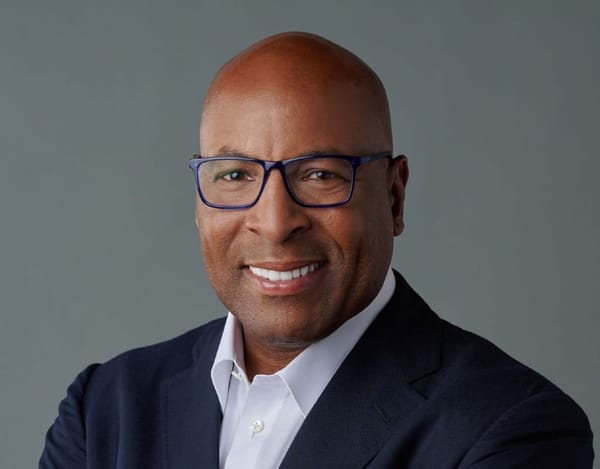
FCC Space Bureau Chief: 'We Are in the Space Industrial Revolution'
Bureau Chief Jay Schwarz said shift from a 'scarcity mindset' to an 'abundance mindset' in space policy needed to continue.


WASHINGTON, September 20, 2025 – Jay Schwarz, Chief of the Federal Communications Commission’s Space Bureau, used his Friday evening keynote at the TPRC conference here to highlight the importance of deregulation in space communications.
Framing his remarks around the rapid expansion of the satellite industry, Schwarz declared that “we are living right now in the space industrial revolution.”
He likened the surge in satellite launches to the “hockey stick” of the Industrial Revolution: “If you look at a chart showing the number of objects launched into space since 1957, it’s the space hockey stick… flat for decades, and then ten years ago, it goes almost vertical.”
He contrasted a “scarcity mindset,” focused on risks and barriers, with an “abundance mindset,” which he described as seeking good things from technology while also mitigating the risks.
“We see offers for innovation that’s gonna improve lives, and we see these opportunities for U.S. leadership in space.”
Outlining the FCC’s priorities, Schwarz highlighted efforts to review outdated power limits for non-geostationary systems, open more than 20,000 megahertz of new satellite spectrum, and streamline licensing to move away from what he called the “default” of “no” stance that stifles innovation.
During a Q&A, an audience member asked what Schwarz would most want a future administration, possibly a Democratic one, to say about how he had influenced thinking on space policy and a new regulatory paradigm.
Schwarz responded by characterizing the FCC’s current system as having a legacy of a “very command and control environment,” arguing that space regulation should continue the shift “from command and control to less command and control or no command and control.”
Kaptivate analysis finds some states’ references to rural America dropped 80 to 100 percent
Idaho, Massachusetts, Minnesota, North Carolina, and Utah had their final proposals approved.
The approval follows recent elections where two Democrats won seats on the commission. Those Democrats oppose the plan but don't take office until January.
Lawmakers are considering how best to reform the fund.
Member discussion