
Fixed Wireless Providers Celebrate Policy Progress
At annual industry gathering, wireless industry leaders cite progress in Washington and state capitols.

Jericho Casper
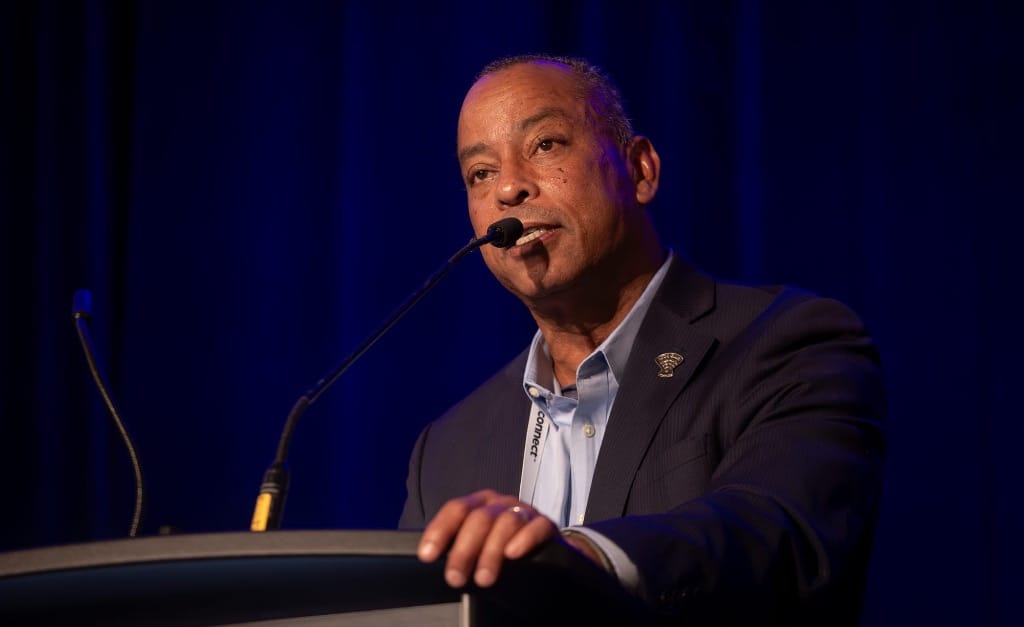
Oct. 16, 2025 – Fixed wireless providers used their annual industry gathering this week to highlight a major policy victory: Blocking proposals by large mobile carriers to rewrite the rules of the Citizens Broadband Radio Service band.
Speaking at the association’s annual WISPAPALOOZA gathering, leaders of the Wireless Internet Service Providers Association said preserving access to shared spectrum remains their top policy priority as the group expands its influence in Washington and state capitals alike.
“This fight about CBRS, we know, is not over,” said Louis Peraertz, vice president of policy for WISPA. “While we are confident that we have made persuasive arguments about the importance of maintaining spectrum rules, we may need your help in our future advocacy efforts,” he told attendees.
The proposal WISPA rallied against would have shifted existing CBRS users into a lower part of the spectrum, the 3.1 to 3.3 GigaHertz (GHz) range to free up the 3.55 to 3.70 GHz band for auction. It also called for allowing priority access license holders to transmit at much higher power levels.
“We worked with the cable industry and other policy allies to aggressively oppose requests filed at the Federal Communications Commission,” Peraertz said.
WISPA’s vice president of spectrum and industry Richard Bernhardt warned that such changes would make it impossible for small wireless providers to share those frequencies.
“Given the political situation we have today, it's absolutely important that we keep telling those in charge why CBRS is really important,” Bernhardt said. More than 60 percent of WISPA members use the shared access band to deliver broadband to hard-to-serve regions.
The group highlighted other spectrum successes this year, including pushing the FCC for access to another shared band, the 37–37.6 GHz band. WISPA has also urged the FCC to allow wireless providers access to the 12.7–13.925 GHz and 42–42.5 GHz spectrum bands.
Focusing on state-level battles
At the state level, WISPA’s advocacy has grown significantly. Steve Schwerbel, the association’s director of state advocacy, said the group was now active in all 50 states, working to defend small wireless internet providers.
Schwerbel pointed to WISPA’s successful campaign to defeat California’s proposed $15-per-month low-income broadband mandate, which he said would have placed heavy financial burdens on small ISPs.
“We brought dozens of our members to Sacramento to meet with legislators from the committees that were overseeing this bill to explain exactly how impactful this legislation would be on our members, and on the access for rural broadband in general,” Schwerbel said.
He listed off more of WISPA’s state policy efforts.
“We have testified, for example, in Michigan, where a bill threatened to expand the requirement for using union labor in broadband expansion projects,” Schwerbel said.
“In Nebraska, we testified on a requirement that would have impacted symmetrical speeds for broadband requirements. And, in New York, we testified on changes to their low speed, low impact broadband requirement program,” he said.
The executives also pointed to recent changes to the Broadband Equity, Access and Deployment program as a major win.
The June 2025 restructuring notice allows both licensed and unlicensed wireless networks to qualify as “priority broadband projects.” The change ensured fixed wireless providers could compete alongside fiber, cable and low-Earth orbit satellite operators for federal broadband funding.
“The important thing is that [the National Telecommunications and Information Administration] now views us as a trusted partner, and so I think as we go forward with NTIA policy, we'll have a better position, better standing to support the needs of our members,” said Peraertz.




Member discussion