
Markey Criticizes FCC Rollbacks, Republican Opposition to Affordability Programs
Markey announced his children’s online privacy act passed the Senate.

Kelcie Lee
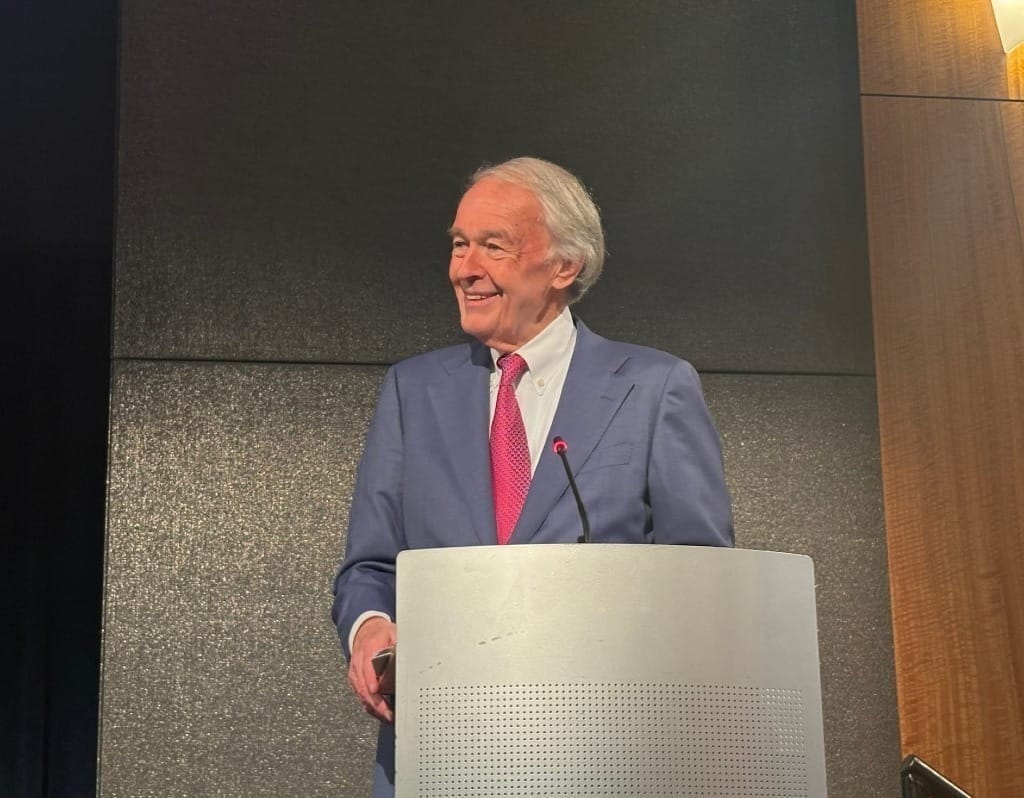
WASHINGTON, March 5, 2026 – Sen. Edward Markey, D-Mass., announced that his Children and Teens’ Online Privacy and Protection Act — a bill that’s been in the works for 15 years — passed unanimously on the Senate floor on Thursday.
Introduced by both Markey and Sen. Bill Cassidy, R-La., Markey said it was a priority to protect children from targeted advertisements and “corporate tech companies” that have monetized technology at the expense of children. The bill would update online data privacy rules and ensure children are protected online.
“It’s the best of technologies and the worst of technologies simultaneously,” Markey said. “It can enable, it can ennoble, it can degrade, it can debase.”
Markey announced that the bill passed at Benton Institute for Broadband and Society’s Telecom Act at 30 event on Thursday. Celebrating and reflecting on the 30th anniversary of the Telecommunications Act of 1996, Markey highlighted the impact of the E-Rate program and his role in creating the initiative’s success. E-Rate gave, and continues to give, K-12 schools and libraries discounts on telecommunications and internet, ultimately aimed at making broadband affordable for digital learning.
“It wasn’t just the wealthy schools, it was every school,” Markey said. “It was every library in America because access to knowledge should never depend on a family’s income or a community’s zip code.”
Markey said E-Rate has delivered more than $75 billion to schools and libraries across the country, making it the largest educational technology program in U.S. history. He emphasized the initiative’s success in bringing technology to people of all income levels, minorities, immigrant communities and elderly populations.
Markey Criticizes FCC and Republican Rollback
Markey expressed disappointment in the Federal Communications Commission’s decision to roll back the E-Rate program’s Wi-Fi hotspot or bus Wi-Fi access at the end of 2025.
The FCC said it made this decision because the prior FCC had exceeded the commission’s statutory authority and that bus Wi-Fi access did not serve an educational purpose. The FCC said it would “no longer support the use of scarce taxpayer dollars to fund unsupervised screen time for kids without accounting for the risks.”
Markey stressed that rolling back these policies is widening the digital divide and affordability gap in broadband access.
“The affordability that was made possible by the Affordable Connectivity Program turned broadband access into real opportunity for people all across our country,” Markey said. “But today, due to Republican opposition, that program has expired. And millions of families are already feeling the consequences.”
He said ACP helped 23 million households afford broadband because the subsidy “made the difference between staying connected and being left offline.”
The ACP subsidy was $30 per month.
Retail broadband prices have been dropping. Comcast, Charter, Optimum and Starlink have each launched promotions in recent weeks. Optimum unveiled a plan just days ago that costs $25 a month for 300 Mbps and included a five-year price lock and plus safeguards against price shock in month 61.
Markey Calls for AI Protections
Markey stressed the importance of artificial intelligence protection, especially for minorities, women, children and LGBTQ+ communities. Markey said, “we must pass my AI Civil Rights Act of 2026,” which has been endorsed by several U.S. civil rights groups. He emphasized the need for policy to keep pace with the rapid development of AI to continue advancing universal service.
“I can promise you that I will be there insistently, constantly, persistently fighting for this program,” Markey said. “We need to fight for programs for the poor, for the disadvantaged, for the immigrant communities in our country. The past is just a memory, the future is a hard reality. And we have to make sure that we are there now in the fight the same way we were 30 years ago.”





Member discussion