NTIA Touts Efforts to Court Foreign Regulators for 2027 World Radiocommunications Summit
The agency touts 'fiber speeds, from space, at a fraction of the cost'

WASHINGTON, Oct. 23, 2026 — U.S. telecom officials are courting foreign regulators ahead of a 2027 international spectrum conference, part of a bid to keep American companies leading the fast-growing satellite broadband market.
In an unsigned Friday blog post by the National Telecommunications and Information Administration, the Commerce Department agency official responsible for U.S. telecommunications policy, the agency said: "America is building a vibrant commercial space economy—and NTIA is laying the groundwork to ensure the United States remains the global leader and partner of choice in satellite innovation."
The agency said that its changes to the Broadband Equity, Access and Deployment program had "resulted in more than $21 billion in taxpayer savings while advancing universal broadband availability."
Under the changes effected by the June 2025 policy notice, the NTIA cut deployment funds for the vast majority of states and territories. But some portion of the $21 billion had already been planned for other "non-deployment" related purposes.
The agency's outreach to the developing nations, according to the blog post, runs through two session with the U.S. Telecommunication Training Institute, for regulators in emerging markets.
The first session, held in May in Accra, Ghana, drew 27 regulators from 20 African countries.
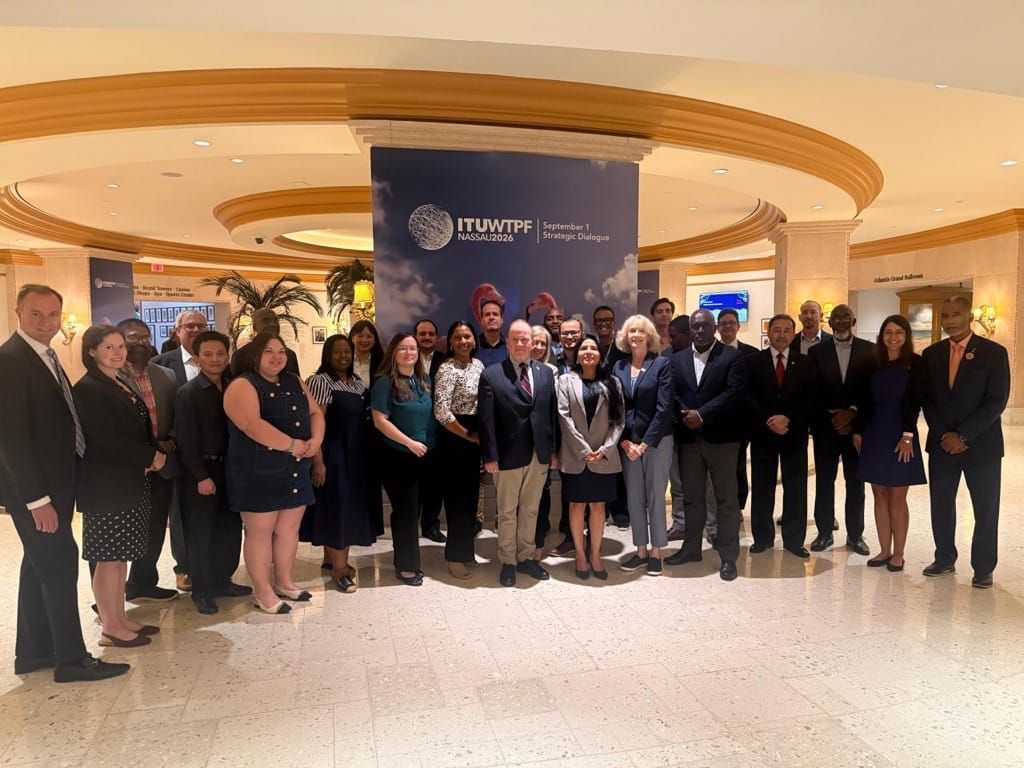
A second, in late August in Nassau, Bahamas, drew 18 regulators from 14 Caribbean and Latin American countries, the NTIA said, followed by a presentation to the Caribbean Telecommunications Union, which has more than 20 member nations.
Satellite-related issues at WRC-27
At stake are rules set at the International Telecommunication Union's World Radiocommunication Conference, known as WRC-27, a United Nations gathering that writes the global rulebook for airwaves.
More than 80 percent of the WRC-27 agenda is satellite-related, NTIA said.
Low-Earth orbit (LEO) satellites, systems that fly closer to the ground than traditional satellites and cut transmission lag, are now a central theme of satellite frequency regulation.
Officials pointed to Hurricane Melissa, which hit the Caribbean in October 2025, when American providers restored "direct-to-device" service, which links ordinary phones straight to satellites, within 24 hours of landfall.
One particularly important issue, the post said, refers to changing equivalent power flux density limits, which govern how LEO satellite networks share spectrum with often older geosynchronous satellite systems (GEO).
The NTIA wants to change these satellite power limits internationally so as to unlock additional capacity. The agency criticized the current system that it said denies capacity for upgrades.
"The U.S. is seeing an increase in [non-geostationary satellite orbit] capacity between 100-700 percent—without complaints of interference from incumbents—ultimately bringing gigabit speeds within reach for LEO services," reads the post. "That’s fiber speeds, from space, at a fraction of the cost."
In other words, NTIA wants those caps loosened worldwide to free up capacity and speed up service, while keeping existing filing rules and interference protections for incumbents.
The agency said it plans more outreach before WRC-27, and support a Trump administration memorandum on "Winning the 6G Race," which directs the government to build a coalition of industry and foreign partners.