Pennsylvania Senate Advances Bill Allowing 18-Month Data Center Moratoriums
Lawmakers must weigh three competing state bills proposing bans ranging from 180 days to three years.

Jericho Casper
WASHINGTON, July 13, 2026 – Legislation that would allow Pennsylvania municipalities to temporarily halt new data center projects while updating local zoning rules advanced in the state Senate Saturday.
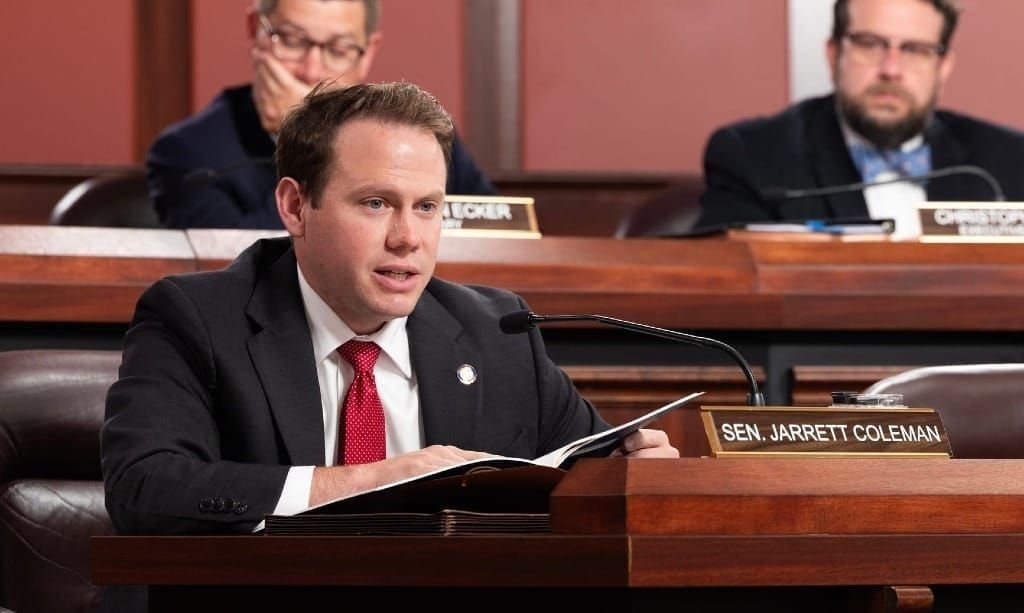
The Pennsylvania Senate Rules & Executive Nominations Committee voted 13-4 to approve Senate Bill 1345, sponsored by state Sen. Jarrett Coleman, R-Lehigh/Bucks. The measure is one of three proposals before the General Assembly that would give state or local officials new authority to pause data center development.

If enacted, Coleman’s bill would authorize municipalities to impose an optional 18-month moratorium on both unapproved and new data center applications, while they revise zoning ordinances and establish policies addressing issues like power supply, water consumption, noise and setbacks which they determine protect the community’s interests.
The measure was amended in the committee to let local governments enact the moratorium by resolution, rather than through ordinance as originally proposed. The change would alter the current framework under Pennsylvania’s Municipalities Planning Code to allow local governments to impose a pause on new data center projects more quickly.
A companion measure, House Bill 2533, sponsored by Rep. Jamie Walsh, R-Luzerne, is pending in the House Committee on Local Government, where it has remained since May 27.
“I hear from my constituents almost every day about their concerns with data center projects,” said Coleman in a release. “My legislation empowers local communities to push the pause button on data centers in order to regulate these projects on their own terms.”
The Senate proposal has a narrower scope than legislation approved by the Pennsylvania House in June.
House Bill 2496, sponsored by state Rep. Paul Friel, D-Chester, would allow municipalities to adopt, by contrast, a six-month pause on new data center applications while they update local land-use ordinances.
Coleman’s bill applies only to high-impact data centers, defined as facilities with a critical IT load of 25 megawatts (MW) or more, while Friel’s measure does not include a size threshold, allowing municipalities to temporarily halt consideration of data center applications more broadly. Twenty-five MW can power between 4,000 and 20,000 average homes.
Senate Bill 1359, introduced by Sen. Katie Muth, D-Berks/Chester/Montgomery, would impose a statewide, mandatory three-year moratorium on the permitting and development of hyperscale data centers, as well as associated power plants and transmission infrastructure.
Unlike Coleman’s proposal, which would give municipalities the option to impose temporary moratoriums on certain large data centers, Muth’s bill would apply statewide and prohibit approvals regardless of when an application was filed.
Despite the “hyperscale” label, SB 1359 data center threshold reaches as low as one megawatt in territories served by smaller electric utilities, casting a wide net.
Some land use attorneys argue that Pennsylvania’s existing zoning framework already gives municipalities tools to address emerging developments.
Brendan O’Donnell, an attorney with Pittsburgh-based law firm Houston Harbaugh’s Renewable Energy, Zoning and Land Use practice, wrote that the Municipalities Planning Code’s existing curative amendment process could provide communities time to update zoning ordinances without imposing broad moratoriums.
O’Donnell argued Muth’s statewide ban is the hardest to justify, because it answers a question of development locations with a one-size-fits-all rule that bans the land use entirely.
Lawmakers will need to reconcile the differences before sending a final bill to Gov. Josh Shapiro, a Democrat.
At least fifteen states have considered data center moratoriums to date, seven of which have failed to be enacted.