
Supreme Court to Consider FTC Firing, Piracy Liability for ISPs in Upcoming Term
Circuit courts are split on whether the FCC can issue fines after SEC v. Jarkesy, but the Supreme Court hasn't yet been asked to weigh in.

Jake Neenan
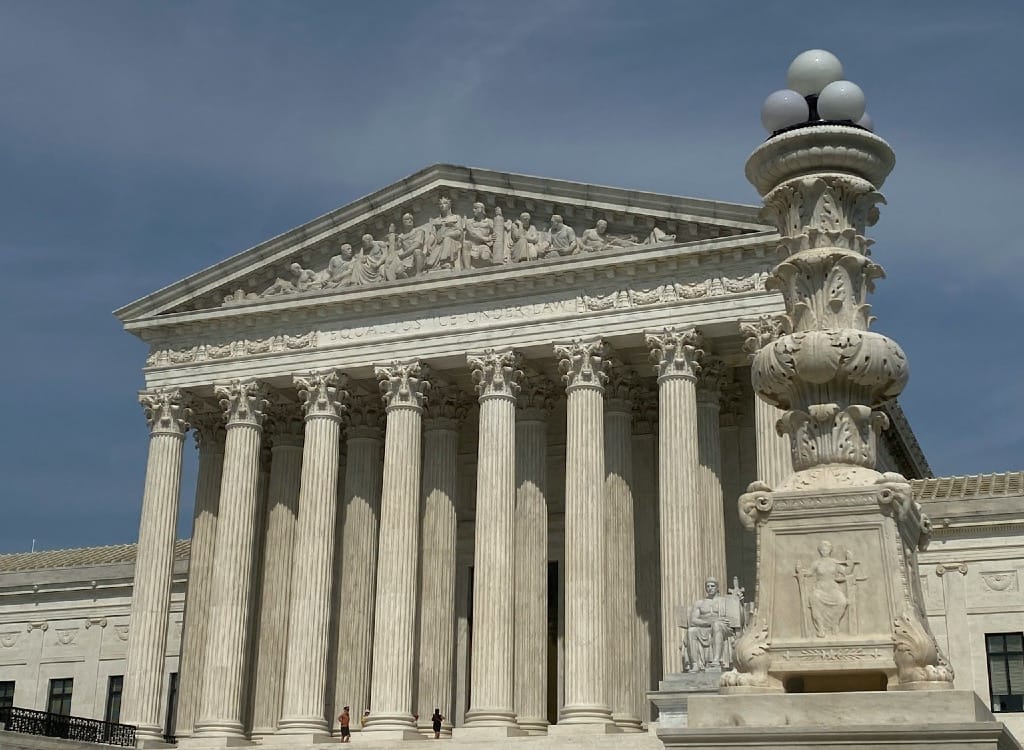
WASHINGTON, Oct. 6, 2025 – The Supreme Court’s 2025 term started Monday with a slate of high-stakes cases on everything from tariffs to voting rights. Justices have also agreed to hear two cases that could impact the telecom industry, but they haven’t been scheduled for argument yet.
Trump v. Slaughter
The Supreme Court last month overturned a decision from the D.C. Circuit and let the Trump administration fire Federal Trade Commissioner Rebecca Slaughter while her appeal plays out. The case is slated for argument in December, but a date hasn’t been set.
Slaughter, who was the last Democrat on the FTC, appealed her dismissal this spring, arguing the precedent set by a 1935 Supreme Court case prevented her from being fired without cause.
The high court appears set to roll that precedent back somehow, having also allowed the Trump administration to fire members of the National Labor Relations Board and Consumer Product Safety Commission – all via brief emergency docket decisions – while cases play out.
Legal experts have said the Supreme Court reversing the case, called Humphries Executor, would give President Donald Trump more ability to fire for any reason members of independent agencies like the Federal Communications Commission.
FCC Commissioner Anna Gomez, the only Democrat in agency leadership, has said she would sue if the Trump administration fired her. Her term ends in June 2026 but she could stay on until the beginning of 2028, as commissioners can stay until their replacement is appointed.
The agency currently has three voting members, the minimum required for a quorum, rather than its usual five. Republican FCC Chairman Brendan Carr and Commissioner Olivia Trusty have a majority and have been able to accomplish their agenda, including repealing some decisions by the Biden FCC.
By law, the agency can’t have more than 3 members from the same party. Replacements for the open spots have not yet been nominated.
Carr has defended the president’s ability to fire his Democratic colleague, saying the Communications Act doesn’t specify for-cause protection for FCC commissioners.
Cox Communications v. Sony Music Entertainment
The Supreme Court agreed this summer to hear a case on whether ISPs can be held liable for copyright infringement by their subscribers. Oral arguments haven’t been scheduled.
After a group of more than 50 record labels sued, a Virginia jury had ruled Cox was liable for $1 billion in damages for not taking enough effort to cut off subscribers repeatedly flagged by automated music piracy detectors. The Fourth Circuit tossed that penalty, but said the cable operator still had some liability because it didn’t cut the connections associated with the infringement notices.
Cox appealed the ruling, arguing it shouldn’t be liable at all for copyright infringement by its subscribers. The ISP is arguing it would have to cut off subscriptions in places where many users are on the same connection, like coffee shops.
The Trump administration has taken Cox’s side, and asked on Sept. 22 to participate in oral arguments when they happen. The ACLU, Electronic Frontier Foundation, Public Knowledge and others have also weighed in in support of Cox.
Sony has argued Cox kept the 57,000 offending connections online in a bid to keep their subscription payments coming in, and thus was partially liable for the piracy. The music industry has until Oct. 15 to submit a brief.
Cox, which counts about 6 million broadband subscribers, is in the process of being acquired by cable giant Charter Communications.
Future issues
There’s currently a split between circuit courts on whether the FCC’s process for collecting fines is unconstitutional. The case hasn’t been appealed to the high court, but experts say the circuit split makes Supreme Court review likely.
The agency fined last year the three major mobile carriers for not vetting third parties before selling customer location data in 2018. After the fines, a Supreme Court decision came down that said the Securities and Exchange Commission had to offer the chance for a jury trial before levying civil penalties. Each carrier challenged their fine in court and argued, among other things, that FCC procedures were also invalid under the new precedent.
The FCC process allows for a jury trial, so long as a company refuses to pay and the Justice Department pursues the fine. That was enough for the Second and D.C. Circuits, but not the conservative Fifth Circuit, which threw out AT&T’s $57 million fine.
T-Mobile is currently trying to have its case in the D.C. Circuit rehearsed after judges upheld a $92 million fine. CTIA, the 5G industry group, has also urged judges to rehear the case and has separately argued to the FCC that its enforcement practices are no longer valid.
Carr, a commissioner at the time, opposed the penalties when they came down, but as chairman has defended the FCC’s ability to issue fines.

Member discussion