T-Mobile Leads in Opensignal’s 2026 U.S. Mobile Network Report
The report analyzes mobile user experience data collected between Sept. 1 and Nov. 29, 2025.
Sergio Romero
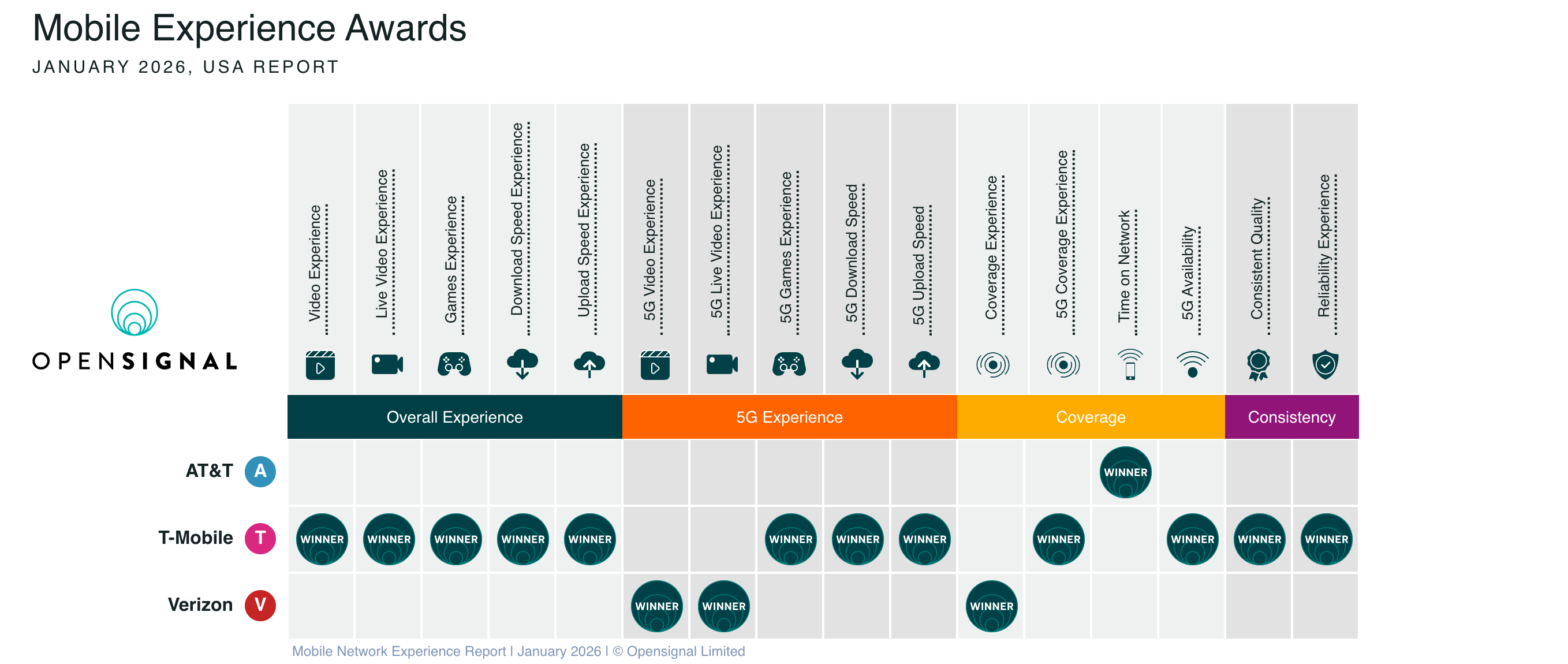
WASHINGTON, Jan. 12, 2026 – T-Mobile continues to lead U.S. mobile network performance, outperforming Verizon and AT&T in key reliability and consistency metrics, according to Opensignal’s January 2026 Mobile Network Experience Report.
Opensignal is an independent analytics firm that measures real-world and mobile broadband performance using anonymized data collected from users’ devices. Its reports focus on consumer experience rather than advertised speed and peak performance measured in tests.
The report analyzes mobile user experience data collected between Sept. 1 and Nov. 29, 2025.


For the second report in a row, T-Mobile ranked first for both Reliability Experience and Consistent Quality, which measure a network’s ability to provide dependable connectivity and support common mobile applications.
T-Mobile also led in 5G Availability and 5G Coverage Experience, with users accessing a 5G signal more frequently and in more locations than customers on competing networks. The carrier posted a 5G Coverage Experience score of 8.3 out of 10.
Verizon led in 5G Video Experience and 5G Live Video Experience, with scores of 71.4 and 73.4 out of 100, respectively. Those metrics reflect users’ ability to stream video at 1080p or better with minimal buffering or delays. T-Mobile placed second in both categories.
AT&T retained its lead in Overall Time on Network, with users connected to a mobile broadband signal 99.6% of the time, narrowly ahead of Verizon at 99.5% and T-Mobile at 99.1%, according to the report.
Overall, T-Mobile won 12 performance awards in the report, compared with three for Verizon and one for AT&T.
The report noted that T-Mobile’s acquisition of UScellular was completed during the reporting period, though UScellular’s performance data was not incorporated into T-Mobile’s scores. Opensignal also said T-Mobile’s satellite-based connectivity service, T-Satellite, had minimal impact on nationwide performance metrics, as satellite connections are primarily used outside traditional network coverage areas.
Both Verizon and AT&T reported launching nationwide 5G standalone networks, while T-Mobile first deployed the technology in 2020. Opensignal noted that while 5G standalone availability supports advanced services, spectrum depth and network capacity remain more significant drivers of user experience.
The report also pointed to upcoming FCC spectrum auctions, including planned AWS-3 and upper C-band releases, as factors shaping long-term network capacity planning for U.S. mobile operators.
Member discussion