
Telecom Act Aides Say Failure to Define Broadband Sparked Years of Regulatory Fights
At the Benton Institute event, panelists reflect on successes and failures of the Telecom Act of 1996

Kelcie Lee
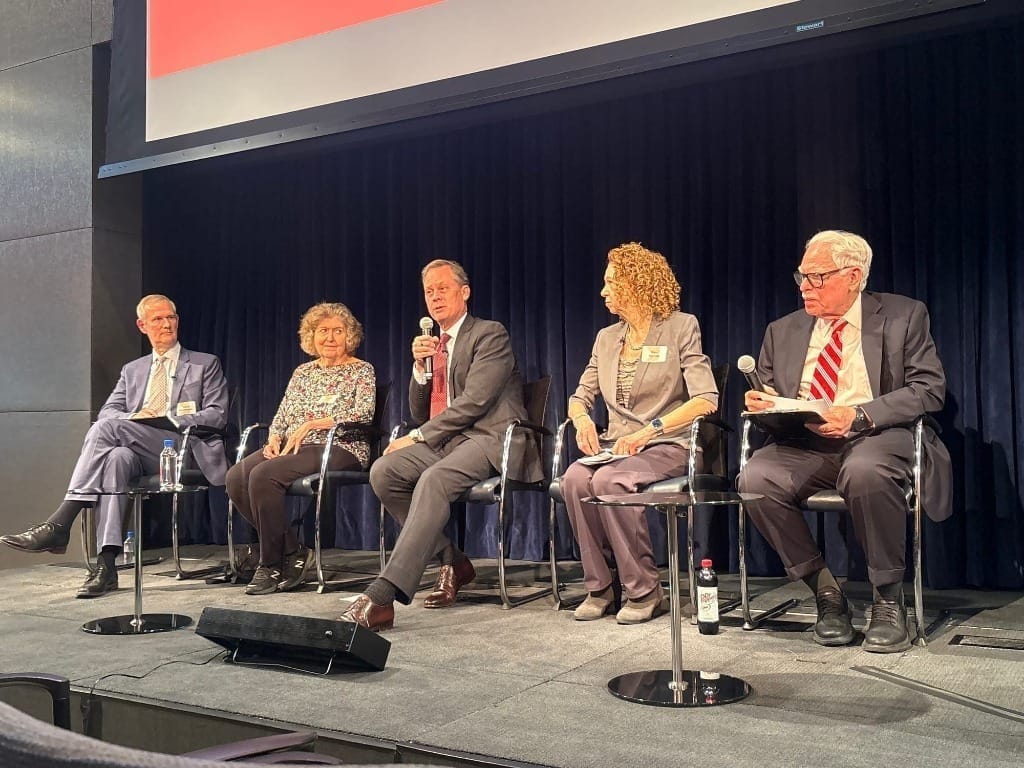
WASHINGTON, March 6, 2026 – When it comes to universal service, architects of the Telecommunications Act of 1996 say they failed to address broadband’s regulatory status and failed to include a mechanism requiring the Universal Service Fund (USF) to be modernized every couple years.
At the Benton Institute for Broadband and Society’s Telecom Act at 30 event on Thursday, moderator Andrew Jay Schwartzman hosted a panel focused on celebrating and reflecting on the Telecom Act of 1996.
John Windhausen, a Senate staffer in 1996, said a “big disappointment” was that the act didn’t better define what broadband was, especially as the country was on the cusp of deploying service at that time. He said the law could have implemented a “lighter regulatory regime for broadband,” which would have prevented “decades of litigious activity and rulemaking proceedings.”
“That was a big fault on our part,” Windhausen said.
INCOMPAS CEO Chip Pickering said mandating the modernization of USF’s regulatory framework every three to five years would have strengthened the program’s evolution and efficiency. Pickering, who shaped the Telecom Act as a staff member on the Senate Commerce Committee, said this provision would have allowed USF to keep up with rapid technological growth and brought down political pressure.
Gina Keeney, who was in the Federal Communications Commission’s Common Carrier Bureau when the Telecom Act passed, agreed with Pickering’s USF provisions. She also said competition measures that were updated every three years would have allowed for healthier markets.
All the panelists said the impact of the Telecommunications Act of 1996 was not something they expected, and celebrated the law’s accomplishment in technology and broadband.
However, looking forward to future legislation for artificial intelligence, Schwartzman said the present-day political atmosphere in the country, given the “sclerotic, paralyzed Congress,” has made it extremely difficult to pass laws that could have the same positive impact as the Telecom Act.
Pickering disagreed, explaining that he is still “ever the optimist.” He admitted that passing legislation like the 1996 Telecom Act is unlikely, but there has been progress in a bipartisan consensus in permitting reform and internet safety for children. Pickering said there is hope in piecemeal bills that build on AI framework and private sector commitments to communities.
“It could happen again and it’s happening in pockets,” Pickering said. “Is it likely in the next six to eight months? Maybe not, but we’re building. We’re growing to it.”
Windhausen also emphasized that despite the Telecom Act’s progress, there is still a long way to go in providing universal service amid an affordability gap, especially to communities without broadband access or telephone service.
“Of that list of 37 items in the Telecom Act, about half of them are irrelevant today, but the biggest one that is still vitally important and relevant are those universal service provisions of the Telecom Act,” Windhausen said. “And the Universal Service Fund is still facing this big huge funding crisis that needs to be resolved.”
Windhausen emphasized the urgency in creating a bipartisan solution to provide ongoing funding to finally close the divide in the country.





Member discussion