USTelecom Presses FCC to Rein in Permitting Costs, Timelines
‘More green lights, less red tape,’ the group’s CEO said.

Jericho Casper
WASHINGTON, Nov. 21, 2025 – USTelecom is pushing the Federal Communications Commission to impose national timelines for broadband permitting.
In response to the FCC’s wireline permitting inquiry, USTelecom has called for the FCC to impose national shot clocks of 60 days for standard broadband projects and up to 90 days for complex or multi-jurisdictional builds.
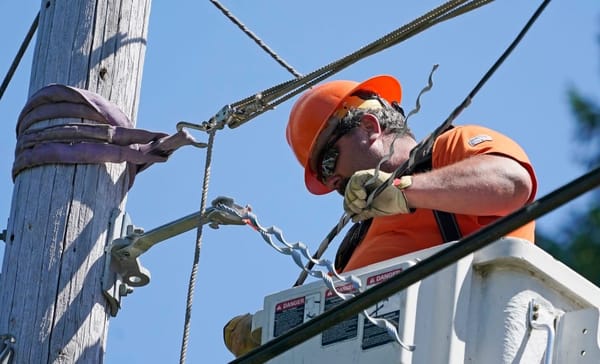
“The horror stories are enormous,” USTelecom’s CEO Jonathan Spalter told attendees at the Media Institute’s Communications Forum luncheon Wednesday, recalling a member in Utah who waited 18 months for approval to connect a single remote community. “We need more green lights and less red tape.”
That same predictability, he argued, should extend to the cost of getting permits approved. In its filing, USTelecom urged the FCC to declare that permitting fees must be strictly limited to documented administrative costs, warning that many localities have turned broadband permitting into a revenue generator rather than a cost-recovery exercise.
“There's a lot of things that we can reasonably do,” Spalter said. “We can ask all of the communities to which we pay enormous fees to allow for permitting to base those fees on actual costs, not to allow our fees to be used as revenue centers for municipalities.”
Industry says the IP transition accelerating
Spalter also used the moment to press for federal support for the transition away from legacy copper networks, a process he described as technologically overdue and financially inefficient.
“We owe a deep debt of gratitude to our friends at the Federal Communications Commission for accelerating our network transformation,” he said. “But we are still required, by regulatory fiat, to maintain parallel copper networks for a dwindling set of customers.”
Invoking the end of the copper penny, discontinued at the U.S. Mint in recent weeks, Spalter argued that the nation needs to treat legacy telecom in the same way.
“The penny cost 3.7 cents to produce. Consumers moved on. The government finally caught up,” he said. “That same logic should apply to networks. Imagine if the government told Apple it had to maintain the iPhone 6 forever.”
New data shows broadband prices continue to fall
Spalter’s comments came the same day the association released its 2025 Broadband Pricing Index, which reports that broadband prices have fallen 43.1 percent over the past decade while the cost of consumer goods has increased 35.8 percent.
Prices for the most popular plans, ranging from 100 to 940 megabits per second (Mbps) dropped from $49.25 in 2024 to $44.95 this year, a decline of 8.7 percent when adjusted for inflation. Faster tiers saw similar reductions: prices for 940 Mbps–1 Gig plans have fallen 22.5 percent since 2015.
At the same time, download speeds have doubled and upload speeds have increased 86 percent over the last decade.
“This is a testament to the relentless pace of innovation,” Spalter said. “Providers are operating in a competitive market that keeps prices down and puts consumers first.”
BEAD implementation: '18 down, 38 to go'
Spalter praised the Commerce Department’s approval of 18 state final proposals under the Broadband Equity, Access and Deployment program but emphasized that the industry was eager for the rest.
“Our companies have been ready to trench fiber since the day BEAD was enacted,” he said.
He encouraged creative use of non-deployment funds to expand middle-mile capacity and help rural communities attract data center and manufacturing investments.
“It will only be through the most advanced technologies that we’ll win the global race in AI – only through fiber technology,” Spalter said, emphasizing adding that satellite will play “an important but limited role.”
“There's a lot of important work to do,” Spalter said. “We're looking forward to doing that work with friends and colleagues across government and states, and also, of course, at the FCC.”
Member discussion