Broadband Adoption Slipping, Researchers Warn Pennsylvania Lawmakers
Cuts to federal benefits could push 233,000 households off broadband, researcher warns.

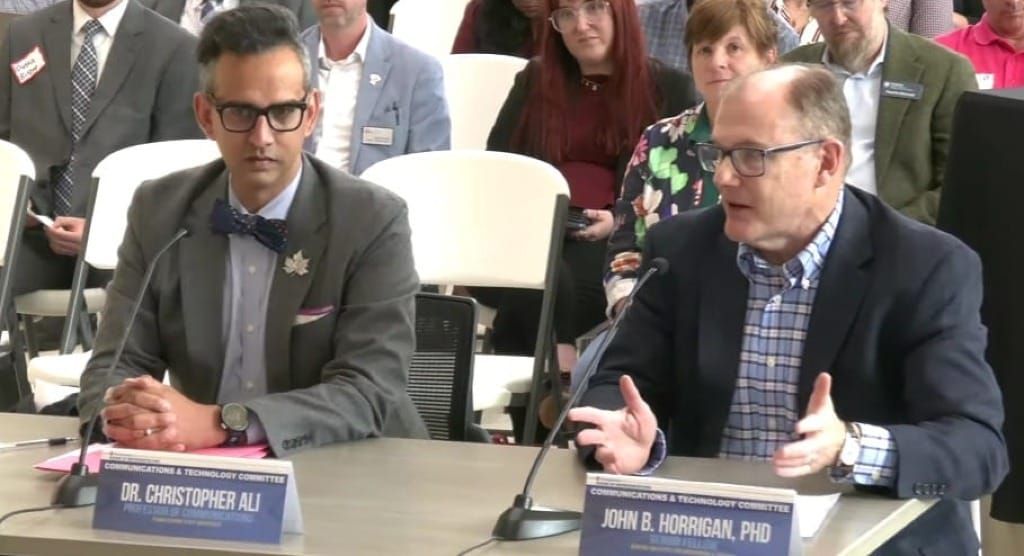
August 21, 2026 – Witnesses told a Pennsylvania House committee this week the state’s next broadband challenge will be keeping households connected.
Broadband adoption has already slipped in Pennsylvania, they said, but the impact of the One Big Beautiful Bill is about to make the problem substantially worse, with one witness estimating impacts of the OBBB could result in the loss of roughly 233,000 broadband connections among Pennsylvania households in the lowest income quintile.

The Pennsylvania House Communications & Technology Committee convened for an information meeting Tuesday, drawing testimony from county and local officials, industry representatives, and two researchers who told lawmakers that Pennsylvania is unprepared for the onset affordability crisis.
Pennsylvania’s wireline broadband subscription rate fell from 76.2 percent in 2022 to 75.5 percent in 2024, pushing the state from slightly above the national average adoption rate to below it. Some counties saw sharp drops, including Lackawanna County, which fell 9.6 percentage points over the same period.
Reductions in federal health and food assistance stemming from OBBB stand to put additional pressure on that figure.
Citing Congressional Budget Office estimates, one of the panel’s policy experts, John Horrigan, senior fellow for the Benton Institute for Broadband & Society, said the poorest fifth of U.S. households stand to lose about $1,200 a year in resources because of reduced Medicaid and SNAP spending and the expiration of enhanced Affordable Care Act premium subsidies.
He pointed to early evidence already emerging in Pennsylvania: SNAP enrollment down roughly 220,000 people, or 11 percent, between July 2025 and April 2026, and ACA enrollment down 431,000 as of July 1.
By his own modeling, he estimated the law could cost Pennsylvania roughly 233,000 broadband connections among low-income households, a figure he cautioned may understate the true impact given other recent cost pressures such as rising gas prices.
Horrigan urged lawmakers to consider state-mandated low-cost broadband tiers, similar to laws passed in New York and Connecticut, paired with continued investment in digital-skills programs.
He pointed to research showing broadband subsidy programs tailored toward low-income households return roughly $2 in economic benefit for every $1 spent.
State lawmakers offered a broader policy prescription
Pennsylvania State University pioneers chair in telecommunications Christopher Ali called on lawmakers to fight harder to retain federal money that can be used for broadband and digital inclusion.
Pennsylvania was originally allocated $1.16 billion through the federal Broadband Equity, Access, and Deployment program, or BEAD. The state ultimately received federal approval in April for $711.3 million in BEAD grants. That leaves millions “hanging in the balance,” Ali said.
He criticized Pennsylvania for not doing more to reclaim funding, including from the federal Digital Equity Act.
Pennsylvania was in line for at least $65.2 million through the program, designed to support digital inclusion programs such as digital skills training, device access and assistance for people who struggle to use online services.
That funding was canceled by the Trump administration in 2025, but the issue remains unsettled, as the administration agreed to restore the competitive grant program without certain race provisions.
“That’s over 450 million in dollars in federal funds that Pennsylvania should have access to, but is not fighting for. This inaction is denying Pennsylvania taxpayers money rightfully guaranteed to them, and I recommend the Commonwealth take a bolder approach to securing its rightful funds to support digital equity and inclusion,” he said.
He specifically identified uses such as a last-mile drop program, fiber construction in communities currently served only by fixed wireless or satellite, a statewide low-income broadband subsidy, device-access programs, and technical support.
He also offered a broader policy prescription, recommending the legislature eliminate the 2031 sunset on the Pennsylvania Broadband Development Authority, or PBDA.
The PBDA’s responsibilities include developing Pennsylvania’s state broadband plan, its BEAD proposal and its Digital Equity Plan, as well as distributing federal and state broadband funds. Under current law, however, the authority is scheduled to close in 2031, or after its funding has been distributed.
Ali argued that the PBDA shouldn’t simply be a temporary vehicle for distributing federal broadband money, and pointed to Minnesota, Vermont and Virginia as models of states with stronger broadband offices.
Ali called for Pennsylvania lawmakers to remove state law barriers to municipal broadband, arguing that communities should have greater freedom to build and operate their own networks when private providers fail to adequately serve them.
Pennsylvania is among 16 states that restrict or inhibit municipal broadband, Ali said. He argued that the restrictions limit competition and deny communities a greater role in determining how they are connected.
Pennsylvania currently has just one municipal broadband provider, Home Net in Kutztown, which began offering service in 2002.
The session convened in order to inform lawmakers about broadband affordability and access in Pennsylvania took place in Indiana County, one of Pennsylvania’s least connected counties, where 22 percent of locations lacked broadband as of 2024.