Broadband from the Moon: How Artemis II Pushes NASA Beyond Apollo’s Radio Frequencies
NASA and other international space agencies have deployed technologies that, in the future, are expected to eliminate communication blackouts.

WASHINGTON, April 6, 2026 – When Apollo 17 astronauts spoke to Mission Control from the lunar surface in December 1972, their voices traveled on S-band radio waves at roughly 2.3 GigaHertz (GHz) — a frequency family NASA had chosen for its ability to punch through the atmosphere and deliver voice, telemetry, television and ranging data in a single unified link.
More than 53 years later, the four Artemis II astronauts now circling the Moon aboard the Orion spacecraft are still using those same airwaves in the radio-frequency spectrum.
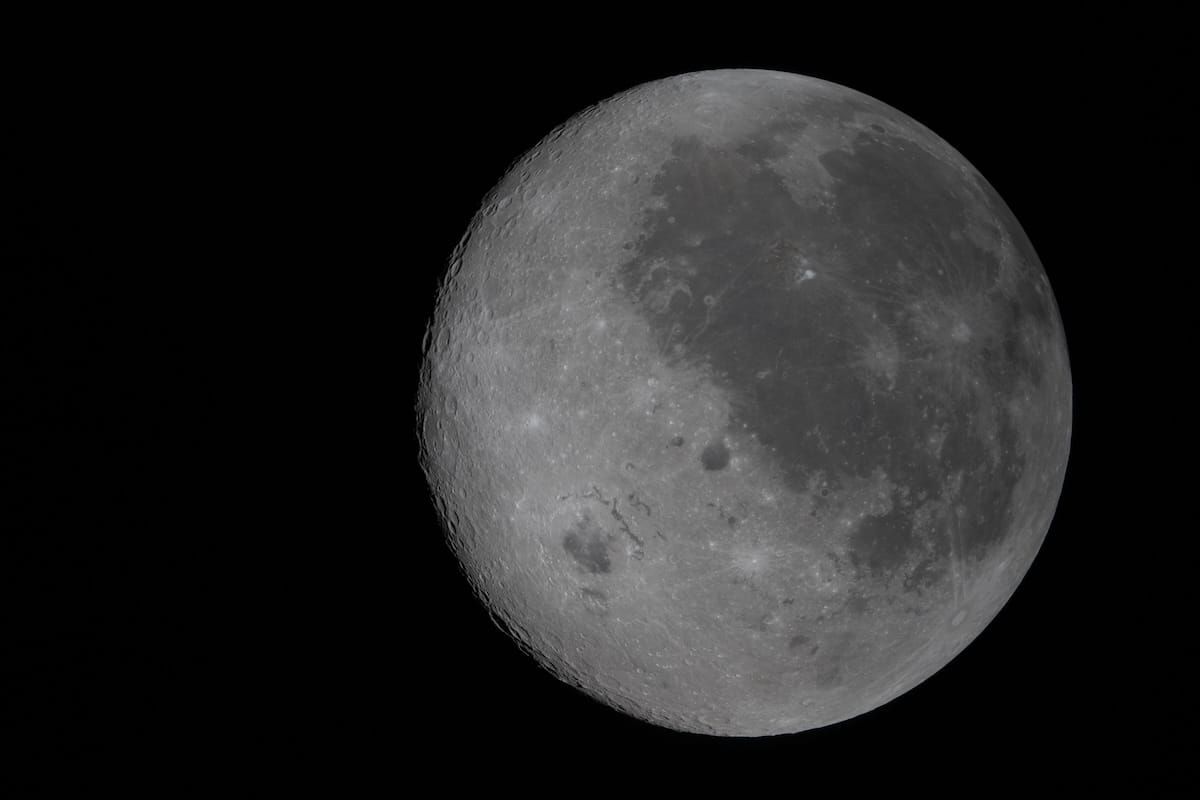
The moon is now filling the astronauts’ windows as on Monday they kicked off their lunar flyby, taking and communicating with mission control their views of the far side never before witnessed.

They also set a new distance record for humanity.
The six-hour flyby is the highlight of NASA’s first return to the moon since the Apollo era with three Americans and one Canadian — a step toward landing boot prints near the moon’s south pole in just two years.
First came a prize — and bragging rights — for Artemis II.
Less than an hour before kicking off the fly-around and intense lunar observations, the four astronauts surpassed the distance record of 248,655 miles (400,171 kilometers) set by Apollo 13 in April 1970.
They kept going, hurtling ever farther from Earth. Before it was all over, Mission Control expected Artemis II to beat the old record by more than 4,100 miles (6,600 kilometers).
Communicating their views back home
Artemis II is layering more communications capability on top of that radio heritage of operating in the S-band.
The S-band has supported every NASA human spaceflight program from Mercury through the Space Shuttle and International Space Station. Those frequencies sit within the 2025–2110 MegaHertz (MHz) and 2200–2300 MHz ranges designated for space research and deep-space operations.
Orion's downlink center sits at 2216.5 MHz, NASA officials told Broadband Breakfast. Uplink and Tracking and Data Relay Satellite (TDRS) relay frequencies slightly different but are still close to 2200 MHz.
Those links are routed through two ground networks: the Near Space Network, which handles near-Earth and cislunar tracking, and the Deep Space Network, whose 70-meter dishes in California, Spain and Australia have anchored interplanetary missions since the 1960s.
Orion carries telemetry, crew audio, video and file downloads over the S-band.
What kind of power is necessary?
Apollo's Unified S-Band transponder operated at roughly 5 to 20 watts of radiofrequency output. A direct watt-for-watt comparison with Orion, however, "does not tell the full story," NASA officials told Broadband Breakfast, because "the amount of data, signal structure, and antenna on the Orion are not the same as the Apollo."
Ground-station capabilities have also advanced enormously. The Deep Space Network's 70-meter stations can run uplink transmitters in the tens of kilowatts, and modern low-noise receivers extract far more information per watt than anything available in the 1960s.
The practical result is that Orion monitors significantly more data than Apollo ever did, even though the underlying physics of S-band propagation has not changed.
260 Mbps in near-Moon downloads
One headline technology demonstration aboard Artemis II is the Orion Artemis II Optical Communications System. Developed by MIT Lincoln Laboratory in collaboration with NASA's Goddard Space Flight Center, the terminal is roughly the size of a house cat and is mounted on Orion's crew module adapter.
O2O uses infrared laser beams rather than radio waves. During the mission, the terminal has achieved multiple downlinks at its design rate of 260 Megabits per second (Mbps) to ground stations at Table Mountain, California; White Sands, New Mexico; and a partner site at the Australian National University.
Weather has reduced the average throughput to about 80 Mbps, NASA said, but even at that rate the system has surpassed 100 Gigabytes of data sent to Earth — a volume that would have taken S-band alone weeks to deliver.
NASA explained the division of labor: S-band handles telemetry, audio, video and file downloads. Optical is used primarily to downlink files, as well as streaming video from the camera controller.
S-band remains the almost-always-on lifeline. Optical is for high-capacity transmissions.
One NASA paper estimated that S-band alone could move only about 7 GB per day from Orion, while a single hour of optical link time could deliver roughly 36 GB.
That roughly 30-fold improvement explains why NASA views laser communications as essential for any sustained lunar presence.
Coming soon: A farside blackout
Artemis II is expected to experience a communications blackout lasting approximately 41 minutes as Orion passed behind the Moon. This is the same phenomenon Apollo crews encountered.
Such a communications blackout is the only option for Earth-based communications networks.
But NASA officials say they are working to eliminate that limitation. The space agency aims in the future to put relay satellites in lunar orbit that are expected to provide continuous coverage, improve landing-site flexibility and support navigation around the lunar South Pole.
In 2024, NASA said, space communications company Intuitive Machines was selected to become the first commercial lunar relay service provider. Relays are expected to come online incrementally beginning in 2027 and build to a full constellation by the early 2030s, NASA said.
Separately, NASA said that its Lunar Surface Electromagnetics Experiment-Night (LuSEE-Night), a project undertaken with the U.S. Department of Energy, is expected to be delivered in 2027 to the Shielded Zone of the Moon by the Commercial Lunar Payload Services program.
Two orbiters on that mission are expected to demonstrate relay capabilities — one of them a joint ESA-UKSA/industry mission — to close the coverage gap over the Moon's far side, NASA said.
Associated Press Writer Marcia Dunn contributed to this report.