Bruce Kushnick: An Open Letter Calling for a Debate with the Group Digital Progress
The authors propose a debate using the Verizon NY 2025 Annual Report, and other pertinent facts


A recent story published on Broadband Breakfast featuring Joel Thayer and Ethan Tun of the Digital Progress Institute (DPI) claimed that outdated rules tying carriers to copper phone lines are diverting billions from modern fiber and wireless buildout, and urging the FCC to finish modernizing them.
The IRREGULATORS — an independent consortium of senior telecom analysts, auditors, and lawyers taking zero corporate funding — challenge DPI to an open, public debate.
DPI’s conclusions rely on incomplete corporate data, manufactured metrics, and corporate-supplied clichés that misrepresent basic telecommunications history. Unfortunately, the FCC’s new deregulatory policies have the same structural data and analytical flaws, making our concerns more critical at this time.
The shell game: How AT&T and the FCC hide tens of millions of copper lines
At the core of AT&T’s case against California's Carrier of Last Resort (COLR) obligations is the claim that AT&T spent over $1 billion in 2023 maintaining copper infrastructure serving under 3% of households.
This number is a manufactured fiction achieved through regulatory shell games:
- Residential Only: The 3% figure covers only residential voice customers.
- Excluding IP-VoIP: Residential customers on copper wires using IP-VoIP (like U-verse) are subtracted from the count, even though they ride the exact same 60-year-old copper wire.
- Erasing Business & Critical Data: The statistics completely ignore business lines, small businesses, government connections, alarm systems, elevator phones, faxes, DSL, and municipal infrastructure. Business and data lines routinely represent 70% to 90% of copper wires in service.
When you count all active services, 30 to 50 million copper access lines across AT&T territories could be hidden from the FCC’s analysis.
Follow the money: How state utilities cross-subsidize wireless
DPI claims state regulations force carriers to burn money on copper. The financial books tell the opposite story.
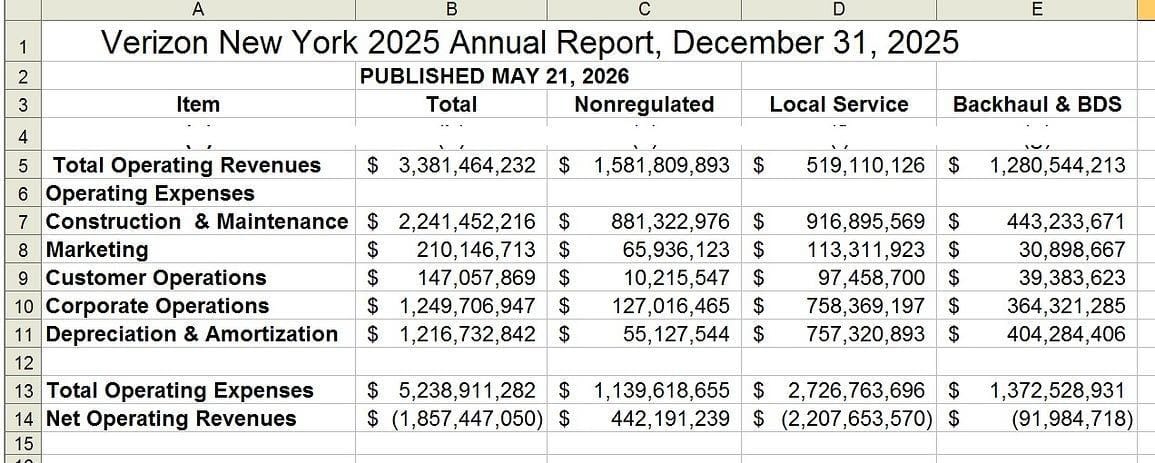
The Verizon New York 2025 Annual Report (published May 2026)—filed under USOA accounting rules governing state utilities—reveals a massive cross-subsidization scheme:
Local copper-wired POTS voice service brings in a fraction of the revenue but pays the majority of the construction budget for networks while virtually no local copper maintenance is being performed, as told by other data within the report.
But it is all of these other line items, from Customer Service to Corporate Operations, (lawyers, lobbyists, the corporate jets and even golf tournament), where local service has been charged over 60% of the total.
This isn't new. In 2012, a formal filing by the New York State Attorney General revealed that 75% of Verizon's wireline capital expenditure was actually diverted to serve wireless cell sites and FiOS video broadband, while letting local landline networks decay.
Carriers dump nonregulated and wireless expenses onto local service utility books to artificially generate "losses," then claim landlines are unprofitable to justify shutting them off.
More importantly, as the IRREGULATORS have documented, the Pacific Bell, AT&T California is a state, telecommunication public utility, and the accounting and financials matched Verizon New York, as Pac Bell has been using the same USOA accounting.
We note: it seems that AT&T CA’s full financial report for the state public utility is not publicly available. But most importantly – there is no mention that Pac Bell AT&T is still a telecommunications public utility, and thus the obligation to serve all customers within their franchised territory.
Replacing reliable landlines with ‘crap wireless’
While FCC Chairman Brendan Carr and DPI argue that shutting off copper frees up capital for next-generation networks, AT&T's actual replacement—AT&T Phone Advanced (AP-A)—is a degraded wireless product where the company takes no legal responsibility for reliability.
This is from the Terms and Conditions, August 2026:
- No Alarm Support: AT&T makes no warranty that the service supports burglar alarms, fire alarms, or medical monitoring systems.
- No Emergency 911 Guarantee: AT&T's legal terms and services state 911 access is not guaranteed to be uninterrupted or error-free and disclaims liability for failed emergency calls.
- Basic Functionality: Terms advise customers that signal strength depends on moving hardware closer to windows or upper floors.
The challenge
The Digital Divide was not created by cities, states, or local regulations. It was created because telecom conglomerates took rate increases, tax deductions (such as Pacific Bell's $3 billion tax write-off in 1994), and regulatory concessions promised for statewide fiber-to-the-home and diverted those funds into wireless.
The IRREGULATORS filed 6 adverse comments in the current AT&T-FCC-CA proceeding, and each was based on decades of tracking the fiber optic deployments that did not happen, state by state, even when the customers were charged for a wondrous digital future. See IRREGULATORS 6 adverse comments
What should really worry the reader is that almost all of the copper wires were part of the original Bell system state telecommunications public utility that was transferred in 1984. Through mergers – California, one of AT&T’s 21 states, in 2026, we end up with millions of copper wired services, most not being identified, which should have been replaced with fiber decades ago.
Talk about ironic twists: Does it really cost AT&T CA a billion dollars for 188,000 lines, 3% of households, at $5,300 a line?
Before the FCC or state utility commissions grant streamlined copper discontinuance, we demand a full, independent audit of all active copper lines and state utility books.
We invite DPI, to industry representatives, and regulatory officials to an open debate to go line-by-line through our findings or an analysis of the Verizon NY 2025 Annual Report’s financials, and, of course, AT&T California’s financials — and let the public keep score.
Bruce Kushnick has been a telecom analyst for over 40 years, and currently the Managing Director of the IRREGULATORS. Kushnick’s new music tune “Celebrating Free Speech,” features excerpts from Patrick Henry’s immortal speech of 1775, which still resonates on this 250th year of America’s Democracy. This Expert Opinion is exclusive to Broadband Breakfast.
Broadband Breakfast accepts commentary from informed observers of the broadband scene. Please send pieces to commentary@breakfast.media. The views expressed in Expert Opinion pieces do not necessarily reflect the views of Broadband Breakfast and Breakfast Media LLC.