
CES2026: Quantum Computing Leaders Map Next Phase in AI Age
Discussion follows two months after Department of Energy's $625 million investment in federal quantum centers

Akul Saxena
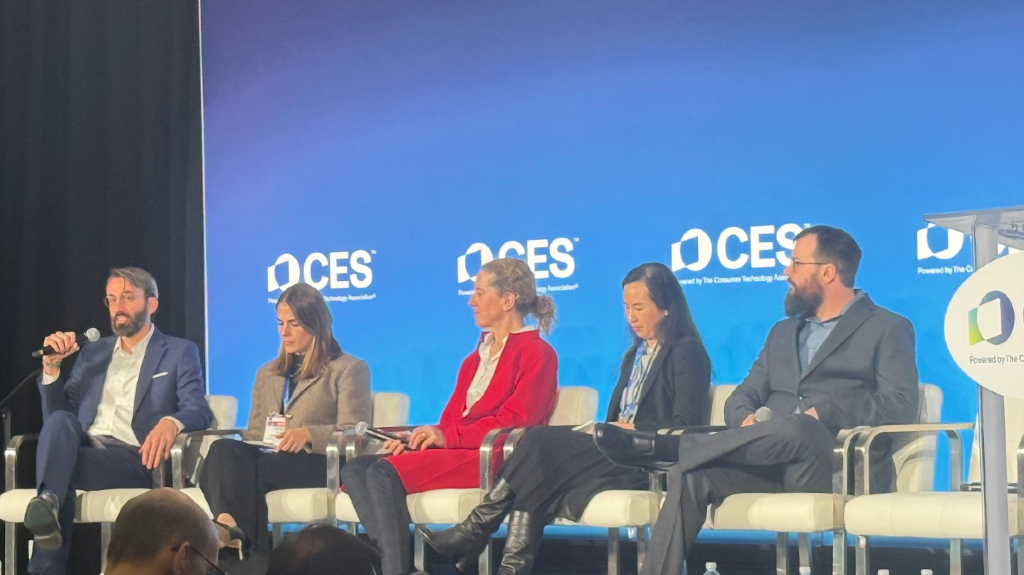
LAS VEGAS, Jan. 8, 2026 — As artificial intelligence reshapes technology and markets, attention is also turning to what comes next, and executives and government officials on Thursday outlining a roadmap for quantum computing. They emphasized hybrid systems, global research ties, and near-term policy and engineering constraints.
Speaking during a CES panel, representatives from Dell Technologies, Amazon Web Services, a federally chartered quantum consortium, and Colorado converged on a common message: Progress in quantum computing depends less on isolated scientific breakthroughs than on coordination across infrastructure, workforce, supply chains, and public policy.
Defining what quantum is and is not
Burns Healy, a researcher at Texas-based technology company Dell Technologies, framed quantum computing not as a replacement for classical systems but as a specialized capability intended to complement existing infrastructure.
Healy said quantum processing units, or QPUs, should be understood in the same category as graphics processing units, which are accelerators designed for specific problems and workloads.
In practice, he said, QPUs would operate alongside CPUs, GPUs, and high-performance computing systems, with classical infrastructure handling most computation and quantum processors reserved for narrowly defined tasks such as optimization, molecular modeling, and materials science.
Healy said this framing was essential to understanding both progress and limits. Quantum devices vary widely in architecture, he said, creating engineering challenges around cabling, cooling, and integration that differ by system. There is no single “quantum computer,” he added, but multiple approaches advancing in parallel.
That reality, Healy said, explained why timelines were now being discussed in specific years rather than vague horizons. Industry and government roadmaps increasingly referenced late-decade targets such as 2028 and 2030, while the Defense Advanced Research Projects Agency has set a goal of demonstrating useful quantum computing by 2033.
An additive cloud strategy
Kat Wang, head of trade, supply chain, and quantum policy at Amazon Web Services, the company’s cloud infrastructure arm, said AWS was investing across several facets of quantum development, including hardware research and development based in Pasadena, California.
She said customer demand for quantum today was driven largely by research and experimentation, ranging from individual scientists to large enterprises. Use cases included chemistry and molecular interactions at the atomic level, where classical simulation becomes computationally expensive.
Wang said AWS maintained a dedicated internal team focused on post-quantum security, reflecting concerns that future quantum systems could undermine widely used cryptographic standards. She emphasized that the risk was not the collapse of encryption itself, but the eventual obsolescence of specific algorithms, a transition already being addressed through new standards.
She added that AWS’s global customer base made international collaboration unavoidable. Quantum supply chains depend on highly specialized components, including cryogenic and refrigeration systems, many of which are sourced outside the United States.
Parallel developments in policy
Celia Merzbacher, executive director of the Quantum Economic Development Consortium, a federally-chartered quantum industry association, said quantum computing was advancing under a model that defied the traditional sequence of basic research followed by commercialization.
Merzbacher said Congress, through the National Quantum Initiative Act of 2018, directed the National Institute of Standards and Technology and the Department of Commerce to establish a consortium spanning national laboratories, universities, startups, and large companies.
Unlike previous technology waves, she said, quantum computing lacked dominant incumbents. Innovation was occurring simultaneously in national labs, universities, and startups embedded within larger firms, forcing basic science and economic development to proceed in parallel.
Merzbacher said the Senate introduced legislation this month to reauthorize the National Quantum Initiative, with an expanded focus on transitioning research into practical applications. She described three pillars supporting recent progress: demonstrated hardware advances, improvements in error correction, and the development of software and algorithms capable of running on quantum systems.
Eve Lieberman, executive director of the Colorado Office of Economic Development and International Trade, said Colorado had positioned itself as a focal point for quantum development by aligning research, capital, and workforce policy.
Other regions – including the greater Washington, D.C. area and Chicago – have also made strong pushes in the space. Connected DMV, for the Delaware-Maryland-Virginia area, participated in a series of quantum sessions at CES2026 on Tuesday, and also operates the Quantum World Congress in College Park, Maryland, in September 2026
Lieberman said Colorado had received funding as a federal quantum technology hub and had committed $44 million in tax credits to support quantum infrastructure. The state has also created a loan-loss reserve program to reduce lender risk for early-stage quantum companies.
She cited Nvidia’s investment in Infleqtion, a Colorado-based quantum firm, as evidence that hybrid computational models were attracting private capital. Lieberman also pointed to quantum sensing applications already producing revenue, including atomic clocks and systems used to detect methane emissions in energy infrastructure.
Lieberman said Colorado had signed government-to-government agreements with the United Kingdom and Finland to support research collaboration and talent exchange, underscoring the global nature of quantum development.
Global research, shared constraints
Panelists said quantum computing’s progress could not be framed solely through national competition. Merzbacher said the United States did not hold an overwhelming lead, noting that advances continued across Europe and Asia and that consortium membership extended beyond U.S. firms.
Wang said governments were balancing export controls with the need to sustain collaboration among trusted partners, while acknowledging that supply chains for critical components remained narrow and internationally distributed.
Healy said the most immediate constraints were not geopolitical but practical: scaling devices, standardizing engineering approaches, and training a workforce capable of operating complex hybrid systems.
Cryptography shifts, not collapses
Panelists also pushed back on claims that quantum computers would “break encryption.” Healy said future systems would threaten specific cryptographic standards rather than encryption as a concept.
Merzbacher said the development of post-quantum cryptographic standards before large-scale quantum machines became available represented a rare alignment between policy and technology timelines.
“We’re not there yet,” she said. “But we know what needs to happen next.”
Federal context: Genesis Mission and DOE funding
The panel occurred in the context of the Trump administration’s Genesis Mission, an executive order directing the federal government to integrate artificial intelligence, high-performance computing, and quantum systems into a unified national research platform focused on accelerating scientific and engineering outcomes
Separately, the Department of Energy has committed $625 million over five years to support its quantum information science research centers, led by national laboratories in partnership with universities and industry, as part of ongoing federal efforts to advance error-corrected quantum systems and integrate them with supercomputing and AI workflows.




Member discussion