
Connected Nation Holds Summit on Network Infrastructure for AI Leadership
The summit covered a wide array of issues on network infrastructure for AI

Naomi Jindra
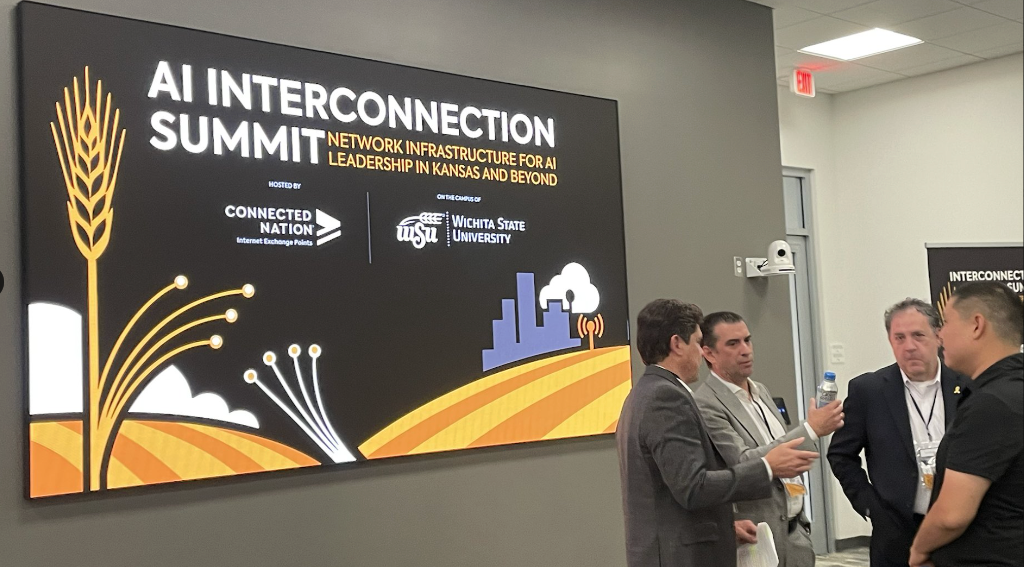
Sept. 17, 2025 — Experts in broadband and internet infrastructure gathered in Wichita, Kansas, last week to discuss how the U.S. can lead in the AI economy at “An AI Interconnection Summit: Network Infrastructure for AI Leadership in Kansas and Beyond.”
The summit covered a broad range of topics, including the establishment of Kansas’s first internet exchange point, the construction of modular and underground data networks, the rise of GPU-as-a-Service, and the importance of low-latency interconnection for next-generation AI applications. Speakers emphasized that local infrastructure, not just cloud platforms, will determine how communities can participate in and benefit from the AI economy.
“We are at the precipice of a great democratization of power — and risk — because of it,” said Tom Ferree, chairman and CEO of Connected Nation, in his opening remarks. “The vast prosperity and, on the other side, the risk containment that AI promises rests heavily on the mass diffusion and its accessibility.”
Building Kansas’ first IXP
Romaine Redman, chief innovation and strategy officer for the Kansas Department of Commerce, emphasized the importance of establishing the state’s first internet exchange point, or IXP.
“For decades, infrastructure projects like highways have defined how communities live, work, and thrive,” Redman said. “Now, broadband — specifically the establishment of Kansas’s very first Internet Exchange Point at Wichita State University — is about to transform entire generations moving forward.”
With an $83.5 million federal investment, Kansas broadband projects will impact more than 25,000 businesses and households statewide, Redman added.
Modular data centers and underground networks
Michael Roark, founder and CEO of iM Data Centers, outlined his company’s plan to build a modular, high-performance computing facility in Wichita. Manufactured in Fort Lauderdale and shipped in three 50-foot-long modules, the design cuts deployment time and costs while delivering high-density racks reaching 120 kW per rack. Similar projects have been launched in Pittsburgh, Miami and West Virginia.
James Jun, CEO of Boston-based Towardex, said his company will deploy neutral, digitally managed underground infrastructure to support Wichita’s new exchange.
“Every cable is not just fiber,” Jun said. “Each one is an engine of economic activity.”
Towardex will build neutral, digitally managed underground infrastructure to eliminate costly, landlord-controlled cross-connects, instead creating shared access points for multiple carriers.
Fiber optics and access to the information superhighway
Allen Meyer, vice president of Stevens Fiber Group, highlighted the role of physical fiber construction in enabling AI-ready networks. His company has worked on projects for Google Fiber, Verizon and AT&T.
“Large-capacity data has a similar challenge: limited, direct access,” Meyer said, comparing today’s consumer-focused internet service to a traveler forced to make multiple stops.
He proposed creating secure, physical micro-networks at Wichita State to provide direct access to internet exchange points.
“In this new era of humanity, we are seeing tremendous advancements taking place in months rather than decades, and it is with this sense of urgency that we are all here,” Meyer added, pointing to AI’s transformative impact on manufacturing, medicine and education.
Putting Wichita on the digital map
Ivo Ivanov, CEO of DE-CIX, called Wichita’s project a chance to give the city a global digital presence.
“The heart of the data center is the interconnection platform: delivering connectivity, density of networks, and building ecosystems,” he said.
Ivanov likened an internet exchange to an airport — where networks, like airlines, securely transfer data packets instead of passengers and luggage.
“Latency is the new currency,” Ivanov said, noting that streaming, gaming, robotics and digital healthcare all demand ultra-low response times.
DE-CIX, which operates the world’s largest carrier-neutral internet ecosystem, will launch Wichita’s first Internet Exchange and debut its AI-IX platform, enabling both AI training and inference at the local level.
GPU-as-a-service in Wichita
Brian Lubin, chief data center officer at Moonshot Energy, explained his company’s pivot to GPU-as-a-Service, a model where businesses lease high-powered servers rather than building costly facilities. “Buy servers, deploy them, lease them,” he said. “Sounds easy, but these servers are incredibly expensive, with heavy capital requirements.”
Lubin pointed to the success of CoreWeave, Lambda, and FluidStack — the latter recently backed by Google in a $1.3 billion deal — as proof the market is real. Moonshot has already run a proof-of-concept in New York with eight NVIDIA H100 servers, showing the model can generate revenue.
Comparing servers to real estate, Lubin said, “Think of a server as an apartment building. Each server has eight GPUs, like eight apartments. You want high occupancy. In servers, that’s utilization. Utilization equals revenue.” He argued that Wichita, with its land, power, and vision, is positioned to become a hub for GPU marketplaces.
Aaron Ginn, CEO and co-founder of OneVP, said shifts in GPU technology are reshaping the AI infrastructure landscape, enabling secondary markets like Kansas to compete.
“Before, data centers couldn’t compete,” Ginn said. “Now the big cloud providers are being forced to change.”
OneVP operates 80,000 GPUs across 50 data centers in 15 countries, providing capacity for telecoms, sovereign clients and enterprises.
Lower costs, faster speeds, stronger economies
Brent Legg, executive vice president of government affairs at Connected Nation, said internet exchange points are essential for improving U.S. internet performance.
“Future internet performance is at risk if we don’t build more of these facilities,” Legg said.
The Wichita facility, backed by a $5 million state grant, will be built on a 1.3-acre WSU campus site. It will launch with three modular 2,000-square-foot units and 25 cabinets, expandable to more than 400 cabinets. Legg called it “the geographic epicenter for AI in the central part of the U.S.”
AI as the wind in Wichita’s sails
Hunter Newby, owner and CEO of Newby Ventures, reflected on how artificial intelligence has accelerated the push for new internet infrastructure. What once seemed far-fetched — building major neutral exchange hubs in places like Kansas City or Wichita — is now being recognized as essential for real-time AI applications that demand near-instant data processing.
He pointed to examples like banks using GPUs for fraud detection at the keystroke, which requires sub-three millisecond response times. That level of performance, he said, is impossible without local, neutral internet exchanges in cities across the country.
What’s happening in Wichita echoes a broader national push. As highlighted by Broadband Breakfast’s upcoming Resilient Critical Infrastructure summit, policymakers and industry leaders are recognizing that resilient, low-latency infrastructure isn’t just a local issue — it’s a national priority





Member discussion