
D.C. Circuit Says Whistleblower Suit Against UScellular Can Continue
The whistleblowers have asked the FCC to pause or reverse the company's spectrum sales over the issue.

WASHINGTON, Oct. 2, 2025 – Federal judges revived on Friday a fraud suit against UScellular can continue, reversing a lower court ruling that had sided with the company.
Mark O’Connor and Sara Leibman, a former FCC attorney, had sued UScellular under the False Claims Act, which mandates financial penalties for fraudulently seeking government funds.
They argued smaller companies that obtained bidding discounts in two Federal Communications Commission spectrum auctions were essentially puppets of UScellular, allowing the company to buy spectrum at a lower price than it could have by bidding itself.
The D.C. District Court had found two attorneys bringing the whistleblower suit made allegations based on information that was already public, which would prevent them from bringing a lawsuit.
The U.S. Court of Appeals for the D.C. Circuit disagreed. The attorneys “identified significant new evidence that Advantage,” one of the bidders, “never functioned as an independent business,” and “allege that Advantage had made an undisclosed agreement to transfer the licenses to UScellular through a merger after the unjust-enrichment period had ended,” the court decision said.
The second allegation might not ultimately be proved, but it was “at least plausibly alleged,” Circuit Judge Greogory Katsas wrote.
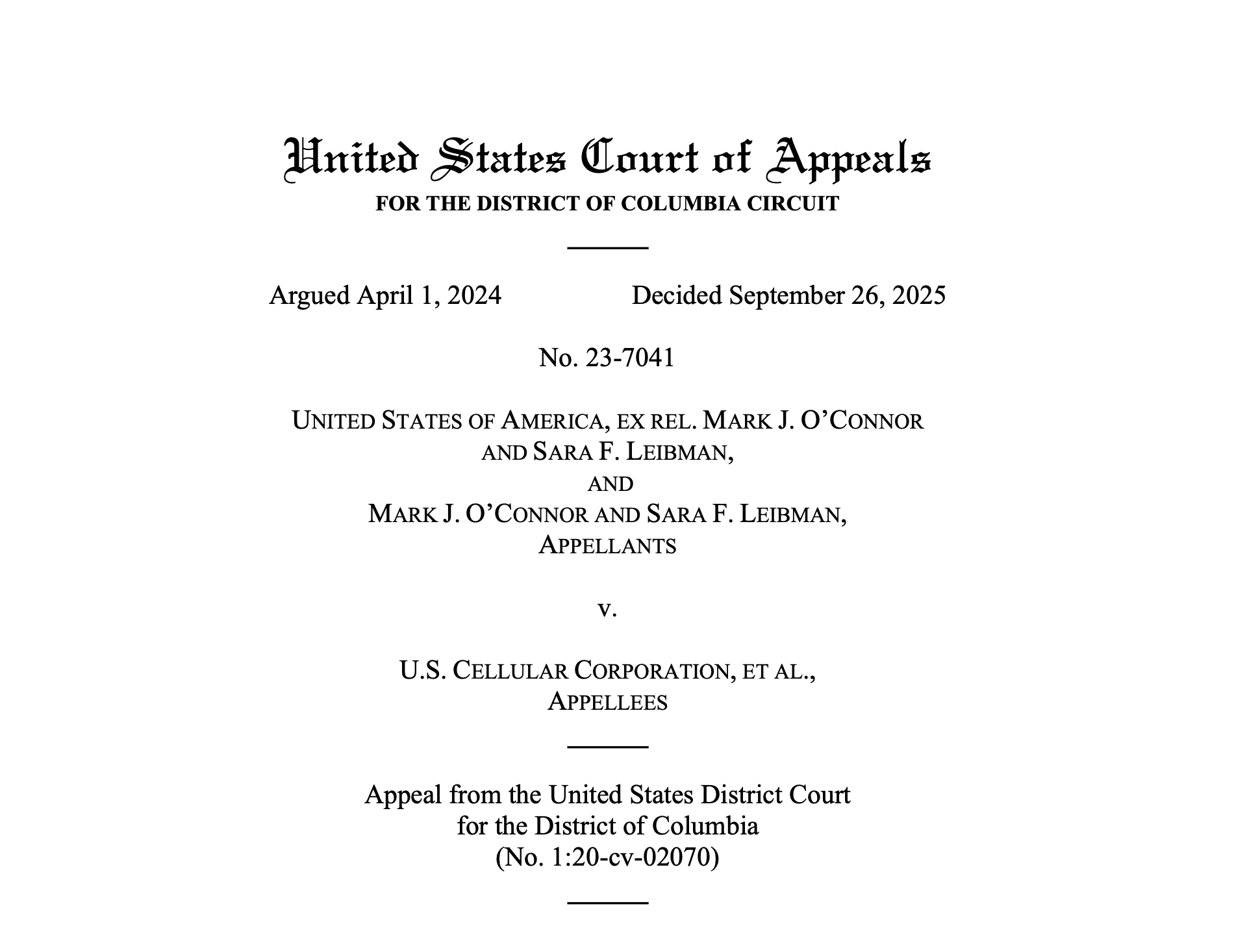
Earlier this year, the same panel of three D.C. Circuit judges sided against Leibman and O’Connor in a separate FCA case related to another UScellular subsidiary, dismissing the case on the grounds the attorneys hadn’t alleged enough non-public information.
UScellular, which has since renamed itself Array Digital Infrastructure, sold many of its licenses and its wireless operations to T-Mobile in a $4.3 billion deal that closed in August. The company is also looking to sell spectrum licenses to Verizon and AT&T for about $1 billion each.
Leibman and O’Connor have asked the agency to overturn its decision blessing T-Mobile acquisition in light of their allegations, arguing UScellular doesn’t meet the character qualifications to hold and sell licenses, and are asking to put the AT&T and Verizon transaction reviews on hold while their case plays out.
About $400 million of the T-Mobile purchase price and $232 million of the AT&T sale are related to spectrum licenses won by the smaller companies, known as designated entities in FCC bidding rules, in which UScellular has an interest. The designated entity licenses in the AT&T transaction are all related to the case that was dismissed.
The agency doesn’t appear persuaded by the attorneys’ allegations, which they had also brought to the FCC while it was reviewing the T-Mobile transaction.
“Nothing in their petition warrants reevaluation of the qualifications of UScellular or its subsidiaries,” the agency wrote in its order approving the deal. “In sum, we do not find there is currently a material question of fact regarding UScellular’s basic qualifications to be a Commission licensee.”
UScellular did not immediately respond to a request for comment. The company and the carriers purchasing its spectrum have said in FCC filings that the fraud allegations don’t have any bearing on whether the agency should approve those transactions.
“The Petition has nothing to do with the merits of the transaction between [UScellular] and AT&T,” the two companies wrote in a May filing. “Relators do not mention the transferee, an affiliate of AT&T, or dispute the public interest benefits that will result from the transaction – benefits that would be delayed by granting their request.”
With the government currently shut down, most FCC employees are furloughed and transaction reviews are expected to be delayed.


Member discussion