
Dean Bubley: After Budget Bill, Do No Harm to CBRS and 6 GHz
The budget law leaves CBRS and 6 GHz unprotected — raising concerns about disruption to Wi-Fi, enterprise and rural broadband services.

The new budget legislation in the United States, called the One Big Beautiful Bill Act, recently passed into law. Deep in the legislation is a section on spectrum, with which the U.S. Government intends to raise around $85 billion for the U.S. Treasury from auctions and ensuing licenses for commercial wireless use. It not only reinstates the FCC’s authority to hold auctions, but it sets goals for at least 800 megahertz of spectrum to be auctioned.
The bill carves out two bands that cannot be considered for auction or relocation: the 3.1-3.45 GigaHertz (GHz) and 7.4-8.4 GHz ranges – spectrum primarily used by the military for applications such as missile defense and satellite communications.
However, the new law does not offer similar specific protections for two other bands desired by the cellular carriers: the Citizens Broadband Radio Service (CBRS) band between 3.55-3.7 GHz, and the unlicensed 6 GHz band between 5.9-7.1 GHz.

Given the current state of spectrum rhetoric in Washington and previous statements from AT&T and others about their hope to somehow “relocate” CBRS and clear the upper portion of the 6 GHz band, this silence has led many observers to fear that they might become targets for the any new FCC effort at spectrum’s program of clearing and auctions in the wake of the new law.
Although the legislative process revealed notable Congressional interest in protecting them, it stopped short of ironclad carve-outs, although the final version of the bill also erects significant obstacles to relocating current CBRS users lower in the 3 GHz band, as AT&T has proposed. An earlier version passed by the House of Representatives proposed to fully preserve the 6 GHz band, recognizing Wi-Fi’s outsized economic impact and the likely political unpopularity of degrading consumer and enterprise Wi-Fi systems already widely deployed.
While the final bill doesn’t take either band completely off the table for auction, the FCC (and NTIA) would be wise to look elsewhere to meet the spectrum demands laid out in the new law. Both the CBRS and 6 GHz bands would be much harder and more costly to repurpose for high-power cellular than casual observers suggest – and would likely fail to raise large sums at auction, especially on the short timescales required.
Clearing and auctioning either of them would also cause significant harm to many American businesses and rural broadband users that have already invested significant money, time and other resources.
For example, CBRS is already widely used by many WISPs (wireless ISPs), often operating in areas unserved by fibre infrastructure. In addition, enterprises in critical sectors such as manufacturing, oil and gas, utilities, logistics, hospitals and education increasingly rely on CBRS private LTE or 5G networks at their sites, with new installations ramping up fast. These cannot be replaced quickly, cheaply and seamlessly, especially if they need to be moved to a new and unusual band with no existing ecosystem of products. Even AT&T – despite its advocacy for changing the band – offers CBRS-based private networks.
Moreover, other entities such as cable and mobile operators acquired “PAL” (protected access) licenses for the CBRS band in an earlier 2020 auction. These licensees have been deploying infrastructure and competitive wireless services using their licensed spectrum. Changing the terms or displacing these licensees out of their bands, in order to benefit another commercial use would provide unprecedented disruption to competitors. It would also create novel legal issues and uncertainty in future spectrum auctions, as it would increase the perceived risk of future forced sales or relocations. It would be a costly and counterproductive precedent to set.
The 6 GHz band, meanwhile, is already widely used for Wi-Fi in both indoor consumer and industrial settings, and is rapidly expanding for other applications such as outdoor Wi-Fi and fixed-wireless access. Wi-Fi 7 is critical for high-performance applications and reliable coverage everywhere from apartment blocks and hotels, through to factories and warehouses. The future Wi-Fi 8 will add further capabilities and will also rely on 6 GHz.
The band is also home to tens of thousands of fixed microwave links used for purposes such as control and management of public utilities’ infrastructure, public safety networks, backhaul for cell towers and long-distance telephone links. These need extremely high reliability and cannot be easily or quickly moved to alternative bands.
Notably, some of the same groups threatened by AT&T’s proposed changes to CBRS – enterprises and WISPs – are also becoming heavy users of 6 GHz spectrum, both through indoor Wi-Fi and outdoor standard-power applications, which can work around the “incumbent” microwave users via a dynamic database system called AFC (automatic frequency coordination).
Furthermore, most leading home broadband providers now sell routers using 6 GHz in conjunction with gigabit-grade broadband. Notably, AT&T now sells 6 GHz-capable Wi-Fi 7 routers, calling them the All-Fi Pro. Verizon also offers 6 GHz Wi-Fi on its FIOS plans, as well as via its newly-acquired Frontier fiber arm.
Cable ISPs including Charter and Comcast also offer 6 GHz routers. All mobile operators also sell a huge range of 6 GHz-capable smartphones and other devices, including recent iPhones and Samsung products. ABI Research estimates that 150 million 6 GHz-enabled devices will ship in North America in 2025 alone. Overall, there are now huge numbers of 6 GHz-capable Wi-Fi access points and devices already used in the U.S. and any attempt to repurpose part (or the entire) of the 6 GHz band would result in massive disruption to consumers and industry.
In summary, while they do not have explicit protection, neither the CBRS band (3.55-3.7 GHz) nor the 6 GHz band are attractive or rational targets for the FCC to auction. Both would be extremely problematic to carve out for high-power 5G/6G for multiple legal, political and technical reasons. They would endanger enterprise wireless for some of the U.S.’s most strategic industries, undermine rural broadband providers and put at risk the world-respected U.S. lead in both dynamic spectrum-sharing and Wi-Fi innovation.
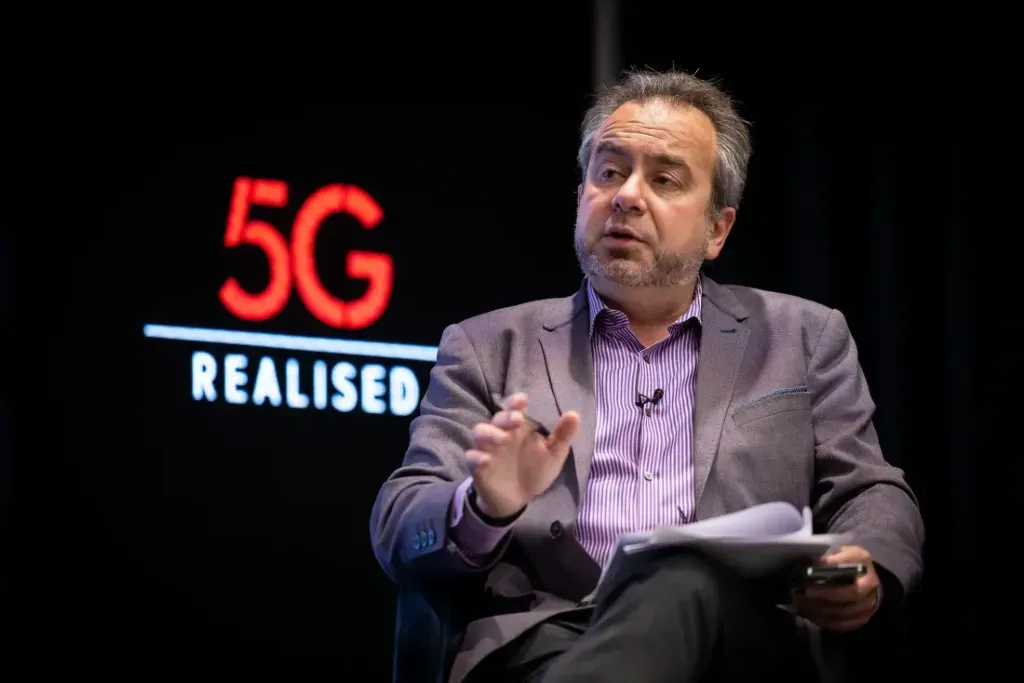
Dean Bubbly is the Founder of Disruptive Analysis. He is one of the leading analysts covering 5G, 6G, Wi-Fi, telco business models & regulation, the future of voice/video, and the emergence of technologies such as quantum networking and AI. This Expert Opinion is exclusive to Broadband Breakfast.
Broadband Breakfast accepts commentary from informed observers of the broadband scene. Please send pieces to commentary@breakfast.media. The views expressed in Expert Opinion pieces do not necessarily reflect the views of Broadband Breakfast and Breakfast Media LLC.







Member discussion