Education Groups Urge FCC to Drop Questions About Ending E-Rate
Coalition argues FCC lacks authority to terminate or narrow school and library broadband subsidies

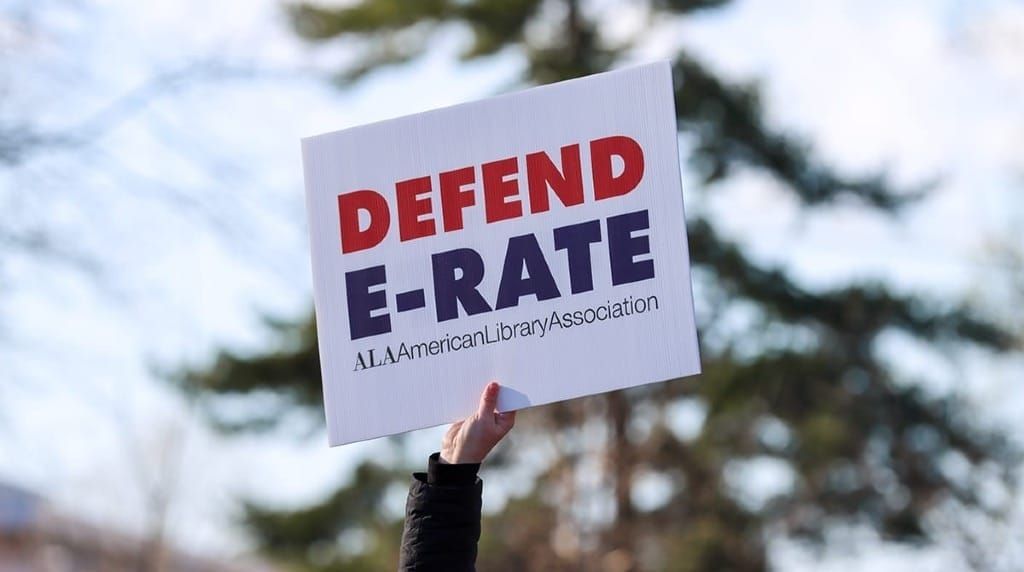
WASHINGTON, June 16, 2026 – Education and library groups have urged the Federal Communications Commission to strip from a draft rulemaking any suggestion that the E-Rate program could be terminated or narrowed.
The FCC “does not maintain the requisite statutory authority to terminate or limit the E-Rate program,” a coalition of groups led by the Schools, Health & Libraries Broadband Coalition argued in an ex parte filing Tuesday.
The coalition disclosed a series of meetings with FCC staff, including meeting Friday with aides to Commissioners Anna Gomez and Olivia Trusty, as well as Monday with senior counsel to Chairman Brendan Carr.
At issue is a draft notice of proposed rulemaking the FCC is expected to vote on this month that, among other questions, asks whether the E-Rate program should be sunset, limited to rural areas, or restricted to regions served by a single provider.
The $2.5 billion-per-year broadband subsidy for schools and libraries was set up in 1996 to address a lack of internet access in education centers.
FCC Chairman Brendan Carr has framed the proceeding as part of a broader effort to ensure E-Rate funds are used strictly for educational purposes and to address concerns about student screen time in schools.
In a statement announcing the proposal, Carr said the review is intended to “empower parents and better protect children.” In an interview with Fox News on June 4, he pointed to concerns about student access on personal devices connected to school networks, saying “they don’t necessarily have any filters on where [students] can go.”
While the FCC’s proposal focuses in part on expanding filtering requirements and addressing student screen use, it also raises broader questions about whether the E-Rate program itself should be scaled back or eliminated
The coalition of school and library groups pressed those arguments directly with FCC officials over the past week, arguing the FCC lacks statutory authority under Section 254 of the Telecommunications Act to terminate E-Rate or restrict it only to certain areas.
They contend Congress established E-Rate as part of universal service and directed the FCC to periodically evolve supported services, but never to eliminate the program.
The coalition’s filing also urged the FCC to reclassify the proposed rulemaking as a Notice of Inquiry, arguing that the draft primarily poses broad policy questions rather than advancing specific proposed rule changes. Advocates said that distinction matters for both procedural clarity and compliance with Administrative Procedure Act requirements.
“The questions asked in the NPRM do not satisfy the Administrative Procedure Act for a traditional rulemaking,” the coalition argued.
In addition, the coalition called for longer timelines for public input than those proposed in the draft order. It recommends a 120-day comment period followed by a 90-day reply period, replacing the current 30-day and 30-day schedule.
The groups argued that E-Rate’s nationwide reach and budgetary significance warrant a more extensive record, particularly given that many stakeholders in K–12 and library systems may be unavailable during summer months.
The groups asked the commission to seek additional record evidence on how E-Rate connectivity benefits both rural and urban communities, what core school and library systems depend on broadband access, and how the program helps ensure universal and affordable service.
SHLB Executive Director Joey Wender argued in an op-ed Thursday that nearly every school in the country now has a high-speed internet connection precisely because the E-Rate program continues to provide ongoing support year after year.
“A network is a continuing commitment. Bandwidth needs grow every year. Equipment ages and has to be replaced, and Wi-Fi that once served a few laptops now supports online testing, security systems, and daily building operations,” Wender wrote.
“Treating E-Rate as a finished project is like deciding to stop maintaining a highway because it has already been built. Congress understood this from the start,” he said.
The FCC is expected to vote on the proposal at its June 25 meeting, although the draft may change in the interim.
Advocates are preparing to engage the broader public ahead of the FCC’s comment process. SHLB is scheduled to host a July 16 webinar to walk participants through the FCC’s draft proposal and outline how schools, libraries, and other stakeholders can submit formal comments to the agency.