
Experts Say Data Centers Face Permitting, Economic, and Community Support Obstacles
As data centers continue construction, some are facing local government ordinances and other challenges.

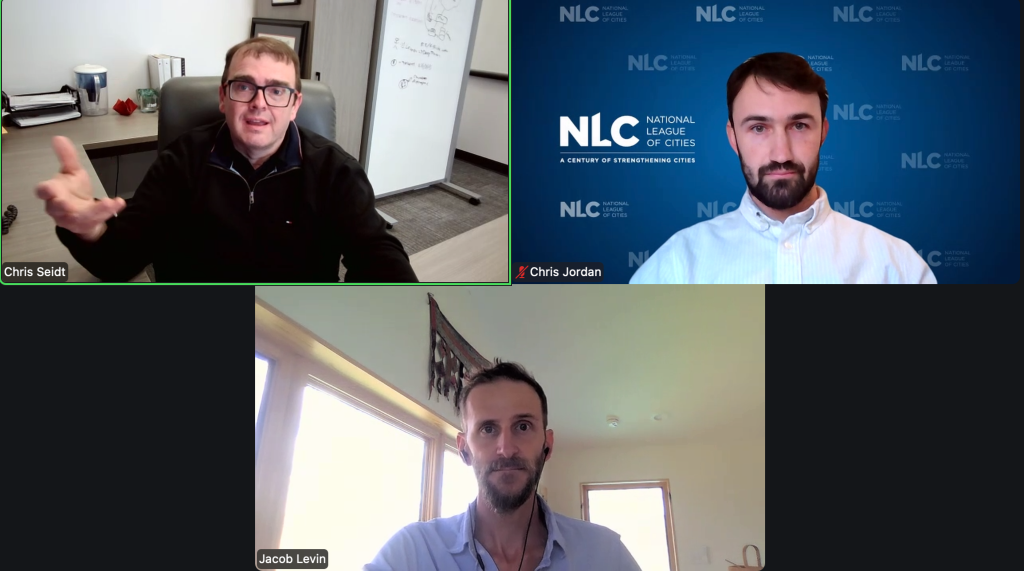
WASHINGTON, March 23, 2026 – Only a third of Americans are supportive of data centers, which is less than their support of building a stadium or airport near their home, said Chris Jordan, the program manager of AI and innovation at the National League of Cities.
“Then if you ask that third of people, what if we increased your electricity bills by $10 a month? That number of supporters is basically split in half already,” Jordan said.
Jordan joined Moderator Chris Seidt and CTC Technology & Energy Principal Analyst and Market Intelligence Specialist Jacob Levin for a conversation on the landscape of data centers, including both the economic promises and pressure to move quickly. At the National Association of Telecommunications Officers and Advisors’ webinar Monday, the panelists spoke about residents’ concerns on environmental impact and community cost.

Jordan said as the collection of global data, especially with artificial intelligence, continues to increase, the need for hyperscaler data centers have also increased.
There are currently more than 1,000 hyperscale data centers in the world, with approximately 600 of those in the United States, Jordan noted. Currently, the areas with the fastest data center growth and planned capacity are Las Vegas, Salt Lake City and Phoenix, Jordan said.
Data center permitting obstacles
Through Jordan’s work with cities through the NLC, he has seen local governments having to update their zoning code to account for hyperscale data centers. For example, Jordan said cities are having to rewrite their laws to define data centers by power draw as opposed to square footage. In other cases, local governments have had to pause because they “feel like they’re playing catch up” when updating ordinances.
“The process to actually bring a new data center online in many communities can be very, very quickly, unless the city goes ahead and designates that development as a special use that needs a special use permit, in which case there would be time for environmental reviews, perhaps even getting the public involved too,” Jordan said.
Different cities have been applying a variety of measures to ensure public safety and protection, Jordan noted. In Linn County, Iowa, the local government added “robust environment provisions” into the ordinance, while Mesa, Arizona, added water use codes to ensure data centers comply with specifications.
Economic hurdles facing data center construction
Jordan notes that data centers employ one job for every 5,000-10,000 square feet, which “as an economic development official, would be a poor choice.” At the same time, he said construction and electrician jobs for the centers provide community benefits too. In total, Jordan said the data center industry currently employs approximately half a million full time jobs.
Levin noted that many local governments and communities believe building a data center is going to ensure economic success and participation in AI in the future, which is not always true. Instead, he said network latency is “the key metric to watch,” especially as consumers use AI differently based on their latency.
Levin said there are several ways to bring down latency, which ensures the optimization to process high volumes of data in near real-time interactivity. Encouraging local internet exchange and increased metro fiber build out are two examples Levin mentioned.
“There are a lot of different methods that local governments can use to try to make sure that they remain economically competitive, beyond just trying to attract a data center,” Levin said.
Uses for BEAD nondeployment funds
Levin said he hopes to see a variety of potentially eligible purposes for the $21 billion nondeployment funds from the federal Broadband Equity Access and Deployment (BEAD) program. While permitting support will be a key one, Levin said he believes states will likely be able to use the funds for data center development.
“One of the other uses is potentially going to be to support AI build out. The devil will be in the details in terms of what is actually permitted,” Levin said. “States can find a lot of creative ways to use these funds to build out fiber and conduit in places where we are likely to see data center development, where they would like to encourage data center development.”




Member discussion