Experts Urge Data Oversight ‘Down to Jitter and Latency’ in Broadband Reporting

Schools, states, and data firms push broadband map accuracy.

Experts Urge Data Oversight ‘Down to Jitter and Latency’ in Broadband Reporting
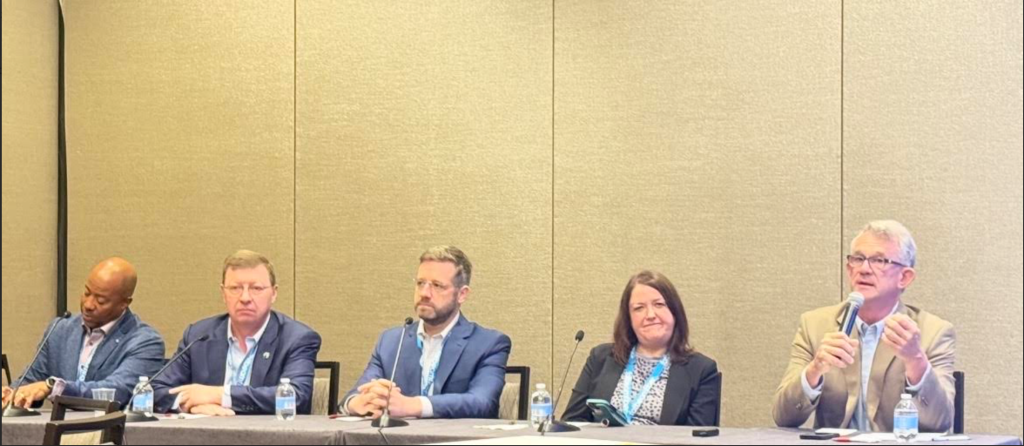
Photo of (from left to right) Scott D. Woods, president of public-private partnerships at Ready.net; Bryan Darr, vice president of government affairs at Ookla; Evan Feinman, principal at Feinman Strategic Network; Kelleigh Cole, director of policy and communications at the Utah Education and Telehealth Network; Philip Neufeld (moderator), executive officer for strategic research at Fresno Unified School District speak during the broadband mapping panel at the AnchorNets 2025 Conference in Arlington, Va.

ARLINGTON, Va., Oct. 30 , 2025 — It’s still an issue: There are gaps in the broadband maps.

Mapping specialists and anchor institution officials said the nation’s broadband maps still fail to show how reliably families can get online, and that schools, libraries, and data firms are helping to close the gap.

The session, here at the AnchorNets 2025 Conference, examined how federal broadband programs such as the Broadband Equity, Access, and Deployment and E-Rate depended on precise, verifiable data. Participants said the Federal Communications Commission’s new location-based maps marked progress over the older census-block system but remained incomplete without granular data from anchor institutions.

Panelists described how schools and states were generating that evidence themselves. In California's Central Valley, Philip Neufeld, executive officer for strategic research at Fresno Unified School District, said his team’s open-source testing app has gathered more than 25 million household results, and showed that roughly one-quarter of families remained effectively unserved despite major fiber upgrades to schools. 

Other states adopted similar data-driven approaches. In Utah, officials partnered with counties and broadband offices to verify where service actually reached homes and community institutions.

 Kelleigh Cole, director of policy at the Utah Education and Telehealth Network, said the statewide system now connected more than 2,000 schools, libraries, and health facilities, nearly all by fiber, allowing policymakers to identified areas marked served that still lack dependable access. 

Private-sector and technical experts said those localized efforts were essential for accountability. 

Bryan Darr, vice president of government affairs at Ookla, said the company processes about 11 million consumer speed tests each day, revealing slower and disparate service in rural and low-income areas such as the Mississippi Delta. 

Scott Woods, president of Ready.net and a former National Telecommunications and Information Administration official, said states must track not only buildout but also adoption, affordability and service quality down to the specifics, past upload and download speeds to jitter and latency levels. 

Speakers agreed that broadband expansion now depends as much on measurement as on money. Without regular local testing and transparent data collection, they said, agencies risk repeating years of overstatement and leaving underserved communities behind.

Member discussion

Popular Tags