FCC Pleased With Pace of Broadband Deployments
The agency's 706 report did not include analysis of broadband affordability or adoption

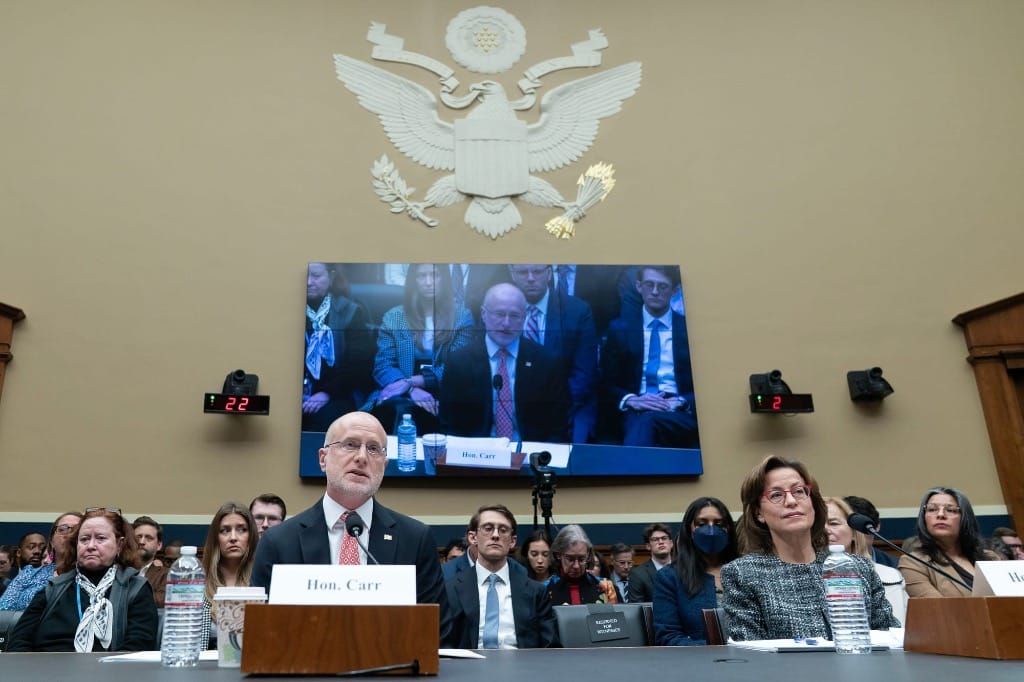
WASHINGTON, Aug. 14, 2026 – The Federal Communications Commission said Friday that broadband is being deployed to all Americans in a reasonable and timely fashion, reversing a finding from 2024 under the Biden administration.
The agency review found 96.9 percent of people in the U.S. had access to terrestrial broadband of at least 100 megabits per second (Mbps) download and 20 Mbps upload (100 * 20 Mbps) as of June 2025, an increase from 94.5 percent two years prior.
Fixed satellite service at those speeds is at least offered virtually everywhere in the country, and FCC Chairman Brendan Carr has advocated for including satellite in the annual review, but the Friday report still included estimates both including and excluding satellite.
The agency said congestion and other factors could affect satellite broadband service quality and consistency. A May Ookla report found subscribers using Starlink — the only consumer low-Earth orbit ISP operating in the country — experienced 100 * 20 Mbps speeds 44.7 percent of the time.
The FCC is required by Section 706 of the Telecom Act to report annually on whether broadband is being deployed across the country “in a reasonable and timely fashion.” The agency found in the affirmative this time.
“More Americans than ever have access to affordable, next-gen services. The digital divide is rapidly closing,” Carr said in a statement. “And a range of data sets show that speeds are up, prices are down, and competition is intensifying.”
The 706 report found 87.6 percent of people on Tribal lands had terrestrial service at 100 * 20 Mbps, and that nationwide 76.9 percent of people had access to at least two terrestrial ISPs offering those speeds.
95.2% of people had access to 5G speeds of 35 * 3 Mbps
On the mobile front, 95.2 percent of people had access to 5G speeds of at least 35 * 3 Mbps, and that 93.2 percent had access to mobile fixed and mobile service meeting the agency’s benchmarks.
Rural telecom consultant Doug Dawson has written that rural cell coverage can still in practice be patchy, since any given area might be covered by one mobile carrier but not necessarily all three, leading to dead zones depending on which provider one subscribed to.
The agency’s report found 87.8 percent of people had access to qualifying 5G from two or more providers, and 73.8 percent were covered by three or more.
In all, about 10.6 million people lacked access to 100 * 20 Mbps broadband, the FCC found. About 3.4 million lived in areas where public funds had already been allocated to fund deployment.
That doesn’t include the $42.45 billion Broadband Equity, Access, and Deployment program, the report said, since those grants are not all yet reflected in the FCC’s broadband funding map.
While the report touted the expansion of broadband deployments, the agency said it still had work to do in closing the digital divide.
“Notwithstanding these impressive results and our findings in this report, our work in closing the digital divide will not cease,” the agency wrote. “On the contrary, we plan to continue our efforts to ensure that every single American has access to advanced telecommunications capability.”
Affordability, adoption scrapped
As a commissioner, Carr dissented from the 706 report issued in 2024. He said that report’s finding that broadband was not being deployed in a reasonable and timely fashion could be used to institute more aggressive regulations over the industry, which he opposed.
He also opposed the agency’s analysis of broadband affordability and adoption, something it hadn’t looked at in prior reports. He argued those were beyond what the agency was supposed to consider under the law, and the agency did not analyze those issues in Friday’s report.
“The record makes clear that broadband providers themselves are concerned with and proactively addressing consumer costs,” the agency wrote. “We reject the argument that the universal service goals nonetheless warrant inclusion in the 706 inquiry because affordability and adoption in particular inform whether advanced telecommunications services are ‘meaningfully’ or ‘effectively’ available.”
The report also axed a long-term speed goal the agency instituted with the 2024 report: 1 Gbps * 500 Mbps.
FCC Commissioner Anna Gomez, the agency’s lone Democrat, was not pleased with that.
“Infrastructure is of little value to consumers when it is not usable for high-speed, reliable connectivity or when it is not affordable. Though Congress only required the Commission to report on deployment, this requirement is a floor, not a ceiling,” she said in a statement. “Omitting affordability and usability from the analysis was a policy decision with which I disagree.”
She said she concurred with the item rather than fully approve it (although a concurrence counts as a vote for approval) over the issue. Gomez also said her office pushed for some edits that noted the limitations of satellite broadband.