FCC Ponders ‘Large Scale Changes’ to School and Library Broadband Subsidy
Wireline chief discusses updating the program which supports internet access for nearly all U.S. public schools

WASHINGTON, July 30, 2026 – The Federal Communications Commission is questioning whether “large scale changes” are necessary to E-Rate, the roughly $2.5 billion federal subsidy that supports internet access for schools and libraries.
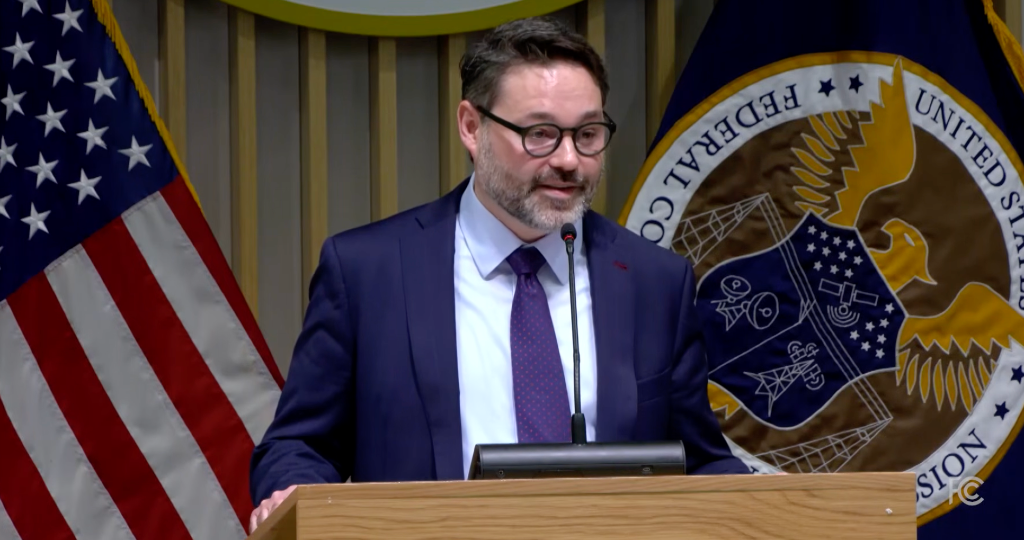
“Responsible governance sometimes means asking whether a program continues to serve its purpose, is still consistent with the statutory goal provided by Congress, and whether there is a need for large scale changes,” Joseph Calascione, chief of the FCC’s Wireline Competition Bureau wrote in a post Wednesday.

On June 25, the FCC adopted a proposed rulemaking seeking comment on a wide array of questions about how to update the E-Rate program.
“The NPRM asks some important questions about whether the goals established by Congress have been met, and whether the E-Rate program should remain unchanged, continue with some changes, and if Congress envisioned the program to operate indefinitely,” Calascione wrote.
Calascione’s post steers clear of the most consequential question raised in the E-Rate rulemaking: whether the program should be eliminated altogether or narrowed to serve only rural schools and libraries.
Instead, the post emphasizes the rulemaking is intended to empower parents, protect kids online, and address screen time during school hours. Those advocating to preserve the program have pushed back on that framing.
Speaking Wednesday on a webcast hosted by the Fiber Broadband Association, Joseph Wender, executive director of the Schools, Health & Libraries Broadband Coalition, cast doubt on the FCC's screen time and parental-empowerment rationale.
He argued that decisions about student screen time belong with local school boards and educators, not the FCC, and that the two issues are otherwise unconnected.
He noted that roughly 95 percent of schools and libraries now depend on fiber connections that E-Rate helps fund – not just for internet access in classrooms, but for systems including security cameras, door access, HVAC, fire suppression systems, and countless other operational needs.
“If E-Rate support went away, schools would still need connectivity. The question is what they would have to cut to pay for it,” Wender said.
SHLB has launched a campaign, SaveOurERate.com, urging schools, libraries, internet service providers, and the public to file comments defending the program.
Of the nation’s 100,083 public schools, 96,416 participate in the E-rate program, an adoption rate of more than 96%, according to research by Funds for Learning, an E-Rate consulting firm. Meanwhile, 32% of private schools use E-rate discounts.
E-Rate also plays a vital role for libraries. Of the 16,751 public library locations nationwide about 12,230 receive E-rate discounts, representing 73% of all sites.
The FCC proceeding is part of what agency officials describe as a “top-to-bottom” review of all four programs under the $8.5 billion Universal Service Fund. Along with E-Rate, the FCC has also opened inquiries touching the Lifeline low-income phone and broadband subsidy and the High-Cost program that funds rural network buildouts.
Wender struck a more optimistic note about Congress, pointing to a bipartisan working group led by Sen. Deb Fischer, R-Neb., and Sen. Ben Ray Luján, D-N.M., expected to circulate a discussion draft of legislation exploring ways to modernize USF’s contribution base this summer.