
Global Cooperation Needed to Manage Space Resources, Says ITU Chief
Doreen Bogdan-Martin emphasized that spectrum for space-related services must be managed through global cooperation.

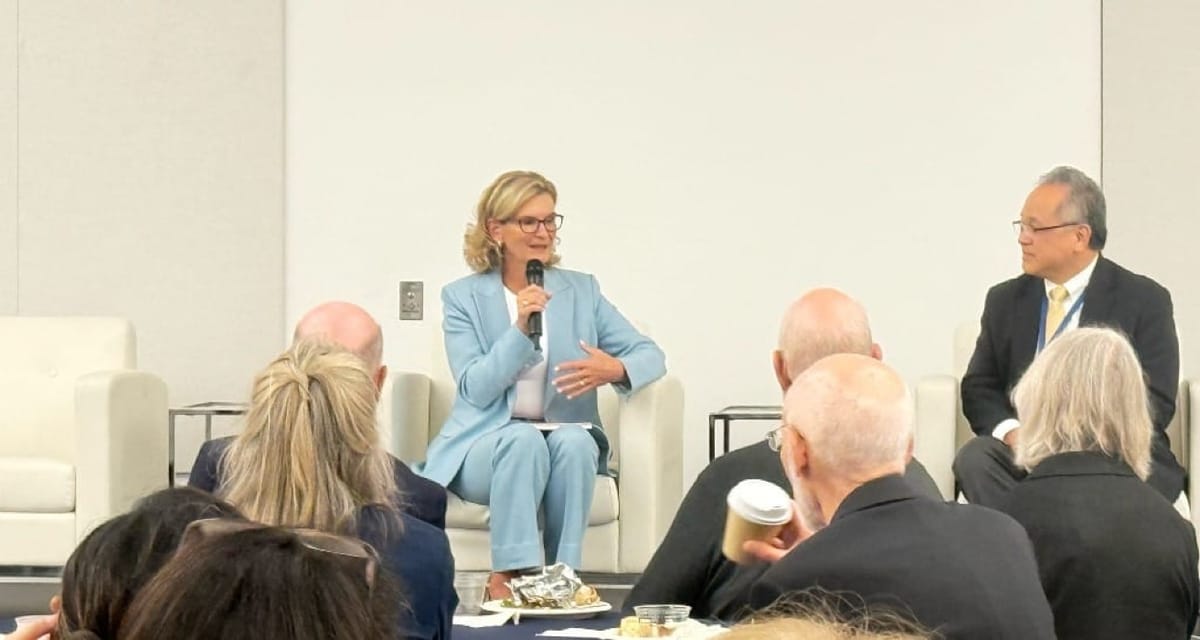
WASHINGTON, September 20, 2025 – The International Telecommunication Union is elevating space issues to the center of its agenda. The next World Radiocommunication Conference in 2027 is planned to be hosted in China, and 80 percent of its program will be devoted to space policy, said Secretary-General Doreen Bogdan-Martin.
Speaking Friday at the Research Conference on Communications, Information and Internet Policy – TPRC – at American University’s Washington College of Law, Bogdan-Martin emphasized that spectrum for space-related services is a limited and contested resource and must be managed through global cooperation.
She said the ITU is considering new spectrum allocations for mobile satellite service and direct-to-device connectivity, as well as laying the technical groundwork for a potential lunar communications network.
Bogdan-Martin, the first woman and second American to head the agency, also highlighted artificial intelligence as an emerging priority, noting that the ITU has already developed about 140 AI-related standards, with another hundred in progress.
A research component for ITU
Bogdan-Martin called on universities to play a stronger role in shaping the organization’s work, urging more U.S. institutions to join the ITU. Only eight are members today, despite the U.S. having been part of the ITU since 1908 and hosting the largest number of private sector participants.
While Bogdan-Martin described recent years as a time of greater cooperation within the ITU, geopolitical tensions remain — particularly between the United States and China.
Washington has recently launched a bid to host a future ITU conference, directly challenging Beijing. Jovan Kurbalija, executive director of the DiploFoundation and head of the Geneva Internet Platform, warned in June that placing the conference in either country could send strong signals about global digital alignment, governance values, and influence over international tech regulations.
The China issue looms large over the ITU’s flagship gathering in 2027, raising questions about how global rules for space and spectrum will be negotiated in a divided international environment.
A history of conflict over ITU in America
Bogdan-Martin’s push for global cooperation despite ongoing geopolitical conflict also comes against the backdrop of the ITU’s contentious history. In 2012, negotiations to revise its International Telecommunication Regulations collapsed over disputes about whether the treaty should cover Internet governance, with the U.S. and allies rejecting proposals from China, Russia, and developing countries.
More recently, global politics again played a role in the ITU as Bogdan-Martin faced off against Russian candidate Rashid Ismailov in the 2022 leadership race. Ismailov argued at the time that he should not be dismissed simply because he came from a country at war with Ukraine.
The ITU is now being tested on whether it can overcome past divides and remain a trusted venue for cooperation.
For more information on the upcoming World Radiocommunication Conference, attend Broadband Breakfast Live Online on Oct. 1, 2025.
 Broadband Breakfast


Member discussion