
Hoopa Valley Tribe Partners With State for High-Speed Internet Backbone
The project represents the first joint-build agreement between a tribal group and the California Department of Technology.

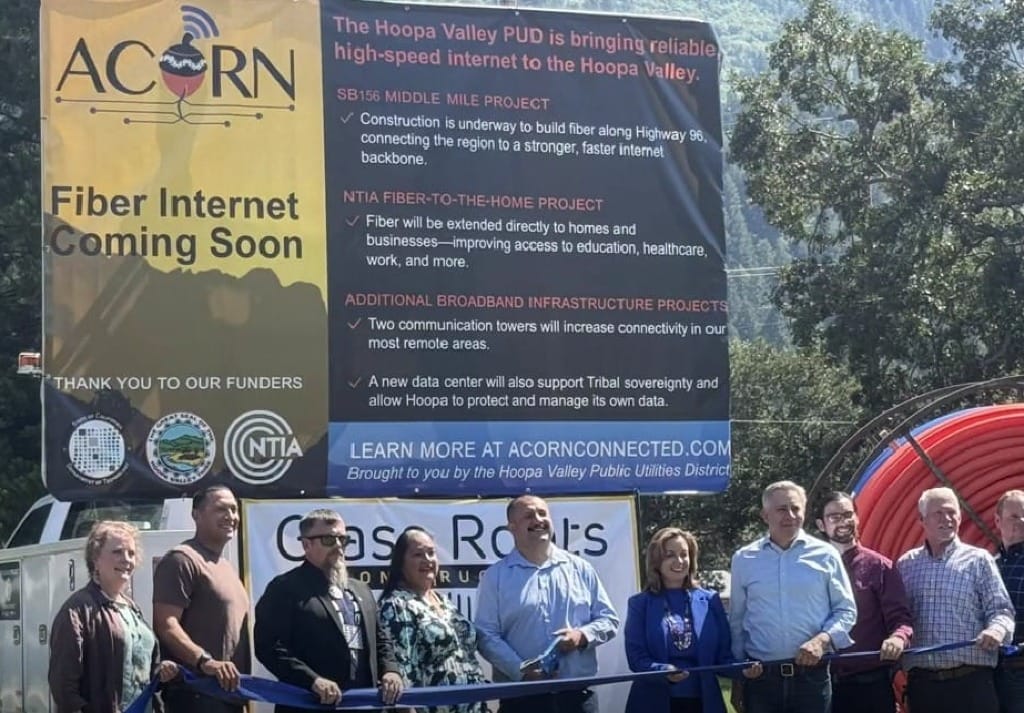
WASHINGTON, August 13, 2025 – Located on one of the largest, most remote tribal reservations in the state, the Hoopa Valley Tribe has partnered with the state of California to bring a high-speed internet backbone to their long underserved population.
Leaders of the project gathered Tuesday to commemorate this milestone for digital equity and celebrate the first joint-build agreement between a tribal group and the California Department of Technology.
“It's an absolute honor to be a partner with the California Department of Technology, California Public Utilities Commission, Caltrans, on behalf of the tribe and it's an absolute honor to facilitate this project and we look forward to being a great state partner for decades to come," said Linnea Jackson, general manager of the Hoopa Valley Public Utilities District.

Construction was already underway on the new fiber route, which will link Hoopa Valley directly into the state’s internet backbone.
Once complete, expected in mid-2026, the tribe’s project leaders told KRCR News their goal was to connect homes, schools, and businesses as quickly as possible, allowing the Hoopa Valley Tribe to enjoy the benefits of reliable, high-speed internet.
“It creates jobs, it creates educational opportunities around technology, there's just a ton of benefits all the way around," said Joe Davis, chairman of the Hoopa Valley Tribe.
The Hoopa Valley build represents one segment of California’s statewide open-access, middle-mile network established under SB 156, a $6 billion broadband plan passed in 2021 that includes a public fiber backbone to help last-mile providers reach rural and underserved areas.
According to Liana Bailey-Crimmins, California State Chief Information Officer and Director of the Technology Department, the COVID-19 pandemic served as a call to action for digital equity by revealing how large the state’s digital divide was.
“One in five Californians don't have access to affordable high-speed internet, so we are here to serve and to provide those opportunities that sub-communities do not have, especially in rural parts of California," said Bailey-Crimmins.







Member discussion