
Illinois to Spend More Than 95 Percent of $1 Billion BEAD Budget
The 46 states that have reported results are collectively more than $17 billion under budget.


WASHINGTON, Sept. 23, 2025 – Illinois is planning to use more than 95 percent of its $1 billion Broadband Equity, Access, and Deployment program budget on deployment projects, the most of any state to have reported so far.
The state released its tentative grant winners Tuesday, becoming the 46th state to do so as part of the $42.45 billion program.
Of Illinois’s nearly 160,000 locations in line for funding under the program, nearly 76 percent would receive fiber and nearly 15 percent would receive satellite under its draft plan. Almost all of the remaining 9 percent would get fixed wireless, with a small amount of cable.
Amazon’s nascent Project Kuiper would nab all of the satellite locations. Local providers are set to serve many of the wireline locations, with Comcast set to serve the most locations of any national ISP in the state at about 13,000.
The state’s broadband office noted it actually received more applications in its additional bidding round, mandated by the Trump administration after it changed the program’s rules. The average per-location cost fell 21 percent to $6,100, the state said.
Still, Illinois said it wasn’t quite able to get to every location. There are 176 unserved homes and businesses and 106 underserved homes and businesses the state is still working on finding a solution for.
After taking comment on the plan for one week, the state will submit its preliminary awards to the Commerce Department for approval. That approval is the last step necessary before states can begin funding projects.
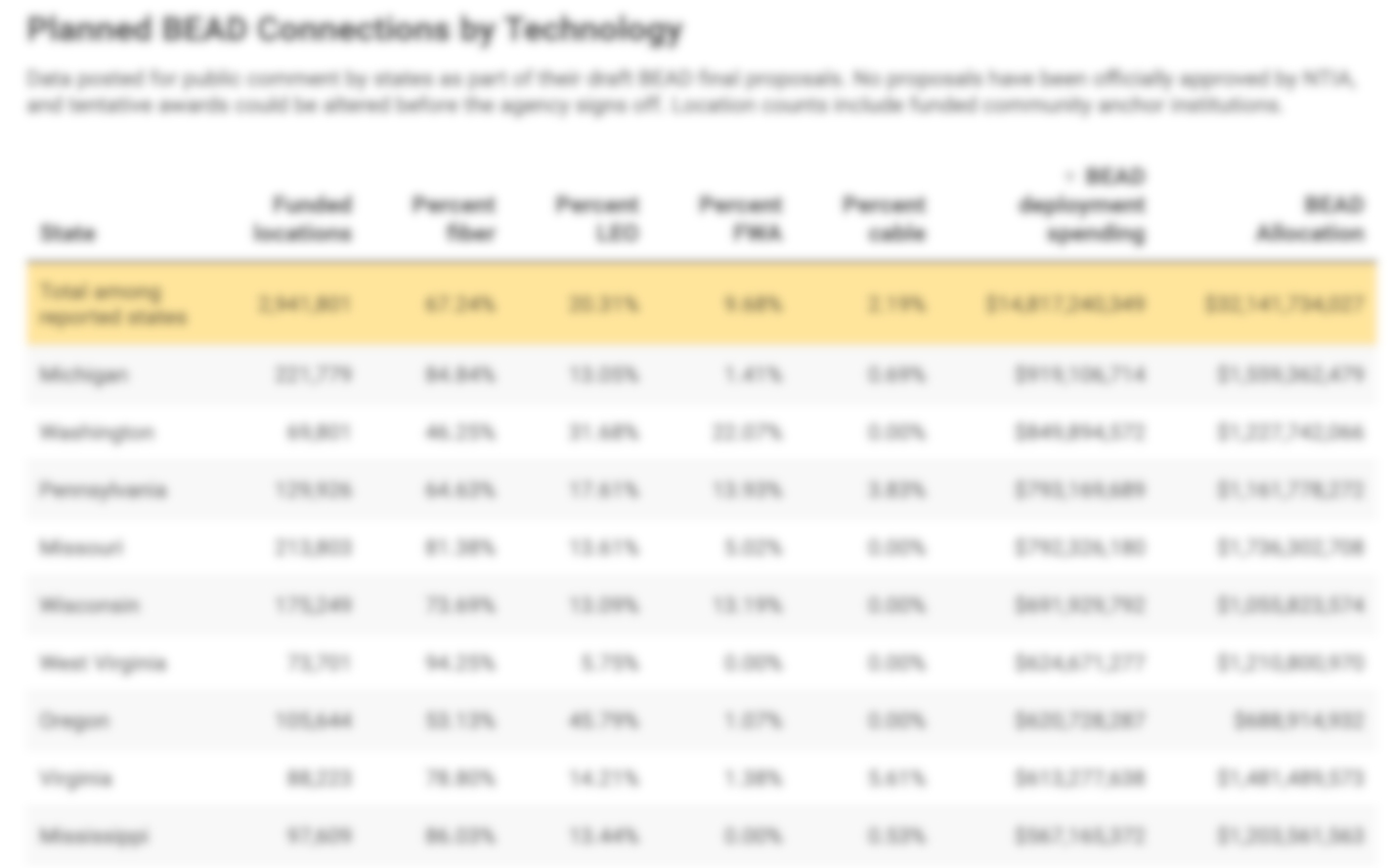
Among the 46 states to have reported their tentative results, BEAD awards are favoring fiber. Nationally, about 67 percent of BEAD locations are in line for fiber, nearly 20 percent are in line for satellite, about 10 percent would get fixed wireless, and 2 percent would get cable. Some states hadn’t found a provider for each of their locations when they reported results.
Results are tentative, and may be altered
Those results are tentative, and could need to be altered before Commerce’s National Telecommunications and Information Administration signs off. The agency is looking for states to negotiate down or award to another provider project areas that exceed certain cost caps, which differ in each state.
Cost savings are a major priority of the Trump administration for BEAD. Its June 6 rule change eliminated an explicit preference for fiber, which can be more expensive to deploy, and made it easier for satellite and fixed wireless to compete.
Even before the revised awards NTIA is pursuing, states have been coming in far under budget. The states that have reported results came in more than $17 billion under their 2023 BEAD allocations.
It’s not clear what will happen to that cash. The Trump administration isn’t excited about the prospect of states spending it, something they had been planning on doing before June. Lawmakers, including Republican Sens. Roger Wicker, Miss., and Shelley Moore Capito, W. Va., have said they want their broadband offices to hang on to the cash rather than return it to the treasury.
“Congress was clear: States can use this remaining grant money,” Wicker said in a Monday constituent email. “That policy rewards those who wisely stewarded their deployment funds.”
The states that have not yet reported their results include California, Texas, Utah, and Florida.
California and Texas received longer deadline extensions, responsible for sprawling programs with significant numbers of eligible locations, have larger deadline extensions, Nov. 2 and Oct. 27, respectively.
Utah’s broadband office website says its draft plan “will soon be available for comment.” It’s not clear when Florida will publish its plan.




Member discussion