
Is AI Coming to 9-1-1? These Panelists Think So
Adoption of new tech reliant on adoption of NG9-1-1

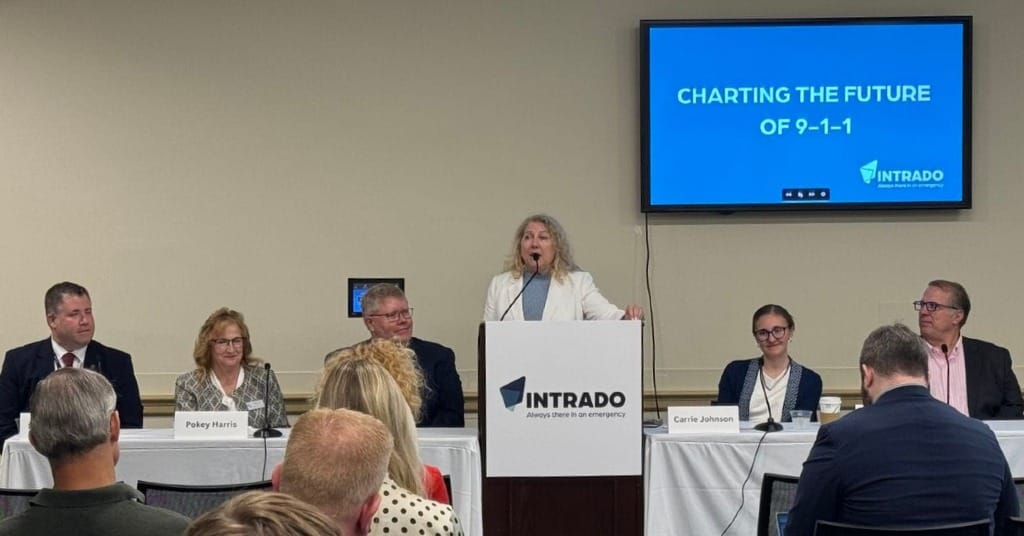
WASHINGTON, July 9, 2025 – Scott Brillman, director of the Fairfax County Emergency Communications Center and member of the NG9-1-1 Institute Board, was optimistic when asked Tuesday what he thought artificial intelligence’s impact would be on the emergency services industry.
“It’s the greatest tool,” Brillman said. He listed off several benefits that AI can provide to the industry, including its ability to quickly translate foreign languages, pick out keywords in calls to help an operator determine what resources to mobilize, and understand human speech in situations where human operators struggle, such as when an emergency responder is out of breath or speaking through a mask.
Brillman was speaking as a panelist at an event hosted Tuesday by Intrado Life & Safety Inc., a company specializing in emergency communication services. Throughout the hour-long event, titled “Charting the Future of 9-1-1” panelists discussed how technologies being developed today could impact the emergency response industry in the future. As one might expect, discussion of AI played a prominent role.

FROM SPEEDING BEAD SUMMIT
Panel 1: How Are States Thinking About Reasonable Costs Now?
Panel 2: Finding the State Versus Federal Balance in BEAD
Panel 3: Reacting to the New BEAD NOFO Guidance
Panel 4: Building, Maintaining and Adopting Digital Workforce Skills
“AI can help. It can augment,” L.V. “Pokey” Harris, director of North Carolina’s 9-1-1 Board and President of the National Association of State 911 Administrators said. “What we’re seeing with public safety answering points in our state is they’re looking at [AI] for administrative phone calls right now. They’re taking that load off of telecommunicators.”
John Snapp, vice president of technology at Intrado, agreed.
“We still have a lot of emergency calls that come in these non-emergency lines,” Snapp said. “[AI] can quickly identify an emergency call that comes into those non-emergency lines and get it back to that trained telecommunicator to be able to help them out.”
Snapp also postulated that AI’s superb pattern-recognition skills could help it detect swatting calls, or calls making false reports, which could save money and cut down on potentially dangerous interactions between police and civilians.
Other developments, such as the rise of satellite internet and the creation of advanced automatic collision notification systems, promise to make emergency service systems even more effective. Snapp explained that due to the emergence of satellite technologies “there is no spot on the Earth that you may not be able to call for help.” Though this is great for consumers, Snapp also noted the problems it creates for the industry.
“Today most of the PSAPs [Public Safety Answering Points] will take calls about three miles out offshore,” he said. “But now the satellite, you can be 10 miles out, 11 miles out, and where is it going to route to?”
Snapp also argued that technologies like AACN, which capture crash data from vehicle collisions and sends the information to emergency responders, could save time and lives by giving first responders more details about a crash: such as how fast a car was going, which airbags went off, and how many passengers were present in the vehicle.
Many of these newer technologies rely on Next Generation 911, a digital internet-protocol based system set to replace the current analog system. Though NG9-1-1 has the potential to dramatically increase the effectiveness and reliability of a local emergency response system, implementing it has been a challenge, especially in areas lacking funding or strong governance structures.
Harris told Broadband Breakfast that even states that lack funding and a strong governance structure can still successfully implement NG9-1-1, so long as they have local officials willing to lead.
“So, West Virginia, they have a new 911 director,” Harris said. “He doesn't have the authority as in what we can do in North Carolina. But he’s a champion for the cause, and he goes up there and he talks with the 911 centers. For states that don’t have that governance, don’t have that authority, don’t have that legislation behind it or the mandates, I’m trying to help them to champion this.”
According to Carrie Johnson, associate vice president of external affairs and policy for AT&T’s FirstNet Program, most funding for 911 programs comes from the state and subscription surcharges on phone bills.
“Without federal funding, states have and will need to be setting up their own funding mechanisms to be able to support this critical role of Next Generation 911,” Carrie said.
Even now, some localities are struggling to operate. According to Brillman, approximately 90 percent of emergency call centers (ECCs) have five call takers or fewer. Snapp explained that this lack of funding has helped delay the implementation of technologies introduced ten years ago.
“We still have a percentage of the ECCs around the country that are not accepting text,” he said. “And a lot of that is to do with most ECCs are under five telecommunicators, and these are more rural areas where they may not get that many text calls.”
Lack of funding can also lead to cybersecurity threats against these centers.
“We are truly seeing nation-state types of attacks against our networks,” Charles Gifford, chief information security officer for Intrado said. “And one of the biggest challenges we have within the ecosystem of 9-1-1 is that you’re only as strong as your weakest link.”
Lauren Kravetz, vice president of Government Affairs for Intrado, agreed.
“I’m going to go out on a limb and say that the 80 percent of centers that have five seats or fewer, five call takers or fewer, are probably the ones that are also the least resourced, and probably have no full-time IT staff that would be protecting the network,” she said.
A congressional hearing originally scheduled for July 9 to examine public safety communications was postponed this week due to canceled House votes, a congressional staffer told Broadband Breakfast. A new date for the hearing has not yet been announced.




Member discussion