
ITU Secretary-General: Space Will Dominate 2027 Global Spectrum Talks
At the Mobile World Congress, two global telecom policy-makers discussed resilience, supply-chain risk and workforce with AI.


Akul Saxena, Drew Clark
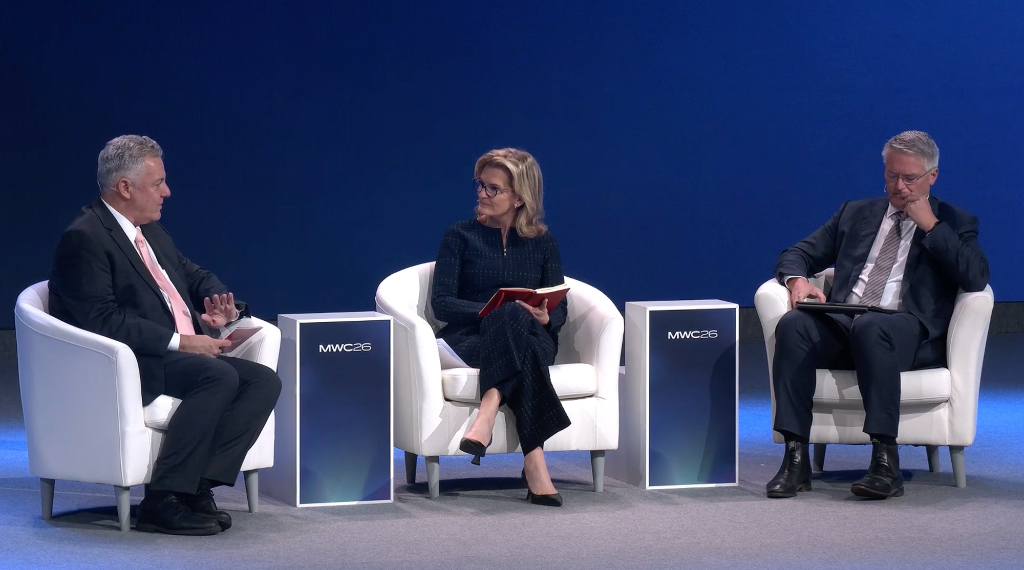
BARCELONA, March 3, 2026 — Space-based services will dominate the 2027 World Radiocommunication Conference, with roughly 80 percent of the treaty agenda focused on satellite and non-terrestrial systems, the head of the International Telecommunication Union said Monday.
Doreen Bogdan-Martin, Secretary-General of the International Telecommunication Union, said the quadrennial conference will revise binding global Radio Regulations governing spectrum allocations and satellite orbits.
The International Telecommunication Union allocates international spectrum bands and develops telecommunications standards used by governments and industry. Founded in 1865 under the International Telegraph Treaty to enable cross-border telegraph communications, it is the oldest specialized agency within the United Nations.
Items under discussion at upcoming WRC 2027
Items under discussion include direct-to-device satellite connectivity, expanded non-terrestrial networks, and lunar communications systems.
“Spectrum requires global consensus,” Bogdan-Martin said during a Mobile World Congress keynote, adding that global standards-making is imperative for trust and certainty in regulatory frameworks.
She said the digital economy is expanding at roughly 12 percent annually, outpacing global gross domestic product, and that the artificial intelligence market is projected to reach $4.8 trillion by 2033. Expanding broadband access, she added, has a direct link to GDP growth, where closing the global internet usage gap by 2030 could add $3.5 trillion to worldwide GDP.
Bogdan-Martin said artificial intelligence could create 170 million new jobs while displacing roughly 90 million globally, citing widely referenced projections.
She said academic institutions must prepare younger generations to engage with emerging technologies and that education models must evolve alongside workforce demands.
“The skilling piece is critical,” she said, arguing that education systems must adapt alongside technological change.
Bogdan-Martin said governance models must move from “static” to more adaptive approaches as artificial intelligence and other emerging technologies evolve more rapidly than previous innovation cycles. Engagement with governments, the private sector, the technical community, civil society, and young people must be continuous and inclusive, she said.
To support that shift, the ITU Academy provides in-person and online training in areas including cybersecurity and spectrum management. The ITU’s AI Skills Coalition, launched with private-sector partners including Cisco, Google, and Microsoft, offers free curricula in multiple languages.
She also said the ITU is placing increased emphasis on submarine cable resilience. Submarine cables carry more than 90 percent of international internet traffic, and the organization has established an advisory body focused on monitoring risks, shortening repair times, and promoting geographic route diversity.
In Africa, roughly 60 percent of the population is under age 25, she said, underscoring the need to involve younger policymakers and university students in shaping digital policy.
Digital infrastructure critical to development
Mathias Cormann, Secretary-General of the Organization for Economic Co-operation and Development, said digital infrastructure should be treated as critical infrastructure comparable to roads, energy grids, and financial systems.
The OECD is a Paris-based intergovernmental organization that provides economic analysis and policy guidance to 38 member countries.
Cormann said broadband networks, submarine cables, data centers, semiconductors, and spectrum systems now play a systemic economic role and require resilience by design.
Policymakers, he said, must work closely with operators to make resilience a core requirement, including building redundancy into networks and strengthening information-sharing mechanisms.
Cormann cited semiconductor shortages in 2021 that delayed 5G base-station rollouts as evidence of supply-chain concentration risk. Roughly 90 percent of global Wi-Fi fabrication capacity is concentrated in a handful of economies, and leading-edge semiconductors are produced almost entirely by a single firm, he said.
“No country can remove these types of risks on their own,” Cormann said, adding that complete technological autonomy is unrealistic. The task, he said, is to manage interdependence and reduce single points of failure.
Cormann also warned that if each jurisdiction develops entirely different rules on data governance, security, spectrum, or infrastructure, costs rise and investment slows.
He said policymakers must keep digital frameworks aligned with a rapidly evolving connectivity landscape and rely on dialogue, evidence, and coordinated approaches rather than a single reform.
When asked to identify one preferred solution, Cormann rejected the premise. “There is no one magic button,” he said. Governments must “do it all” – improve access, quality, affordability, reliability, and security simultaneously, and rely on data, evidence, and stakeholder involvement across the connectivity ecosystem.
The next World Radiocommunication Conference will convene in 2027 to negotiate updates to the Radio Regulations governing global spectrum allocations and satellite orbit use.
Delegations will address direct-to-device services, non-terrestrial networks, and other space-related systems that require cross-border coordination under internationally agreed rules.





Member discussion