
Judges Press FCC, Challengers in FirstNet Spectrum Case
The agency is looking to make more spectrum available to AT&T-operated FirstNet.

Jake Neenan
WASHINGTON, Nov. 24, 2025 – Judges poked holes Monday in arguments from both sides of a legal dispute over whether the Federal Communications Commission can open up more public safety spectrum for FirstNet, the government’s nationwide first responder network operated by AT&T.
The agency moved last year to start the process of allowing FirstNet to use unassigned parts of the 4.9 GigaHertz (GHz) band, currently set aside for local public safety users.
The agency said in a unanimous order it would in the future select a band manager for the spectrum, which could then enter into a sharing agreement with FirstNet. It also asked incumbent users for usage data and started a recertification process that would likely reduce their license areas.
A coalition backed by Verizon and T-Mobile, called the Coalition for Emergency Response and Critical Infrastructure, sued, arguing the band manager was an attempt to sidestep the FCC’s inability to assign spectrum to federal users, and that FirstNet can’t operate outside the band allocated for it in 2012. The group also thinks the extra airwaves would be a multibillion-dollar windfall for AT&T, which can use excess FirstNet capacity for its commercial wireless service.
A separate pro-FirstNet group, the Public Safety Spectrum Alliance (PSSA), also sued, but because it wanted the FCC to go further. The 2024 order doesn’t rule on what will become of the incumbent spectrum that is found to be unused after the data collection, which is likely to be a larger source of airwaves than the currently unassigned portions. PSSA wanted the agency to say at the outset that it would all go to FirstNet.
Oral arguments were held Monday before the U.S. Court of Appeals for the D.C. Circuit in Washington.
Coaliton for Emergency Response and Critical Infrastructure (CERCI)
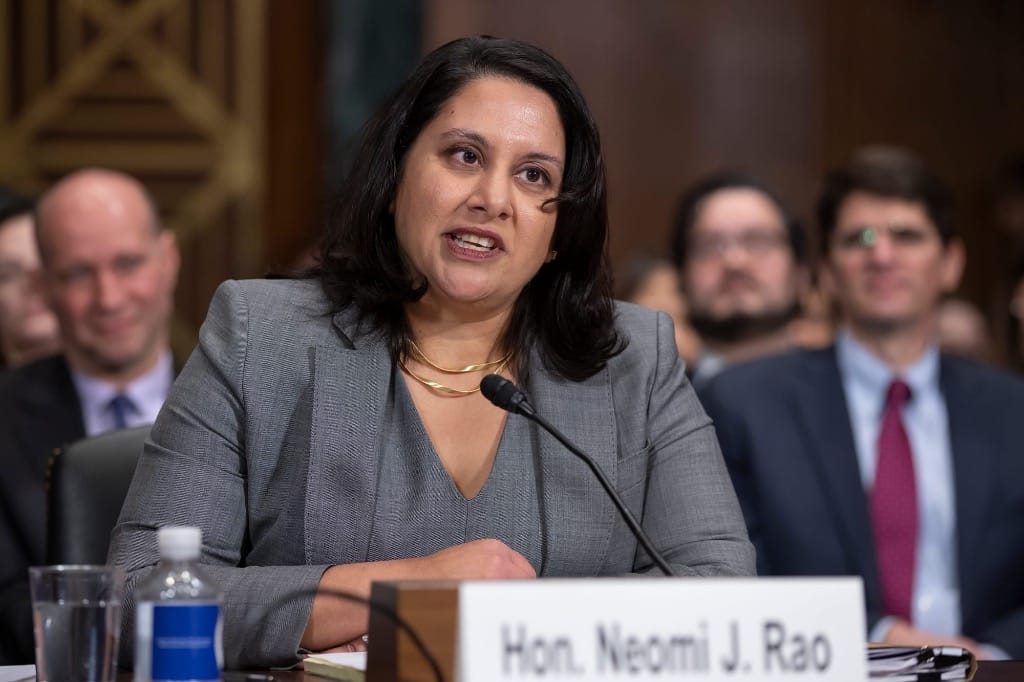
Circuit Judge Neomi Rao, a Trump appointee, pressed CERCI on whether FirstNet was actually prohibited from operating outside its 700 MHz band spectrum. She pointed to a provision of the 2012 law standing up FirstNet that allows it to contract with federal and state entities and other organizations.
“If FirstNet is given this ability to contract with other entities, why wouldn’t that include something like a sharing agreement with the band manager?” she said.
Jessica Ring Amunson, the Jenner & Block partner representing CERCI, insisted any contracting would be to aid the operation of the network within the 20 megahertz of spectrum Congress initially directed the FCC to vacate and hand to FirstNet.
She said it would have been “extremely important” for bidders on the initial FirstNet contract to have known that the network could in the future have access to more spectrum, an impression they didn’t have. Verizon and T-Mobile didn’t pursue bids.
Circuit Judge Gregory Katsas, also a Trump appointee, questioned whether the FCC action, intended to increase utilization in the band, was as unreasonable as CERCI contended.
There are “I think, some hard questions on legal authority, maybe some hard questions on reliance. But on the other hand, it seems like the commission had a very real problem here it was responding to,” he said. “And, just on an intuitive level, [it] responded in a very reasonable way.”
Amunson said the agency should have been more deferential to the interests of incumbents, some of whom made investments under the impressions they could expand their networks under the current licensing regime.
Katsas was also interested in a question he struggled to get a clear answer on, which was the precise role of the National Telecommunications and Information Administration in the matter, or what it should be legally. NTIA manages federal spectrum use and houses the FirstNet Authority, which oversees AT&T’s operation of FirstNet.
He said the argument that the FCC’s band manager was a workaround for the agency’s lack of authority “has a lot more intuitive force, at least in my mind, if NTIA is this independent regulator that is and should be handling federal entities like FirstNet.”
FCC
Adam Candaub, the FCC’s general counsel, said NTIA was aware of the FCC’s work and had “acquiesced” to the FCC selecting a band manager and approving a sharing agreement with FirstNet.
Candaub said the two agencies usually coordinated on issues like this in an informal way, and that NTIA would, as FirstNet’s overseer, ultimately be signing off if FirstNet entered into the sharing agreement. He said similar sharing agreements with federal entities for public safety had “been around for decades, and they seem to work.”
“Seeming to work and being legal are two different things,” Katsas said.
He said the order did seem to mostly be a means of getting FirstNet, a federal entity, access to more spectrum, and that he “would feel much better” if he had a clear idea of NTIA’s role, as the manager of federal spectrum, in reviewing and approving FirstNet’s use of those airwaves.
The FCC would at least have to change the designation of unassigned parts of the band, noted Joshua Turner, a partner at Wiley representing the Franternal Order of Police, who intervened on the FCC's side, because it’s currently not used for federal purposes.
Rao again brought up FirstNet’s authority to enter into contracts as weighing in the FCC's favor, asking “There’s no reason to think the contracting authority wouldn’t cover something?”
“No, absolutely not,” Candaub said.
Public Safety Spectrum Alliance (PSSA)
Rao said it wasn’t immediately clear to her that PSSA had standing to sue, or what exactly the group wanted the court to do.
“Redressability is tough where you want the agency to do something rather than not do something,” she said.
PSSA said on the terms of the FCC’s order which found that the 4.9 GHz band was underutilized, it should have had to explain why it didn’t preemptively say that spectrum assigned to an incumbent, but found to be unused, would be FirstNet’s.
Circuit Judge Robert Wilkins, an Obama appointee, said it wasn’t out of the ordinary for a regulator like the FCC to address a problem step by step, as it was doing on that question.
The FirstNet Authority’s authorization is set to expire in 2027, so Congress will need to pass legislation reauthorizing the agency to avoid a disruption.


Member discussion