
Legal Experts Warn FCC’s Brendan Carr Edging Toward ‘Coercion’
Panelists likened FCC chairman’s content interventions to 'jawboning'

Jericho Casper
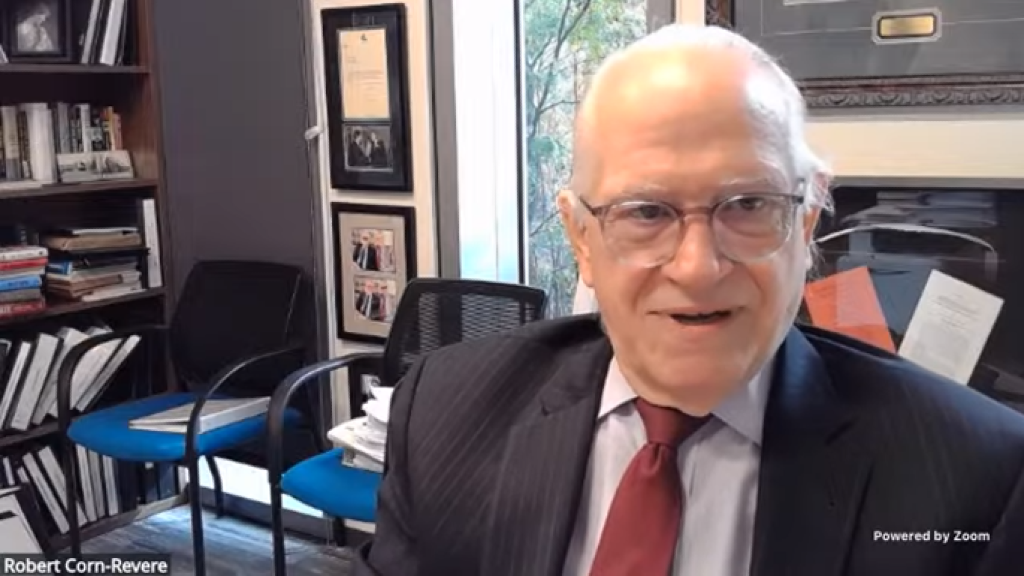
WASHINGTON, Oct. 8, 2025 – Legal scholars and free speech advocates warned Wednesday that Federal Communications Commission Chairman Brendan Carr’s increasingly vocal interventions in broadcast content decisions were edging toward coercion.
“The out-in-the-open nature of the FCC actions and Chairman Carr’s statements of late really are a textbook illustration of the difference between persuasion and coercion,” said veteran First Amendment attorney Bob Corn-Revere.
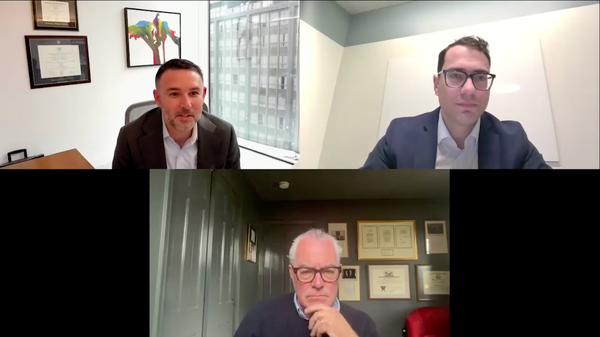
Speaking at an American Enterprise Institute event, senior fellow Clay Calvert cited a string of recent examples in which Carr publicly pressured networks or stations over perceived political bias.
Those included reopening a news distortion complaint against CBS following its 60 Minutes interview with Kamala Harris, on-air criticism of radio station KCBS for broadcasting the location of ICE agents, and threats against broadcasters under the FCC’s public interest mandate for airing Jimmy Kimmel Live! after the late-night host commented on the assassination Charlie Kirk.
“We’ve been hearing a lot about the public-interest standard lately,” Corn-Revere said. “It’s something that Chairman Carr regularly brings up, as if that gives him authority to micromanage content on particular stations and particular shows. It doesn’t.”
Corn-Revere traced the “public interest” mandate to the 1927 Radio Act and 1934 Communications Act, saying it was intended as a general mandate to describe the overall function of the FCC.
A very limited 'public interest' mandate
“It is a very limited mandate, which cannot be used as a blank check in the way that it's being thrown around right now by Chairman Carr,” he said,noting that the public interest mandate had been used in some “more erudite ways” before.
He recalled former FCC Chairman Newton Minow’s 1961 speech to the National Association of Broadcasters calling broadcasting a "vast wasteland," and then “hinting very broadly that stations weren’t going to have their licenses renewed pro forma, that they had to step up their game and do so in ways that Minow would approve,” he said.
Corn-Revere said court decisions over the years have drastically limited what the FCC can do under the guise of the public interest. “The commission is required to walk a tightrope between the public responsibilities and the limitations imposed by the First Amendment,” he added.
Carr’s revival of the 'news distortion' policy
Carr’s revival of the FCC’s long-dormant “news distortion” policy marked another troubling expansion of authority, the panel said.
Rooted in the FCC’s general “public interest” authority under the Communications Act of 1934, the policy holds that broadcasters can violate their license obligations if they deliberately falsify or stage news events. It developed alongside the Fairness Doctrine in a 1949 FCC report, which required stations that covered controversial issues to present opposing viewpoints.
Daniel Lyons, a Boston College law professor and AEI senior fellow, pointed to the Supreme Court’s 1969 Red Lion Broadcasting v. FCC decision, which upheld the Fairness Doctrine on the theory that broadcast spectrum was scarce.
“Red Lion was a case testing the constitutionality of the Fairness Doctrine,” Lyons explained.
“The Court itself made clear that, in fact, the doctrine had a chilling effect,” Lyons said, but it stopped short of striking it down, leaving the issue open for reconsideration.
“That's exactly what Chairman Mark Fowler cited in 1987 when he decided to repeal the Fairness Doctrine completely, citing that the FCC was discouraging broadcasters from covering newsworthy and controversial events.”
Red Lion unlikely to withstand scrutiny, Lyons said
Asked whether Red Lion was still good law, Lyons pointed to Supreme Court justices Clarence Thomas and Ruth Bader Ginsburg who each suggested in the mid-2010s that the decision was “bad law” and unlikely to withstand scrutiny today.
Corn-Revere questioned whether the news-distortion standard Carr has used against CBS and others could still survive constitutional scrutiny.
“The real question for news distortion is whether or not it can still constitutionally exist as a policy in the wake of the FCC limiting the Fairness Doctrine,” he said, questioning the spectrum scarcity rationale for broadcast regulation. “It really is a relic of the past that's simply been dusted off and used.”
Ashkhen Kazaryan, senior legal fellow for the Future of Free Speech, cautioned that “jawboning,” or political pressure on media, was not confined to one party. She said power “gets to your head,” and warned that Washington was normalizing behavior that threatens independent journalism.
“We’re normalizing jawboning, and that’s what I’m worried about the most,” Kazaryan said.



Member discussion