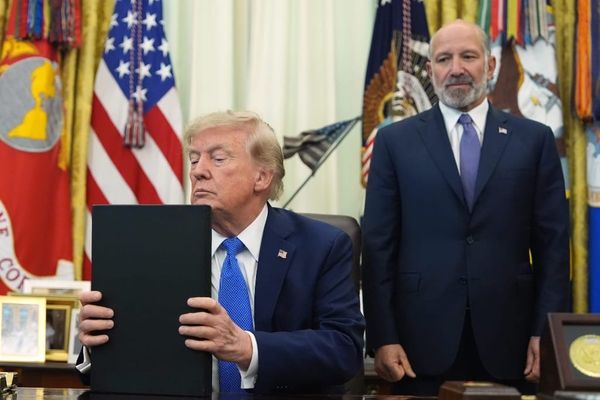
Lutnick Confirms No Effort to Rescind BEAD Non-Deployment Funds
Lawmakers pressed Commerce Secretary Howard Lutnick on why BEAD has not yet connected any households, ties to Jeffrey Epstein


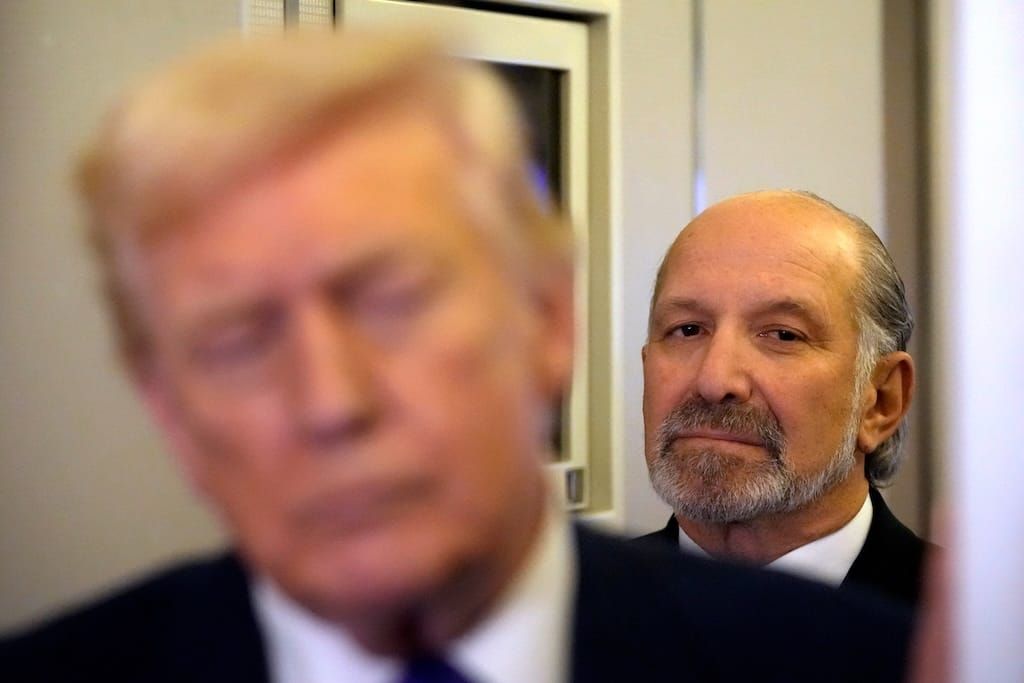
WASHINGTON, Feb. 10, 2026 – Commerce Secretary Howard Lutnick touted the Trump administration’s success in halving the $42 billion price tag for broadband deployment under the BEAD program, and confirmed that the government has no intention of keeping states from receiving all allocated funds–non-deployment as well as deployment.
But lawmakers pressed Lutnick on why the Broadband Equity, Access and Deployment program has not yet connected any households, how quickly states can move from approved plans to funding, and what NTIA plans to do with more than $20 billion in uncommitted dollars.
Democratic senators also extensively questioned him on his ties to the disgraced former financier Jeffrey Epstein.

 Broadband Breakfast
Of the $42.5 billion originally allocated to the BEAD program under the Infrastructure Investment and Jobs Act, about $21 billion has been approved for infrastructure expenditures by the National Telecommunication and Information Administration, a Commerce Department agency.
There’s been some question about whether the administration, and Lutnick in particular, might seek to claw back the other $21 billion. Asked specifically about that by Commerce, Justice, Science Appropriations Subcommittee Chairman Jerry Moran, R-Kan., Lutnick said the money will not be returned to the Treasury: “That is not the plan.”
As to eligible uses, Lutnick encouraged participation in the NTIA’s Wednesday listening session.
“We're listening to what are the best ideas to spend that money. We are going to spend that money, that money you have appropriated, and we're going to use the best ideas. Money will be approved in alignment with the statute.”
Focus on reducing costs
Lutnick told lawmakers the department’s approach has centered on reducing costs and accelerating execution through changes, announced in June, called the “Benefit of the Bargain” round. Now, Lutnick said, the program is technology neutral and structured around competition across eligible technologies.
That means the program will fund “fiber, where fiber makes sense, fixed wireless where it works better, satellite where geography demands it.” Companies receiving funds must still meet statutory performance standards, he said.
Lutnick pointed to Louisiana as an example of cost savings under the revised approach, describing a shift from an earlier projection of more than $1.3 billion to a plan of less than $500 million, or 63 percent less.
According to the revised plan, as approved, Louisiana will fund 127,108 locations, with fiber serving 81 percent, low-Earth orbit satellites serving 8 percent, and fixed wireless serving 6 percent, and cable or other deployments serving 5 percent.
Lawmaker questions on broadband
Lutnick repeated that the NTIA has approved 50 of 56 state and territory final proposals and described the remaining approvals as close.
He outlined a sequence in which NTIA negotiates approvals, states complete grant paperwork, states sign grant documents, and then begin drawing funds.
Multiple senators raised questions about the unspent non-deployment dollars, particularly as NTIA revised state infrastructure spending downward. Moran cited his state, Kansas, of a state that will spend only 37 percent of originally allocated funds.
Technology choice and vendor performance also came up repeatedly. Senators raised concerns about whether certain technologies are suitable in specific geographies and how states should respond if a provider attempts to change terms after an award.
In one exchange related to SpaceX and Starlink, Lutnick said a proposed “rider” sent to states was outside the program’s guidelines and statute and would not be accepted, adding that states would be able to pursue alternative execution if a provider could not proceed without changes.
In addition to deployment mechanics, lawmakers discussed permitting, pole access, and other barriers that can slow construction timelines, especially in rural and hard-to-reach areas.
Most of the hearing focused on Lutnick’s Epstein tides
Under questioning from Democrats, Lutnick acknowledged that he had met with Jeffrey Epstein twice after his 2008 conviction for soliciting prostitution from a child, reversing Lutnick's previous claim that he had cut ties with the late financier after 2005.
Lutnick again downplayed his relationship with the disgraced financier who was once his neighbor in New York City as he was questioned by Democrats during a subcommittee hearing of the Senate Appropriations Committee. He described their contact as a handful of emails and a pair of meetings that were years apart.
“I did not have any relationship with him. I barely had anything to do with him,” Lutnick told lawmakers.
But Lutnick is facing growing scrutiny, including calls for his resignation, from lawmakers after the release of case files on Epstein contradicted Lutnick's claims on a podcast last year that he had decided to “never be in the room” with Epstein again after a 2005 tour of Epstein's home that disturbed Lutnick and his wife.
The commerce secretary told senators Tuesday that he and his family actually had lunch with Epstein on his private island in 2012 and he had another hour-long engagement at Epstein's home in 2011.
Lutnick is the highest-profile U.S. official to face bipartisan calls for his resignation amid revelations of his ties to Epstein. His acknowledgement comes as lawmakers are grasping for what accountability looks like amid the revelations contained in what's known as the Epstein files.
In countries like the United Kingdom, the Epstein files have triggered resignations and the stripping of royal privileges, but so far, U.S. officials have not met the same level of retribution.
White House press secretary Karoline Leavitt said Tuesday that Lutnick “remains a very important member of President Trump's team, and the president fully supports the secretary.”
Some Republicans raised concerns about Lutnick and Epstein
During the hearing, Moran, the subcommittee chairman, stuck to questions about BEAD.
But several Senate Republicans raised questions about Lutnick's relationship with Epstein. Sen. Roger Wicker, R-Miss., said the visit to Epstein's private island “would raise questions.” And Sen. Thom Tillis, R-N.C., told reporters, “It's something I'm concerned with.”
Senate Majority Leader John Thune did not mention Lutnick by name, but told reporters Tuesday that those mentioned in the Epstein files are “going to have to answer questions around that.”
“I think the American people are going to have to make judgments about whether or not they think those answers are sufficient,” added Thune, a South Dakota Republican.
Associated Press Reporter Stephen Groves contributed to this report.