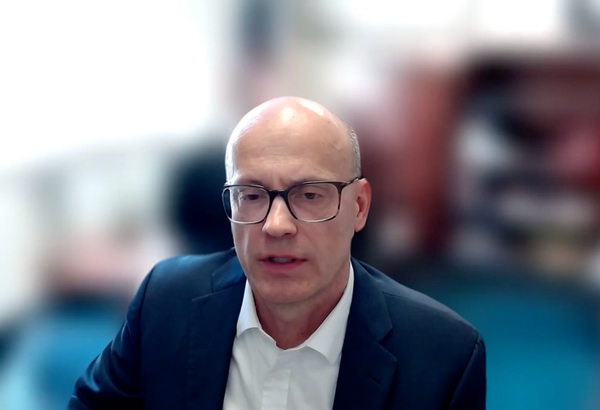
Mariam Sorond: America Has No GPS Backups. Fixing That Should Be About Engineering, Not Politics
A telecom executive urges Congress not to block FCC review of a spectrum proposal meant to give America a backup to GPS.


Commercial pilots flying near conflict zones watched their instruments report positions miles from where they knew their airplanes actually were, while also navigating ground proximity alarms triggering unexpectedly. In parts of the Middle East, consumers are struggling with food delivery, ride-sharing, and countless other apps that depend on accurate location data. In Finland, soldiers are relearning how to navigate with paper maps.
The culprit is Global Positioning System (GPS) jamming and spoofing, a disruption of the satellite signals that are foundational to modern life. Except this threat isn’t just confined to far-off war zones. Airports in Dallas, Denver, and New Jersey have each experienced high-profile GPS disruptions. Solar storms have impacted GPS signals, affecting farming from Minnesota to Nebraska at the height of planting season. In America, GPS underpins everything from emergency response and critical infrastructure to finance, energy, logistics, and the smartphones we carry every day, and we are incredibly reliant on it.

GPS is a national treasure, but it is also one constellation of satellites, and that one constellation is a single point of failure. A GPS disruption hitting multiple sectors at once would result in a cascading crisis of epic proportions.
China and Russia built terrestrial backups years ago, but America still hasn’t. Leaders on both sides of the aisle, from President Trump to Senators Ted Cruz and Ed Markey, agree that action is needed now. During his first term, President Trump signed an executive order to strengthen Positioning, Navigation, and Timing (PNT) resilience, and the current Federal Communications Commission (FCC) has made closing this gap a priority.
When the FCC initiated a Notice of Inquiry on PNT technologies, Chairman Carr called for “a whole-of-government approach” and said the “FCC is stepping up to do its part.” He has championed a system of systems and recently said, “we have to move quickly to support the private sector's innovation and stand up of complementary and supplementary systems.” The Chairman has also said, “We want everyone with technology that could complement GPS to get a fair shot at any regulatory changes they might need.”
That last phrase matters because the debate in Washington has recently been cast as a false choice – either the country protects the businesses already operating in a given slice of spectrum, or it builds a complement and backup to GPS.
My company has a petition before the FCC to use the spectrum licenses we paid for in the lower 900 MHz band to enable a ground-based complement and backup to GPS. Our proposal is not an either-or; it is a win-win. Toll operators, railroads (licensed users), and retailers, airlines, and the security industry (unlicensed users) also use the band to support important operations, and they deserve confidence that their equipment will keep working. At the same time, America urgently needs a complement and backup to GPS that solves our national security vulnerabilities.
We strongly believe that the two can coexist, and the evidence proves it. Our extensive studies and engineering work, submitted to the FCC, show that licensed and unlicensed users can continue operating alongside a ground-based 5G-powered 3D PNT solution. We have run public demonstrations showing RFID readers and security systems working without disruption. We have also committed to reasonable accommodations for licensed users, including financial and technical support to facilitate a smooth transition to an optimized lower 900 MHz band plan.
But we are not asking anyone to take our word for it. We are asking that the FCC expert engineers engage in a rigorous, proven process, study the issues, and evaluate the evidence in the record. Unfortunately, an amendment attached to a House appropriations bill would bar the FCC from taking this next procedural step, a Notice of Proposed Rulemaking (NPRM). An NPRM allows the FCC to closely examine the public technical record, evaluate interference and coexistence claims, and come to evidence-backed conclusions. Blocking the FCC from doing its job does not settle the question of whether coexistence works. It just prevents anyone from finding out.
Every spectrum proceeding in American history has drawn opposition, because the airwaves are finite and change is hard. But the wireless economy that put a smartphone in every pocket was built by an expert agency working patiently through each of those conflicts, one engineering analysis at a time. If a contested FCC proceeding can now be killed before the engineering is even reviewed, then mere opposition becomes sufficient to stifle innovation. If opponents cannot win on the engineering merits, they can simply stop the process before the facts are evaluated.
When I testified before the House Energy and Commerce Committee’s Subcommittee on Communications and Technology, my message was simple. America needs a complement and backup to GPS, and the FCC should be allowed to do what it has done for decades. Build a technical record, examine competing claims, and let the evidence decide.
The lower 900 MHz band can continue to operate as it does today, and America can finally develop the complement and backup to GPS it has lacked for far too long. It doesn’t have to be an either-or because it's actually a win-win.
Mariam Sorond is the Board Chair and Chief Executive Officer of NextNav (Nasdaq: NN), where she leads the development of groundbreaking terrestrial 3D positioning, navigation, and timing (PNT) solutions to backup and complement GPS. Her work addresses a vital national security imperative: strengthening the nation's PNT infrastructure to ensure continuity and precision in critical applications. With nearly three decades of experience spanning mobile, wireless, fixed, and satellite networks, Mariam brings a rare combination of technical depth and strategic leadership to the role. Prior to joining NextNav, she held senior executive positions at VMware, CableLabs, and DISH Network, driving innovation across 5G, broadband, and edge technologies. She has also served in key advisory roles for the NTIA and FCC, helping shape spectrum policy and communications infrastructure, and is currently on the Board of Directors at CTIA, the wireless industry association. This Expert Opinion is exclusive to Broadband Breakfast.
Broadband Breakfast accepts commentary from informed observers of the broadband scene. Please send pieces to commentary@breakfast.media. The views expressed in Expert Opinion pieces do not necessarily reflect the views of Broadband Breakfast and Breakfast Media LLC.