Maryland’s Single View Platform Enhances Broadband Development
Officials say platform supports visibility of statewide broadband assets.

Kelcie Lee
WASHINGTON, Jan. 28, 2026 – Maryland’s newly established Single View platform supports visibility of statewide broadband assets, helping officials plan projects faster, spend smarter, and coordinate with private providers, making it a national model in public-sector broadband development.
On Wednesday’s Fiber for Breakfast hosted by the Fiber Broadband Association, Eric Bathras, CTO of Office of Infrastructure at the Maryland Department of Information Technology, shared the most recent updates on Single View, and future plans to build out the program.
Through Bathras’ experience working at ACOM, he noticed large gaps in states’ ability to navigate all its broadband and digital infrastructure assets, especially in the public sector. As a result, he joined an effort of drafting a state executive order that would establish a solution to this problem.
On Jan. 7, Maryland Gov. Wes Moore signed the executive order to establish the Digital Infrastructure Group (DIG) to streamline development of broadband infrastructure and bring agencies that owned broadband assets together.
“We are uniquely positioned to lead the nation’s first state Digital Infrastructure Group,” said DoIT Secretary Katie Savage. “Our in-house expertise combined with cutting-edge geospatial platforms and existing infrastructure will give us the tools to plan and coordinate infrastructure development effectively. We will transform from a reactive and uncoordinated system to one that optimizes taxpayer dollars and even gives the State opportunities to boost revenue from major ISPs and cellular carriers.”
This led to the creation of Single View, which put together a statewide approach for broadband development as opposed to individually, according to Bathras.
Single View surrounded four key pillars in what DIG calls the “Goldilocks approach,” which include transportation variables, vertical assets, government institutions and community needs. These pillars make it easier to serve the broadest of needs with one just-right public investment, instead of fragmented, agency-by-agency spending that duplicates infrastructure and limits greater public benefit.
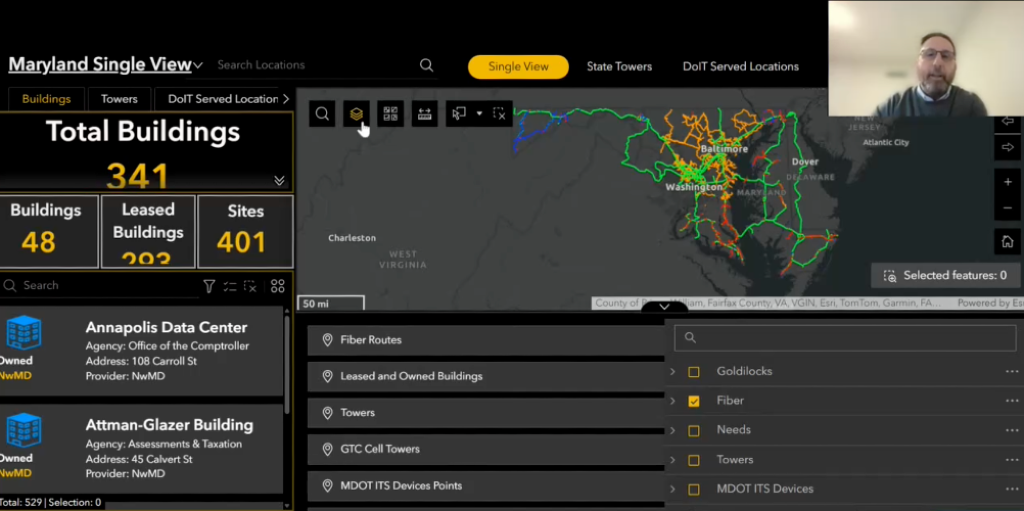
Bathras demonstrated Single View’s use, which is only for the use of DIG, including the aerial map of Maryland’s private and public sector towers, as well as information on the owner, vendor, generator type and height of the towers. Bathras highlighted the importance of a central tower management platform for potential funding and tower initiatives, such as getting fiber to multiple towers.
The program also features a heat map of underserved areas in the state where developers can focus on building new infrastructure projects, along with color-coded locations of Community Anchor Institutions and Intelligent Transportation Systems. This allows the state to identify projects that can achieve each key pillar in order to maximize each public dollar investment.
Beyond Single View’s current use, Bathras said the DIG is working on optimizing artificial intelligence within the platform to fast-track infrastructure projects. By telling AI chatbots the Goldilocks approach and pillars, it could recommend development that would take into account these priorities, while also providing information on projected costs, route recommendations and detailed plans.
The DIG is also looking into future opportunities for Single View, including operational management in a snow storm or another major event that could affect power and incorporating utility-related information. Single View can currently distinguish between aerial and underground infrastructure, but is continuing to work with partners on what data points regarding utility assets might be included on the platform.
Member discussion