White Paper
Negative Impacts of Higher Power Operation on the Citizens Broadband Radio Service
White Paper Provided by Spectrum for the Future
Executive Summary
Valo Analytica conducted this technical analysis to evaluate the harmful impacts of increasing allowed power levels in the Citizens Broadband Radio Service (CBRS). The findings of this technical analysis are clear: increasing CBRS transmission power would dramatically increase harmful interference levels, thereby disrupting the carefully calibrated CBRS ecosystem, reducing how many network operators can co-exist in the band, and effectively overpowering and undermining existing PAL and GAA operators’ ability to use the band. In other words, as a result of increased power levels, the diverse and fast-growing array of operators using the CBRS band today would be reduced to a fraction.
This analysis uses actual CBRS deployment data combined with additional details from representative real-world CBRS deployments at John Deere (manufacturing), Miami-Dade International Airport (transportation & logistics), and Amplex Internet (rural broadband). In each case, the interference from increased power levels is clear and would cause massive throughput erosion, shrink private network coverage, and fundamentally undermine the spectrum access and innovation the CBRS band was carefully designed to foster.
Key Top-Level Findings
High-power operations will harmfully disrupt existing operations of both Priority Access Licensees (PAL) and General Authorized Access (GAA) operators.
- If fewer than 2% of CBRS base stations are converted to high power, there would be a massive loss of data throughput across the CBRS ecosystem, a permanent data loss that would slow network operation to a crawl.
- Each high-power device deployed in the band would dramatically and disproportionately preempt shared use across as much as thousands of square kilometers, undermining the availability of GAA spectrum upon which 96% of existing CBRS operations rely.
- If deployed, higher power levels will overwhelm existing operations in a manner that neither the existing technology (e.g., SAS) nor current FCC rules are equipped to manage. As a result, CBRS license holders will face catastrophic service degradation on the channels they paid to secure at auction. The negative impacts would be felt all across the CBRS networks used by so many, including those used in Education, Academic Research, Agriculture, Communications, Healthcare, Hospitality, Manufacturing and Transportation.
When applied to real-world deployments, higher power levels in this study were shown to have the following illustrative impact:
- As a result of higher power, John Deere's CBRS deployment would incur a 1000x degradation of throughput and latency, rendering substantial portions of their network used in their American manufacturing facility unusable. Further, CBRS network coverage in their office facility would shrink from its current facility-wide multi-acre coverage to an area smaller than what is covered by a pair of wireless ear buds.
- Miami International Airport (MIA) risks losing nearly a third of its CBRS network capacity if higher power is allowed. Given that MIA uses its network extensively for security, public safety offload, identification of foreign object debris on the tarmac, baggage handling, and even Customs and Border Protection operation, the loss of such network capacity would be "catastrophic."
- Amplex Internet, a rural Wireless Internet Service Provider in Ohio, represents a real-world cautionary tale of the harmful impact of higher power on CBRS networks. Due to Canadian operations today at power levels comparable to those proposed for CBRS, parts of its network are already suffering from network outages and a loss of network reliability - disrupting the ISP's service to a significant portion of its customer base. As a result of higher power, Amplex’s rural customers lose their Internet connectivity as their previously stable wireless broadband links are overwhelmed by high power from up to 200 km away.
Background
With commercial operations since January 2020, the Citizens Broadband Radio Service (CBRS) represents a landmark innovation in America's wireless policy, serving as the world’s first large-scale implementation of a dynamic, three-tiered spectrum sharing framework. Over 1,000 different operators— ranging from traditional carriers to non-traditional players like private enterprises and municipalities— currently utilize the band and have deployed more than 430,000 base stations. Remarkably, CBRS has proven that commercial operations can coexist seamlessly with high-priority U.S. military radar systems, with zero reported instances of interference to date. This innovation band has become a catalyst for digital transformation across a wide array of sectors, powering mission-critical applications in manufacturing, aviation, agriculture, and hospitality, while simultaneously expanding the reach of both fixed and mobile broadband.
At its core, CBRS can support such a massive and diverse ecosystem of operators because of its carefully calibrated power limits. These power limits were specifically engineered for dense small cell deployments, not traditional high-power macro towers. Unlike standard mobile broadband bands where a single base station mounted high on a tower might “shout” across miles—effectively drowning out other potential users—CBRS rules established significantly lower power levels in order to accommodate multiple operators, not a select few. As a result, the band ensures that a manufacturing plant, a rural ISP, and a municipal airport can all operate their own private networks in the same area without interfering with one another, or the military. It was under these carefully developed technical parameters that CBRS operators invested significant resources and developed business plans to deploy CBRS networks.
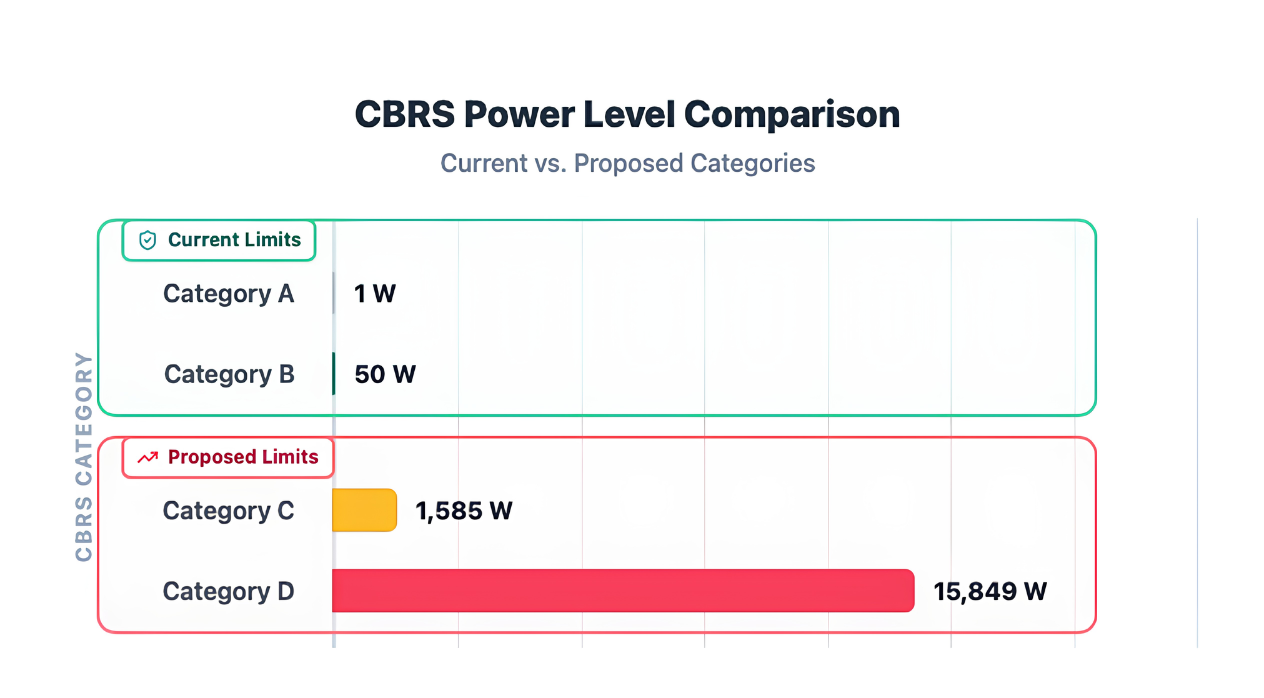
While CBRS has been widely deployed and is growing rapidly, some national cellular carriers have suggested that the FCC implement significantly higher transmit power levels in the band. In sum, such a proposal seeks to raise allowable power levels by 32 times (“Category C”) and 320 times (“Category D”) compared to the existing power limits. As demonstrated in this study, such a fundamental change would effectively dismantle and undermine the small-cell architecture that defines the band today and that is responsible for the many varied users who currently coexist within the ecosystem.
By looking at three distinct CBRS deployments, this study quantifies and illustrates the widespread disruption to existing CBRS operations if the FCC allows high-power macro-cellular devices to enter the 3.5 GHz band. As part of the study, a "Shadow Spectrum Access System” (Shadow SAS) analysis was conducted, which involved emulating a production SAS and running standards-compliant algorithms against actual registration data from over 430,000 active CBRS devices. This technical simulation was then used with three real-world CBRS deployments—John Deere manufacturing, Miami International Airport, and Amplex Internet—to demonstrate how higher power levels would cause massive throughput erosion, shrink private network coverage, and fundamentally undermine the spectrum access and innovation the CBRS band was designed to foster.
Shifting to a macro-cellular power model fundamentally undermines the innovation, enhanced throughput from spectrum reuse, and wireless competition that CBRS has fostered. By transforming a highly efficient spectrum band supporting many users into a restrictive environment dominated by a few high-power “megaphones,” higher-power operations threaten to render a wide array of critical industrial and enterprise networks unusable. CBRS network investment and business plans would be stranded and undermined. To ensure that America continues to lead in both nationwide 5G, private wireless networks, and localized industrial innovation, policymakers should resist calls for high-power operations in CBRS that would only unwind the substantial innovation and competition that this spectrum band has delivered to date.
1. Introduction
The FCC established the Citizens Broadband Radio Service (CBRS) to address the nation's growing demand for wireless capacity, promote technological innovation and competition, and pioneer a new model of dynamic spectrum sharing.1 Also called the “innovation band,” CBRS was designed with the objective to provide localized service using relatively low-power base stations, which results in maximizing deployment flexibility, spectrum re-use, and use case diversity.2 This objective has been met as a result of CBRS’s unique three-tier “use-or-share” sharing architecture combined with options to acquire relatively cost-efficient licenses that cover small service areas, or even to access spectrum on an opportunistic “as needed” basis.
Despite its success to date, some have now suggested to significantly increase the maximum transmit power of the relatively low-power base stations to be on par with typical macro-cellular base stations that are allowed to operate at power levels which are tens to hundreds of times higher than CBRS.
There is strong concern in the CBRS community that allowing high-power base stations to operate in the CBRS band would fundamentally alter the localized "low-power, small-cell" nature of the band, causing widespread interference that would disrupt existing operations, business plans, and investment, crowd out users, and potentially impair federal incumbent protections. Many of these existing CBRS operations support critical functions for manufacturing, private networks, and wireless Internet access.
In this study, we use actual CBRS deployment data3 combined with rules- and standards-compliant Spectrum Access System (SAS) algorithms to show that proposals to allow CBRS base stations (called Citizens Broadband radio Service Devices, or CBSDs) to operate at power levels tens to hundreds of times greater than currently allowed will predictably disrupt the fundamental nature of the band. As a result of higher power, significantly higher levels of interference would occur over long distances and would knock some stations off the air completely. Reliability and functionality of CBRS operations would be impaired and reduce the amount of spectrum geography available to support hundreds of thousands of existing critical CBRS deployments.
These conclusions are based upon detailed technical analyses conducted by experts in the rules and industry standards employed in CBRS,4 and supported by real-world experiences of CBRS users as illustrated by the following three specific use cases:
- Miami International Airport (MIA). MIA utilizes CBRS for a variety of purposes including Customs and Border Protection operations, surveillance, ramp monitoring, and baggage handling. The airport relies upon the localized nature of current CBRS power rules to manage coexistence with external interferers outside of its 3,230-acre property. Higher-power CBSD operation would result in MIA losing almost one-third of its network capacity if even a single high power CBSD were located almost anywhere in the Miami metropolitan area. This threat is manageable under current CBRS power limits. Discussions with one of MIA’s network engineers indicates that the loss of so much capacity due to higher power would be “catastrophic” to their operations.
- John Deere. Deere uses CBRS extensively at its Midwest manufacturing and office facilities for purposes as varied as control of autonomous mobile robots, computer vision on manufacturing lines, and replacement of wired infrastructure. Under existing CBRS rules, external interference has already occasionally caused network disruption on certain CBRS channels, but such interference has been manageable. Increasing the power of external transmitters by a factor of tens to hundreds would only exacerbate and compound existing challenges and render coexistence efforts hopeless, a result identified by network administrators as being (as with MIA) “catastrophic” to their operations. The Company would be left with little choice but to abandon their existing CBRS network deployment and investment and seek alternative (and likely more costly) solutions.
- Amplex Internet. Amplex is a wireless internet service provider (WISP) that delivers internet access over CBRS to homes and businesses in northern Ohio. Certain portions of their network operate in relatively close proximity to the Canadian border where high-power 3.5 GHz operations in Canada already exist in the same frequency band as CBRS. As such, Amplex’s existing network deployment and operational challenges due to these currently present high-power operations provide a helpful real-world case study of the perils of higher-power operations in the band. In sum, the high-power 3.5 GHz macro cells in Canada are causing substantial interference to Amplex’s radios over a distance of at least 80-200 km, resulting in repeated disruption to internet service for 50% or more of its customers on certain base stations that point towards Canada. Implementing such higher-power operation throughout the CBRS footprint in the United States would result in similar network degradation and loss in network reliability on a much larger and more widespread scale.
These use cases are not intended to be exhaustive given that CBRS is used in a wide range of different ways. Rather, these use cases were chosen to better illustrate the devastating impact to existing operations that would be caused by the introduction of higher-power operations. As the study demonstrates, the negative externalities of such higher power would extend into the operations of both GAA and PAL licenses. The broad impact to both GAA and PAL operations is not surprising since numerous CBRS networks were designed and deployed with the understanding that both PAL and GAA could be used and deployed together to provide a cost-efficient localized network for end users.
Substantial disruption in the operation of one tier of CBRS access has cascading negative effects on the other.
Based on our analysis, the clearest impacts of higher-power operation arise from two effects:
- Substantial growth in the geographic size of PAL Protection Areas (PPAs),5 which, by rule, causes immediate termination of co-channel GAA grants in the newly enlarged areas and potentially reduced power for other operations in the area to meet aggregate interference protection levels; and
- Increased levels of interference, potentially from hundreds of kilometers away. In some cases, interference can arise from nearby CBSDs operating on adjacent channels, which current FCC rules and SAS standards are not equipped to manage, even for PALs.
On a nationwide scale, the impact of the larger PPAs on GAA availability will be substantial. Note that over 96% of CBSDs rely on GAA. In addition to GAA-only operators, almost all PAL devices also use GAA spectrum to meet their aggregate bandwidth needs. Using an analysis of existing PAL channels in use by currently-deployed CBSDs and comparing PPAs at current power levels to those that would be created at higher power, we find that on average Category C PPAs would be almost twice as large, and Category D would be about three times as large, blocking co-channel GAA use and causing power reductions for PAL and GAA operations in surrounding areas, across correspondingly larger geography. These impacts will reverberate among the dozen or more broad sectors that today rely on a functioning CBRS ecosystem under existing power limits.
The study also identifies multiple ancillary impacts to the CBRS ecosystem that would be caused by higher-power operations.
2. Context
CBRS provides broadband access to American citizens and businesses while sharing radio spectrum with critical military systems and commercial satellite earth stations on a non-interference basis. The CBRS model provides opportunities for both traditional and non-traditional operators to offer fixed and mobile broadband services on a shared-spectrum basis. It also allows for offices, factories, and other enterprise users to economically deploy their own LTE and 5G (and eventually 6G) private networks to support localized, secure, and resilient communications.
CBRS operates under a unique three-tiered spectrum use rights architecture based on interference protections (see Figure 1 and the interference management matrix in Annex C). The top tier consists of incumbent government and commercial satellite earth station operations, which are always protected from interference caused by CBRS. The second tier is CBRS Priority Access License (PAL), and the third tier is opportunistic CBRS General Authorized Access (GAA). PAL is licensed by county6 and must protect incumbents from interference. PAL receives interference protection from co-channel GAA, and from co-channel PALs in neighboring license areas if they are owned by a different licensee. GAA must protect incumbents and co channel PALs. GAA users receive no interference protection from PAL or other GAA users.
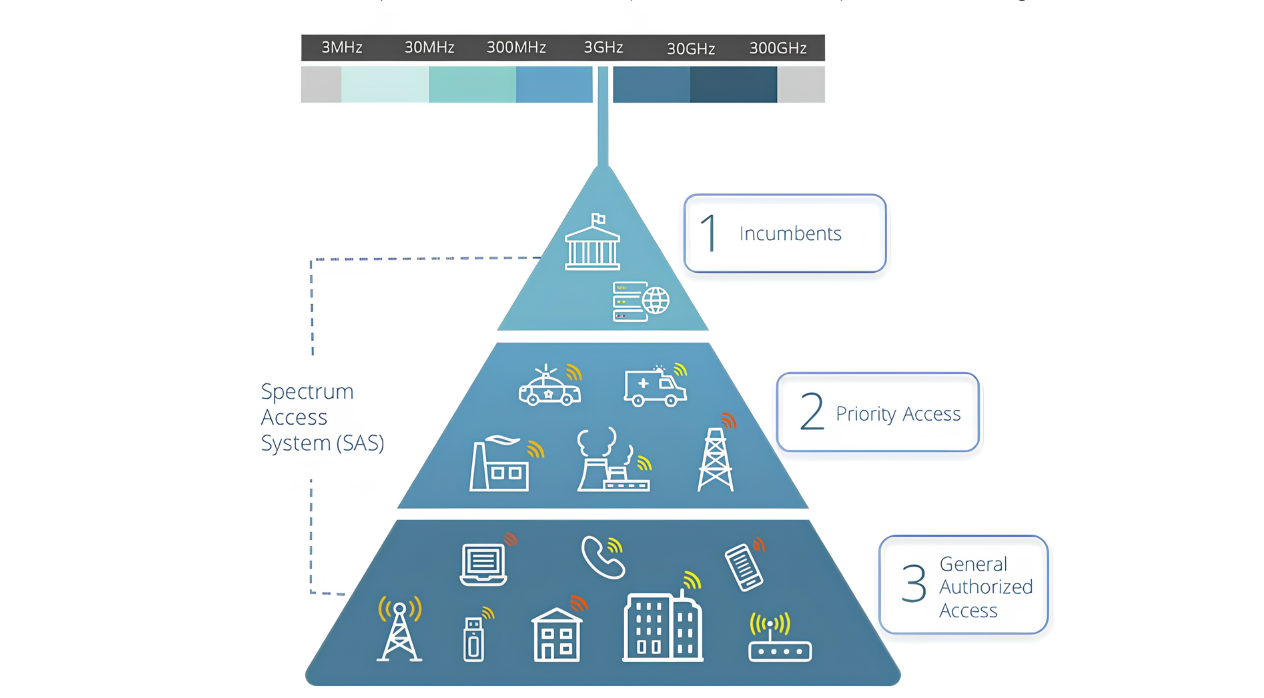
In the FCC’s rules – and therefore in SAS implementations – there are no adjacent channel protections between CBSDs for either PAL or GAA. (Please see Annex C for a summary of interference protection rights in CBRS).
Central to CBRS is its “use-or-share” principle. Within a PAL’s designated license area, GAA users are allowed to use the PAL’s channel as long as the aggregate interference doesn’t exceed an FCC mandated interference protection criterion within defined PAL Protection Areas (PPAs) surrounding the PAL’s operating CBSDs (please refer to Annex A). Note that co-channel GAA operations are not allowed inside of a PPA. This restriction is strictly enforced by the SAS. Even outside a PPA, co-channel GAA and PALs belonging to other licensees may need to restrict their transmit power to meet the interference criterion inside the PPA.
CBRS operators (both GAA and PAL) make very good use of GAA. Currently, over 96% of all CBSDs use GAA spectrum to provide service. Almost two-thirds (64%) use GAA spectrum only, one third (33%) use both GAA and PAL. Only a small fraction (less than 4%) operate using PAL channels only.7 From a bandwidth perspective, 80% of CBRS use is on GAA spectrum grants, and 20% is on PAL grants.8
CBRS operations are coordinated through a centralized Spectrum Access System (SAS). The SAS knows where and when the military is using particular frequencies, as well as the locations and protection parameters of the satellite earth stations, and manages CBSD operation so as not to interfere with either set of incumbents.
Each CBSD must first register with a SAS before transmitting, providing its location, desired frequencies, and desired power. The SAS then determines the available frequencies and transmit powers that the CBSD can operate on that will not cause interference to the incumbents or, as appropriate, to CBSDs operating under a PAL. If a PAL brings a device into service, its PPA contour is computed, and the appropriate protections are enforced against other CBSDs operating on the same channel in that area. All CBSDs must subsequently check in with a SAS on a regular basis to make sure it is still clear to transmit (for example, incumbent military radar has not begun operating in the area, or a PAL has not come on line). Depending on where the CBSD is located with respect to incumbent military operations, this check in or “heartbeat” process happens on a timescale ranging from a couple of minutes (generally in coastal areas where the Navy radar operates on a dynamic basis) to several hours (in the interior of the country away from the coasts or any other military radar facilities).
Two different categories of CBSDs are defined by the FCC. The first type, Category A, is a lower-power device that may be used indoors at any height, or outdoors if their antenna is at or below 6 meters (approximately 20 ft). The second type, Category B, is higher power than Category A, may only be used outdoors and has no antenna height restrictions.
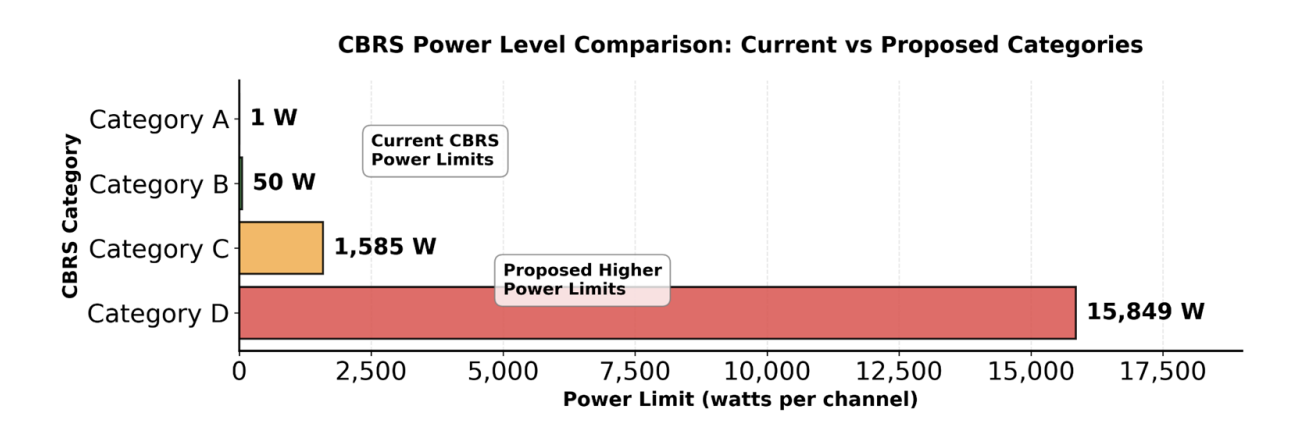
The FCC’s rules limit the transmit power that may be used by CBSDs. Category A CBSDs are limited to 1 watt (1 W) per 10 MHz of spectrum (0.1 W per MHz), while Category B CBSDs are limited to 50 W per 10 MHz (5 W per MHz). The nominal channel size in CBRS is 10 MHz, but most CBSDs aggregate more than one channel, and are therefore allowed proportionately greater total transmit power, but must always respect the maximum allowed power per MHz of spectrum. These power limits are expressed in Effective Isotropic Radiating Power (EIRP), which takes the gain of the antenna into account when determining transmit power. In setting these power limits (and rejecting requests to set them higher), the FCC noted that “lower power limits may lead to greater spatial reuse of the band, reduced coexistence challenges, and increased aggregate network capacity”.9 The case studies presented in this document show that actual CBRS users rely on this lower-power characteristic of the band.
Higher-power CBSD operation was first proposed by T-Mobile in a Petition for Rulemaking filed in June 2017.10 In denying T-Mobile’s request, the FCC argued that relitigating power limits would upset the balance struck between incumbents and new users and noted that even at that early stage, significant investment had already been made in reliance on the existing rules, and changing power limits would require re-evaluating exclusion zones and delay commercial deployment.11 T-Mobile has since backed off their support for higher-power CBRS operation.12
In May 2019, AT&T filed with the FCC proposing a new Category C CBSD with max EIRP of 1585 W per 10 MHz.13 Dish followed in March 2021 proposing a new Category C max EIRP of 1585 W per 10 MHz and a Category D max EIRP of 15,849 W per 10 MHz.14 These power levels are roughly 32 and 320 times the current maximum (Category B) power limits respectively (see Figure 2).
While the FCC’s most recent CBRS Notice of Proposed Rulemaking (NPRM) was largely focused on procedural and administrative updates to the band, it also requested comments on these petitions. The NPRM again noted that the FCC’s objective regarding CBSD power rules is to “balance the public interest objectives of providing greater flexibility to operators against the need to ensure efficient use of the spectrum to create a flexible regime suitable for a wide variety of use cases.”15
3. Case Studies
We identified three case studies that represent some of the diversity of CBRS use in order to examine the potential impact of higher-power CBRS operation on existing CBRS deployments. These case studies cover three key application areas: manufacturing, private networks, and wireless internet access. The analysis is based on discussions with the respective operators, deployment details provided by the operators, considerations regarding current CBRS deployments by other operators in the areas, and simulations of the impacts of surrounding operators potentially converting to higher-power operations. While these case studies are based on specific deployments, we believe that the conclusions reached with regard to the negative impacts of high-power CBRS operations would apply more broadly to most if not all of the CBRS ecosystem.
A. John Deere Manufacturing Facilities
Bottom line: John Deere uses CBRS extensively for manufacturing, logistics, and office operations. They hold PAL licenses and, like most PALs, also utilize GAA. Under existing rules and power levels, their network engineers have seen some throughput and latency degradation due to external co-channel interference but they have managed to engineer around such problems. However, if the external interference were increased in power by up to 320 times, the situation becomes intolerable and their network unusable. Analysis shows that any high-power Category C CBSD within approximately 10-20 km of their manufacturing facility would terminate their co-channel GAA grants outright. For Category D, this distance increases to 20-30 km, encompassing most of the surrounding populated area. In a specific case near their headquarters facility, if a nearby device were converted to Category C power, Deere’s co-channel private network’s coverage would shrink to a range of between 44-103 feet, and would no longer be able to cover Deere’s relatively compact office campus. If the interfering CBSD converted to Category D power, Deere’s co-channel network coverage shrinks to an area smaller than the reach of wireless earbuds. Even worse, the interfering signal exceeds blocking and adjacent channel protection levels, potentially causing interference to Deere’s “protected” operations on its PAL channel due to adjacent channel GAA interference. There is no regulatory or SAS-enforced remedy for adjacent channel interference. Higher-power operation would likely unleash a multitude of adjacent channel and blocking interference cases throughout the CBRS ecosystem, in addition to co-channel interference.
John Deere utilizes CBRS to deploy private networks across its manufacturing and distribution facilities. This technology is a cornerstone of their digital transformation, aimed at improving and better controlling operational technology logistics and factory efficiency.16
Deere's transition to private cellular networks via the CBRS band in particular is driven by the need to overcome the limitations of traditional wireless solutions in industrial environments. Key justifications for the transition include:
- Infrastructure Reduction: Private cellular allows for an 80% reduction in access points compared to other wireless solutions like Wi-Fi. For example, in an 800,000 sq. ft. area, Deere replaced 82 Wi-Fi access points with just 4 CBSDs, achieving a ~1:20 ratio.
- Reliability: A properly operating CBRS network eliminates connectivity loss and interference issues common in metal-heavy settings like warehouses with dense steel bins.
John Deere utilizes the CBRS band for a variety of logistics and manufacturing applications, including:17
- Autonomous Mobile Robots (AMRs): Used for material transport, order fulfillment, and warehouse automation.
- Fully Autonomous Tow Trucks: Automated towing vehicles that perform 1.5-mile round trips at Harvester Works.
- Computer Vision and Machine Learning (CVML): Enhancing navigation for automated guided vehicles (AGVs) and optimizing inventory management through wireless cameras and micro computing devices.
- Mobile Equipment: Ensuring "0-loss mobility" for conveyance systems, fork trucks, and scanners as they move throughout massive facilities like the 2.8 million sq. ft. North American Parts Distribution Center (NAPDC).
- Wired Infrastructure Replacement: Transitioning traditionally wired devices, such as shop floor PCs, printers, PLCs, torque controllers, and weld power supplies, to cellular connectivity.
Deere employs a Centralized Packet Core to manage RF designs and technology transitions. Their deployment strategy includes:
- Lab Testing: Recreating production issues and testing software updates or new hardware (UEs/CPEs) before field deployment.
- Validation: Performing on-site surveys and "Single Radio Head Walk Tests" to validate RF designs and Signal-to-Interference-plus-Noise Ratio (SINR) levels.
- Efficiency: The high reliability of CBRS allows Deere to move manufacturing processes around more flexibly and with limited installation time between transitions.
Deere does not support the proposed higher-power operations at Category C or D levels due to coexistence concerns.18
Implementing higher-power CBRS operations, specifically moving from existing limits to Category C or D power levels, would be "catastrophic" for John Deere's private industrial networks, according to Deere’s Technology Architect. These changes threaten to dismantle the delicate balance of the current three tiered sharing model, favoring large mobile operators at the expense of enterprise innovation.19
Our analysis shows that the shift to high-power macro cellular operations would introduce severe technical and operational challenges for Deere's facilities in Illinois and Iowa. The following impacts would be similar at other Deere locations utilizing CBRS:
- Destruction of Uplink Performance: High power signals from nearby commercial towers optimized for downlink-heavy mobile broadband (TDD Config 2) effectively "hammer" and destroy Deere's uplink-optimized private network performance (Configs 0 and 1). Deere has measured a 1000x reduction in throughput due to co-channel interference from external co-channel CBSDs, dropping speeds from 25-100 Mbps to mere kilobits per second, prior to implementing coexistence measures. If external interference power was increased by tens or hundreds of times, such mitigation measures would be rendered hopeless.
- Crippling Latency: The same co-channel interference from higher-power results in latency spikes increasing from the nominal range of milliseconds to exceeding one second, rendering mission-critical, time-sensitive applications—such as autonomous vehicles and real-time computer vision—completely unusable.
- Increased Penetration of External Signals: While Deere's thick concrete factory walls currently provide some protection, high-power Category C/D signals would easily penetrate these barriers, disrupting their indoor private networks that are essential for "smart factory" automation.
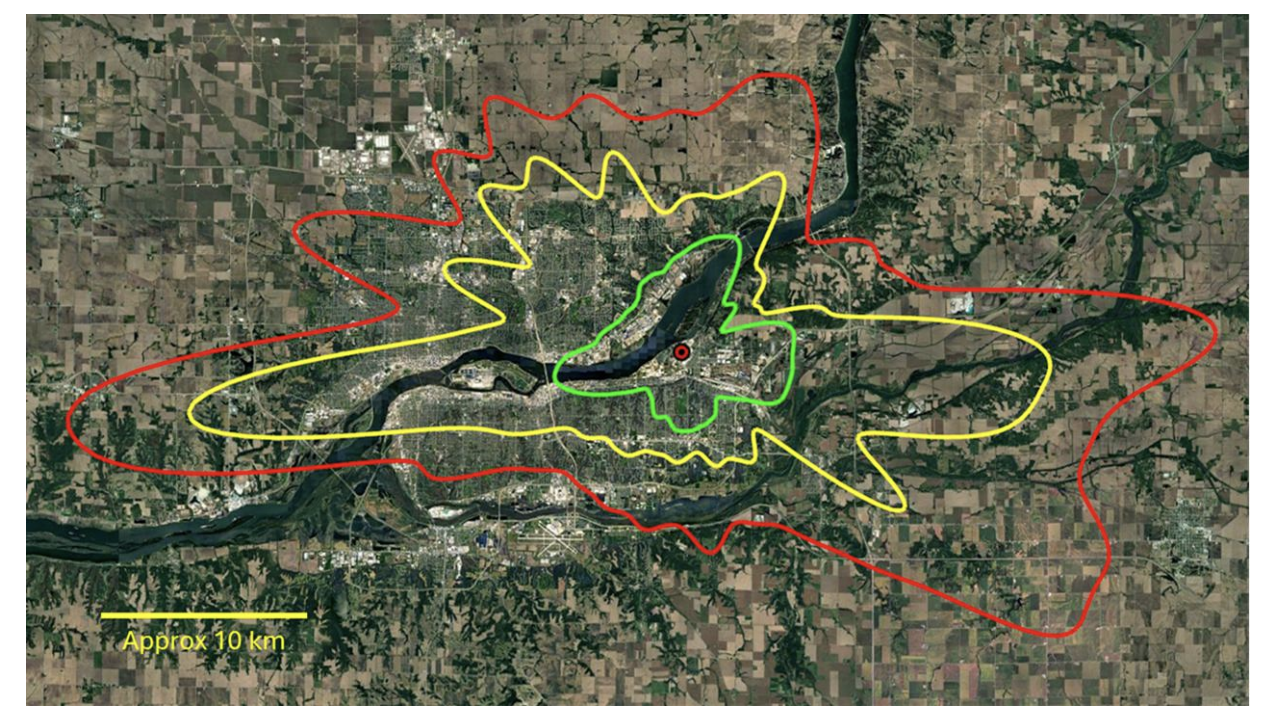
- Interruption of Operation: A single high-power PAL transmitter as far as 30 km away will block these channels currently being used in Deere’s network. Figure 3 shows the approximate areas where placement of a single Category B, C, or D PAL CBSD would automatically terminate any co-channel GAA grants at the Deere Moline manufacturing campus.20 The Category B separation is manageable (and is being managed today); the Category C or D impact areas are much larger and would be much more problematic, or even impossible, to manage. Besides causing termination of Deere’s GAA grants due to PALs within the contours, co-channel GAA operations anywhere in the contours will cause the same destruction of performance and latency discussed above, and these impacts will be due to much more distant high-power devices, not just the closer-in lower-power interferers that Deere is dealing with today.
- Infrastructure Obsolescence: CBRS investments are at risk of being "stranded" or rendered obsolete if the framework is altered to prioritize macro-cellular use, forcing Deere (and other enterprises) to return to less reliable wired or Wi-Fi solutions and/or abandon advances enabled by private cellular technologies.
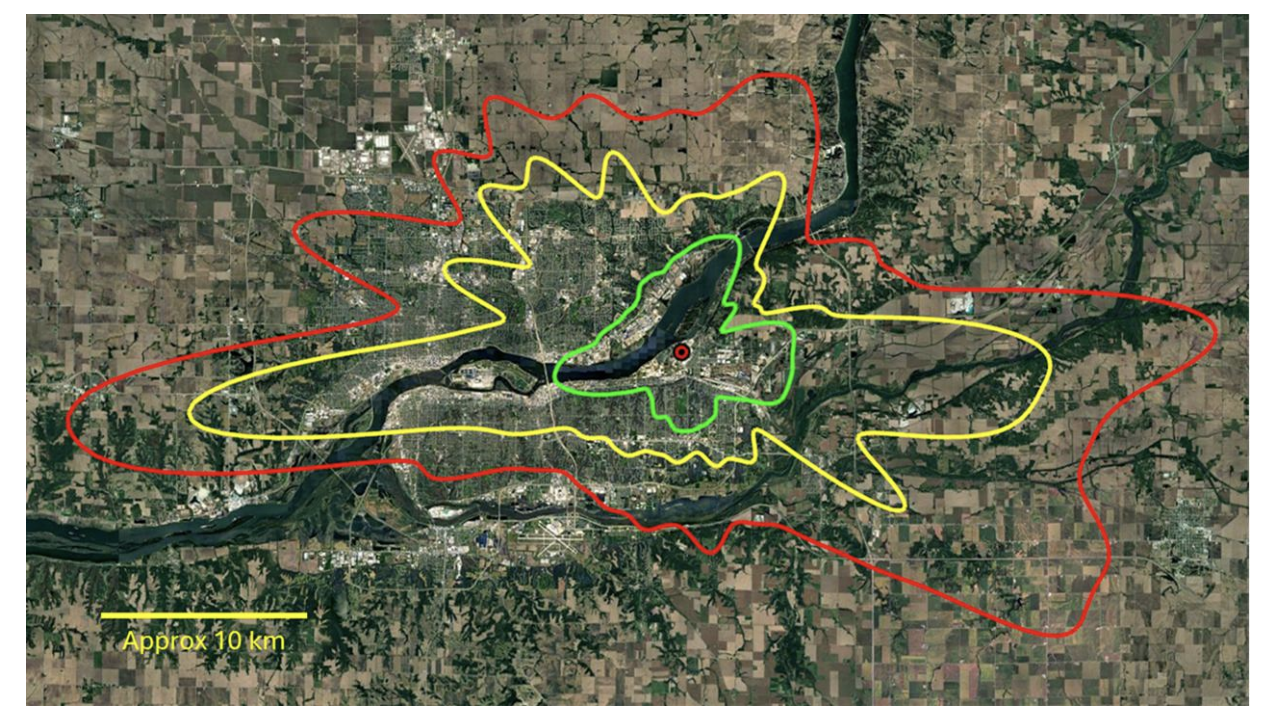
Deere's current operational data provides clear evidence of the risks posed by increased power:
- "Whack-a-Mole" Interference: Deere already experiences interference from nearby commercial towers, such as hi-site CBSDs operated by a major MNO using GAA grants in Moline, IL, but has been able to work around the interference by making adjustments to its deployments. The interfering CBSDs would likely be strong candidates for Category C or D operations if allowed, making interference dramatically worse for Deere’s operations. Increasing the allowed power levels would transform the band into a macro cellular environment where smaller, localized enterprise networks cannot survive.
- Reduced Spectrum Efficiency: Higher-power limits prevent the dense deployment of small cells that Deere relies on for targeted low-latency coverage. This leads to less efficient use of the spectrum and forces facilities to operate with limited bandwidth to avoid co-channel interference from distant high-power towers.
- Forced Operational Compromises: To coexist with current MNO CBRS signals, Deere has had to already adjust its equipment resulting in a not insignificant loss in hardware capacity and increased costs. An environment in which nearby CBSDs were allowed to operate at significantly higher-power levels tens to hundreds of times greater would exacerbate the problem.
- Breakdown of the "Digital Thread": Deere's manufacturing strategy relies on a continuous "digital thread" of data from the factory floor to the cloud. Interference even under existing rules can challenge this thread by causing inconsistent connectivity and a poor user experience for industrial IoT devices.
Higher-power operation would exacerbate the coexistence challenges identified above by reducing options to engineer around co-channel (or potentially even adjacent-channel) interference.
A specific example helps to show how the conversion to high-power CBSDs could threaten Deere’s operations, even Deere’s PAL operations could be disrupted due to adjacent channel high-power GAA.
Deere uses CBRS at its headquarters building in Rock Island County, IL. They own one PAL channel in that county but also use GAA, as most PAL operators do. Based on information provided by Deere, a major MNO operates high-site GAA CBSDs on a tower 1.2 km away at a height of 50.3 m (165 ft) above ground level. One of the MNO’s CBSDs points directly at the Deere facility and there is a direct line of sight between the two.
In Annex D, we provide details of a link budget analysis of the coexistence situation between the MNO’s CBSD and Deere’s CBSD, assuming power levels for the interferer corresponding to Category B as well as the proposed Categories C and D. We specifically consider the “near-far” problem: over what distance can the victim CBSD communicate with its desired user terminals given that it is suffering interference from a powerful transmitter on the same channel. We reach the following conclusions:
- Interferer Operating at Category B Power Level. The Deere CBSD is able to communicate with its intended user terminals over a maximum distance of 76-177 m. This is roughly compatible with the extent of Deere’s office campus and currently provides adequate coverage.
- Interferer Operating at Category C Power Level. The communication distance of the Deere CBSD drops to 14-31 m, which is insufficient to cover its campus.
- Interferer Operating at Category D Power Level. The coverage distance shrinks to 4-10 m, which is equivalent to or less than the reach of a set of wireless earbuds.
Figure 4 shows the coverage of the existing CBSD serving John Deere office facility with an existing nearby (1.2 km) co-channel interferer present. The green circle is the coverage assuming the interferer is operating at a Category B power level. If the interferer converts to Category C or D, the coverage of the Deere CBSD shrinks to an area the size of the yellow and red circles respectively. As evident from Figure 4, the deployed CBRS network is no longer able to cover the facility’s footprint when the interferer is at Category C or D power; instead, coverage is reduced to a small or tiny fraction of the facility.
In the Category D scenario, the interference situation is even worse than described because it would also impact adjacent channels. The absolute power level of the interference as received by Deere’s outdoor cell would be -27 to -35 dBm/10 MHz (assuming ITM and eHata predictions, respectively).21 These values exceed the FCC’s requirements for the maximum power that a PAL must be able to accept from blocking and adjacent channel signals.22 Both of these values exceed the acceptable level of interference from the adjacent channel according to 3GPP specifications.23 This means that the MNO’s signal at Category D power would render Deere’s CBSD inoperable even if it is not on the same channel that Deere is using.
Given that the channel immediately adjacent to Deere’s PAL channel in Rock Island County is assigned for GAA use, the MNO’s GAA signal on that channel would disrupt Deere’s PAL operations on the adjacent channel. FCC rules and SAS implementation do not consider or enforce any adjacent channel protections for CBSDs, even PALs. The rules and standards are based on current Category A and B power levels and generally do not envision interference at the overwhelming levels that could become commonplace if Category C or D power levels are allowed. Accordingly, CBRS networks across the country were designed, funded, and deployed with these parameters in mind.
The current low-power, small-cell nature of the band allows for high spatial re-use because the interference levels remain manageable. Introducing macro-cellular power levels will radically change the technical landscape for CBRS and create an environment where nearby high-power towers "blind" the far low-power devices that the band was designed to support.
B. Miami International Airport
Bottom Line: If high-power CBRS is allowed, Miami International Airport’s private CBRS network will lose almost one-third of its network capacity, thereby jeopardizing its existing (and planned) operations for video surveillance, baggage screening and handling, public safety communications, Customs and Border Protection operations and other functions. In addition, it will jeopardize – if not outright cancel – current plans to expand CBRS use in nearby passenger cruise terminals.
Miami International Airport (MIA), located on 3,230 acres near downtown Miami, is America’s busiest airport for international freight and second busiest for international passengers with over 485,000 commercial flight operations in 2024.24 MIA has six concourses, 131 gates and over 90 carriers. Miami Dade County, through the Miami-Dade Aviation Department (MDAD), operates MIA and four general aviation (GA) airports within the county.25
MIA operates an extensive CBRS network on the airport property. The network facilitates numerous important functions for the airport’s operations, including:
- Video surveillance of sensitive areas
- Surveillance of baggage handling areas
- Monitoring of ramp areas for multiple purposes including foreign object detection
- Connectivity for handheld baggage scanners
- Offload of FirstNET public safety communications
- Connectivity for Customs and Border Protection’s Enhanced Passenger Processing (EPP)26
- IoT for elevators and movement conveyors
- Smart restrooms
- Neutral host capability to allow public use of the CBRS network for mobile broadband connectivity
- Autonomous lawn mowers
- Digital signage
CBRS networks at the four GA airports in Miami-Dade County are also being deployed to support some of the same functions, including video surveillance and autonomous grounds-keeping technologies.
In addition to the airports, Miami-Dade County is planning to deploy CBRS at several passenger cruise terminals in and around Dodge Island in Biscayne Bay.
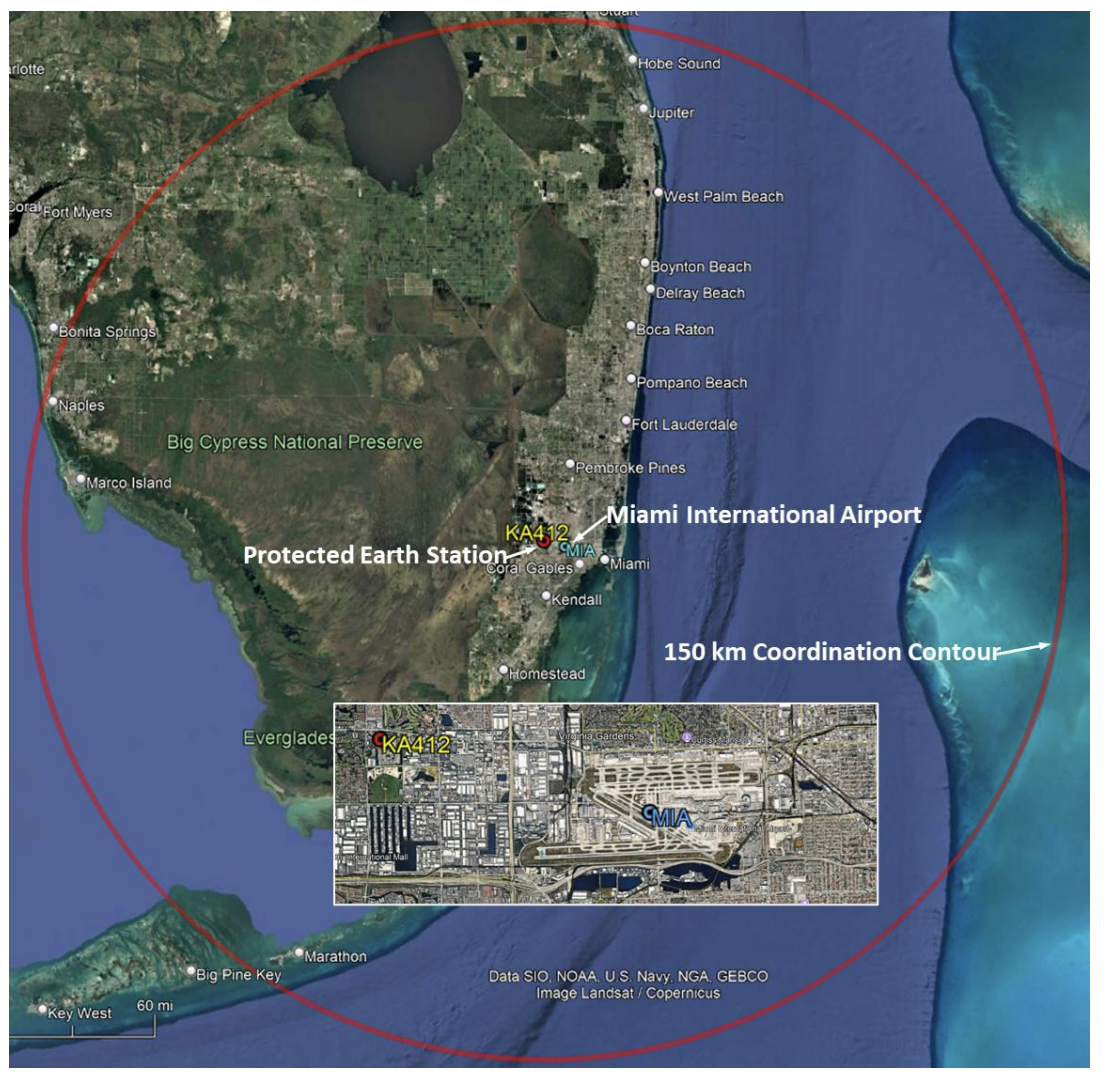
Under the current CBRS rules, operations in the Miami area are a delicate balance of geography, network deployment characteristics, and channel selection. Covering most of southern Florida is the protection area associated with a legacy fixed-satellite service (FSS) earth station located just west of MIA (see Figure 5). The FCC’s rules require CBRS operators to protect the earth station’s frequencies from interference from all CBSDs within a distance of 150 km from the satellite dish. Figure 5 shows this distance encompasses most of southern Florida. This effectively blocks CBRS deployments on channels 8-15 (more than half of the CBRS band) anywhere in Miami. All regular-power CBRS deployments in the Miami area, including MIA’s, are therefore compressed into the lower seven channels of the band.
CBRS is designed to facilitate coexistence even in the presence of significant constraints such as the loss of multiple channels discussed above. Because CBRS power limits are established to facilitate highly localized spectrum use, and PAL “use-or-share” rules allow the re-use of PAL channels in areas where they are not being used by the PAL holder, there is substantial ability to adapt CBRS spectrum use to local conditions. MIA’s deployment makes good use of such adaptability: a combination of indoor use, targeted outdoor deployments, and the natural geographic buffer of the airport property have allowed MIA to use seven channels of CBRS spectrum under GAA access, providing 70 MHz of bandwidth to meet their network’s throughput needs.
Higher-power operations would upset the adaptability of CBRS operations and threaten MIA’s access to spectrum resources needed to meet their requirements. Because of the much greater transmit power that would be allowed under Category C or D operations, PAL Protection Areas for Category C or D CBSDs would extend to a much greater distance than those for Category A or B under current rules.
Any co-channel GAA device within the PPA would automatically be forbidden from operating on that channel by a SAS and would immediately lose access to that channel when the Category C or D CBSD utilizing the PAL channel commences operation. While MIA’s extensive land area naturally shields it from disruption that would be caused by PPAs established by off-property Category A or B PAL devices, its geographic buffer is no match for the much greater land area that is consumed by Category C or D PPAs, and therefore MIA’s operations are at substantial risk for losing GAA access to channels being used by a macro-cell type Category C or D device on a PAL basis virtually anywhere within a very large portion of the Miami area. The use-or-lose nature of CBRS was based on relatively low-power localized uses of CBRS, not high-power high-site operations in which a single device can prohibit any shared spectrum use across areas larger than thousands of square kilometers, which would also violate the FCC’s intent to prevent spectrum warehousing in the CBRS band.27
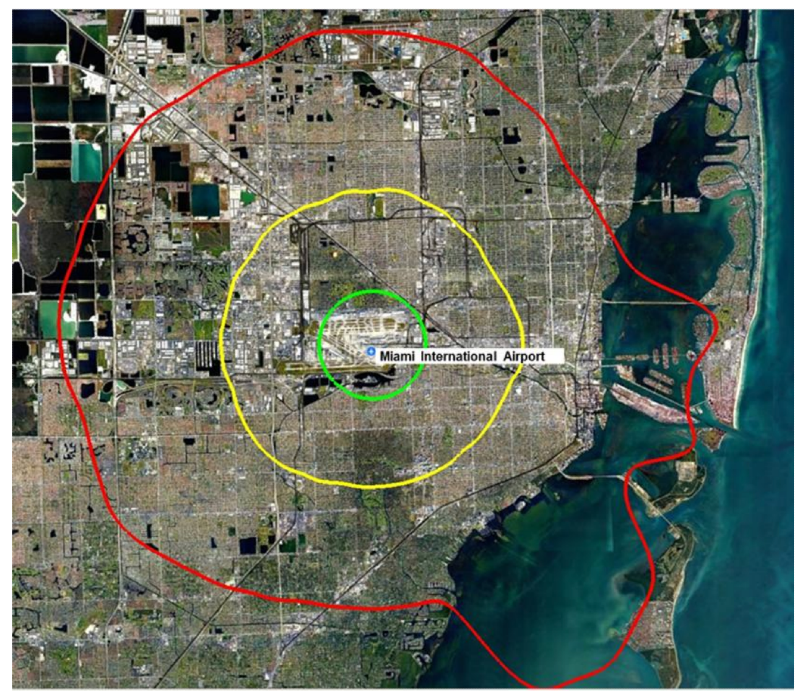
The consumption of spectrum over very large areas by higher-power operation is depicted in Figure 6 below showing the Miami metropolitan area with MIA at the center. The contours represent the approximate area in which a single PAL CBSD would preempt MIA’s operations on the same channel, with green representing current Category B power, yellow representing proposed Category C, and red representing proposed Category D. The same “reverse PPA” method as described above and in Figure 3 was used (see Annex E).
The contours were created by establishing corresponding standards-compliant omnidirectional PPAs centered on the airport, and therefore are a good representation of the area in which a PAL base station would, conversely, create a PPA impacting MIA. The category B contour primarily encompasses the MIA airport property itself, but MIA controls this area and therefore manages CBRS deployments within it so there is little risk at current CBRS power levels. The Category C and D contours represent very large areas where any co-channel PAL operations would shrink the availability of GAA access and force MIA’s co-channel GAA operation off the air, representing a very significant risk to MIA’s critical operations.
Of the seven CBRS channels (1-7) in use at MIA on a GAA basis and not blocked by FSS, four of them are assigned to PAL operators in Miami-Dade County. Channels 1 & 2 are owned by Echostar, and channels 4 & 5 are owned by Comcast. Channels 3, 6, and 7 are reserved for GAA in the county. There are no PPAs on any of the PAL channels that impact MIA’s CBRS operations under current CBRS deployments.
Echostar (which merged with Dish) is one of the original proponents for high-power CBRS. Further, the channels that they own are immediately adjacent to the 3.45 GHz band just below CBRS (3450-3550 MHz), which is used by high-power mobile broadband operators in the 3.45 GHz Service (the so-called “AMBIT band”). Power levels allowed in the AMBIT band are comparable to proposed Category D limits. If high-power operations were allowed in CBRS, it is conceivable, or perhaps even likely, that a 3.45 GHz Service operator would acquire or lease the Echostar CBRS channels and could very easily aggregate them with AMBIT channels to provide high-power, high-bandwidth capabilities.28
The impact to MIA’s CBRS network would likely be the loss of access to CBRS channels 1 & 2 due to the PPA that would be created by high-power CBRS operations. The PPA would likely extend across the MIA property, and therefore by rule it would preempt the use of MIA’s private CBRS network on those channels. We also note that Miami-Dade County’s planned use of CBRS at several passenger cruise terminals in and around Dodge Island in Biscayne Bay would likely also be preempted by high-power operation virtually anywhere in the Miami area.
28 It is worth noting that AT&T and EchoStar filed applications seeking the FCC’s consent to assign EchoStar’s 3.45 GHz spectrum licenses to AT&T. AT&T have also announced that they have deployed in this spectrum. Echostar held all the available licenses in the upper two channels (I & J) of the 3.45 GHz band and holds the majority of the PAL licenses in the lower two channels (1 & 2) of the CBRS band.
Because network throughput is directly proportional to the amount of available bandwidth, the loss of two out of seven channels would result in the loss of 2/7th (~29%) of MIA’s network capacity. The loss would be instantaneous the moment the high-power CBSDs came on the air.
C. Amplex Internet
Bottom line: Operating a CBRS network near the Canadian border has provided Amplex with a unique "stress test" for high-power interference scenarios because the band is used for high power macro cells in Canada. Specifically, portions of the Amplex CBRS network (both PAL and GAA) with equipment directed toward Canada experience periodic signal disruption today from Canadian macro cells operating in the same frequency band. These Canadian cells utilize power levels comparable to those proposed for Category C and D CBSDs, frequently causing interference into Amplex's network operations and causing disruption (and complete outages) to Amplex's customers close to the Canadian border. Amplex's experience in these border locations serves as a practical cautionary tale of the broader interference challenges U.S. operators will face if Category C or D power levels are authorized domestically and more widely.
Amplex operates a CBRS network in northern Ohio (see Figure 7 below). The network provides internet access to homes and businesses, particularly those that are outside of the reach of wireline networks. The typical architecture consists of a CBSD installed on the roof of a customer’s home or office, pointing to a serving CBSD on a tower some distance away that provides connectivity to the Internet.
Amplex’s network provides a good opportunity to understand the true potential impacts of higher-power CBRS operations. Amplex’s network is located close to Canada where the same frequency band that is used for CBRS in the U.S. is used for mobile network operations, but at power levels nearly as high as
those proposed for CBRS Category D. For example, Canadian stations operating in the 3.5 GHz band (3450-3650 MHz) are allowed to transmit with a power level of up to approximately 71 dBm per 10 MHz. This level is more power than the proposed Category C level of 62 dBm per 10 MHz, and about 80% of the proposed Category D power level of 72 dBm per 10 MHz.
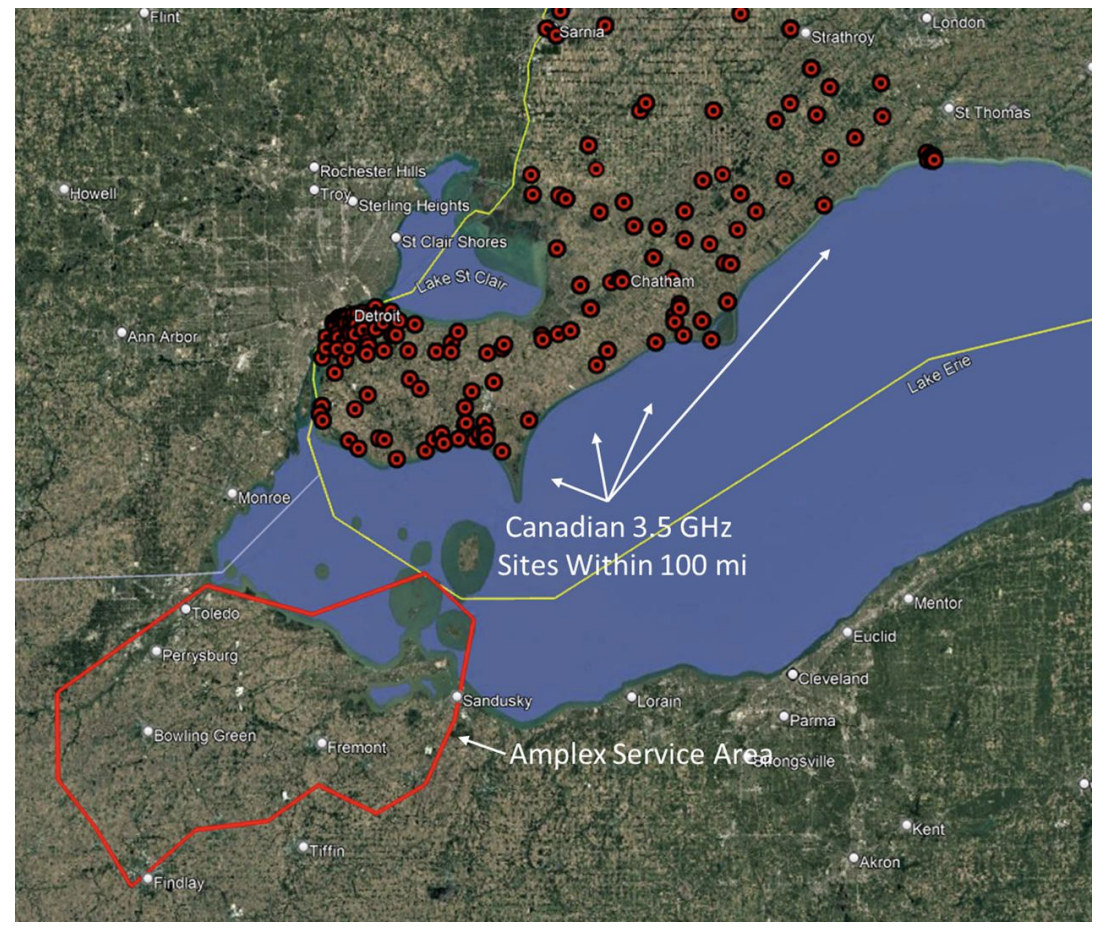
Unlike in the U.S., specific technical details of macro cell network deployments are publicly available from the Canadian spectrum regulator, Innovation, Science and Economic Development (ISED). These details include location, height, transmit power, antenna gain, antenna beamwidth, antenna pointing direction, frequency, and bandwidth. When combined with similar details about the Amplex network, it is possible to analyze the minimum distance over which interference is apparently occurring.
Links in Amplex’s network experience interference on a recurring basis as a result of these Canadian higher-power operations. This interference results in Amplex customers losing their internet service repeatedly, which can last one or more hours at a time and occur throughout the day and night. The following figure includes some examples, showing the number of customers attached to four of Amplex’s serving CBSDs over a period of 12 hours. The interference events manifest as reductions in the customer attachments due to loss of service, caused by interference from one or more co-channel Canadian base stations.
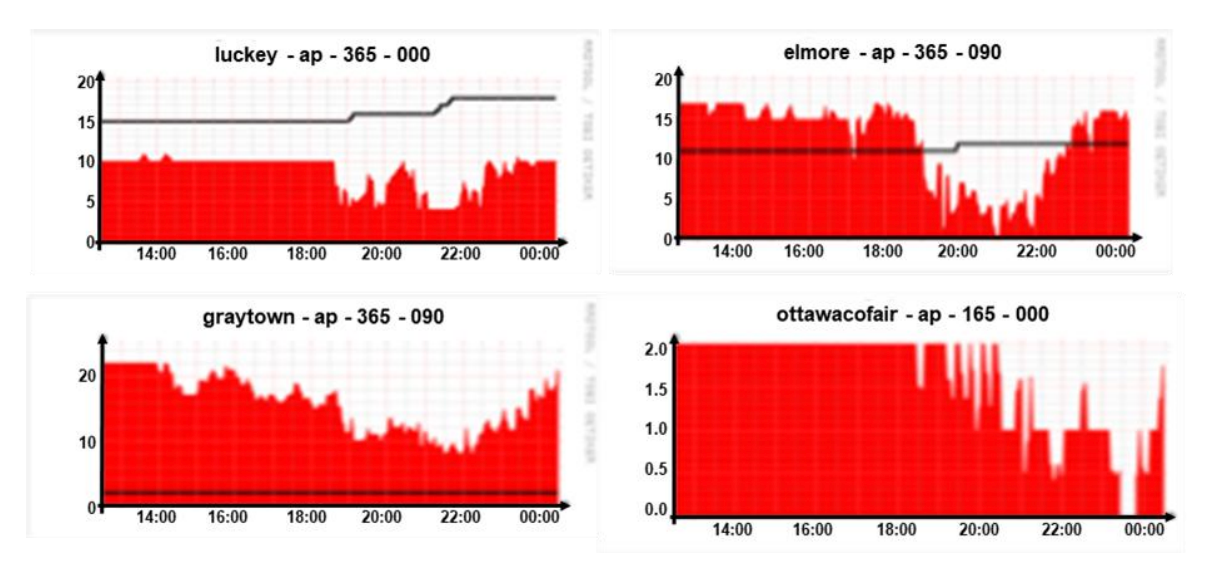
The evidence that these outages are caused by Canadian high-power stations is based on:
- The only Amplex base stations receiving significant interference are those that point north or northeast toward Canada where Canadian 3.5 GHz systems are deployed.
- Amplex experiences no interference on north-facing CBSDs in the western part of their network that is south of Michigan instead of Canada.
- There is no comparable interference in any links that do not point towards Canada.
- Amplex synchronizes transmissions from each of its CBSDs so that its own transmitters are not the source of interference.
- Some of Amplex’s CBSDs that are operating on protected PAL channels are receiving interference. The SAS automatically protects PALs from co-channel interference caused by other CBSDs outside of the Amplex network, but not from Canadian macro cells.
Data on the interference caused by the Canadian high-power operations serve as a direct analog for evaluating the coexistence challenges that would occur if widespread high-power Category C or D operations were allowed in CBRS. For example, we can use Amplex deployment data combined with Canadian high-power base station deployment data to identify the Canadian stations that operate co channel with an Amplex base station, and for which the Amplex and Canadian stations are within each other’s main beams (see Figure 9). We can then take the distance to the closest Canadian station that fits these criteria as the minimum distance over which interference can occur.
We emphasize that this is the minimum distance, since Canadian stations that are more distant but that fit the same co-channel and beam intersection requirements could be contributing to the interference. The Amplex network uses a proprietary radio access technology, so there is no way to discern which specific Canadian station (or stations) is/are causing the interference (for example, by decoding cell IDs) because they are using a different air interface. Along with other considerations such as different TDD configurations, this keeps Amplex from being able to synchronize its signals with the Canadian base stations to help mitigate interference.
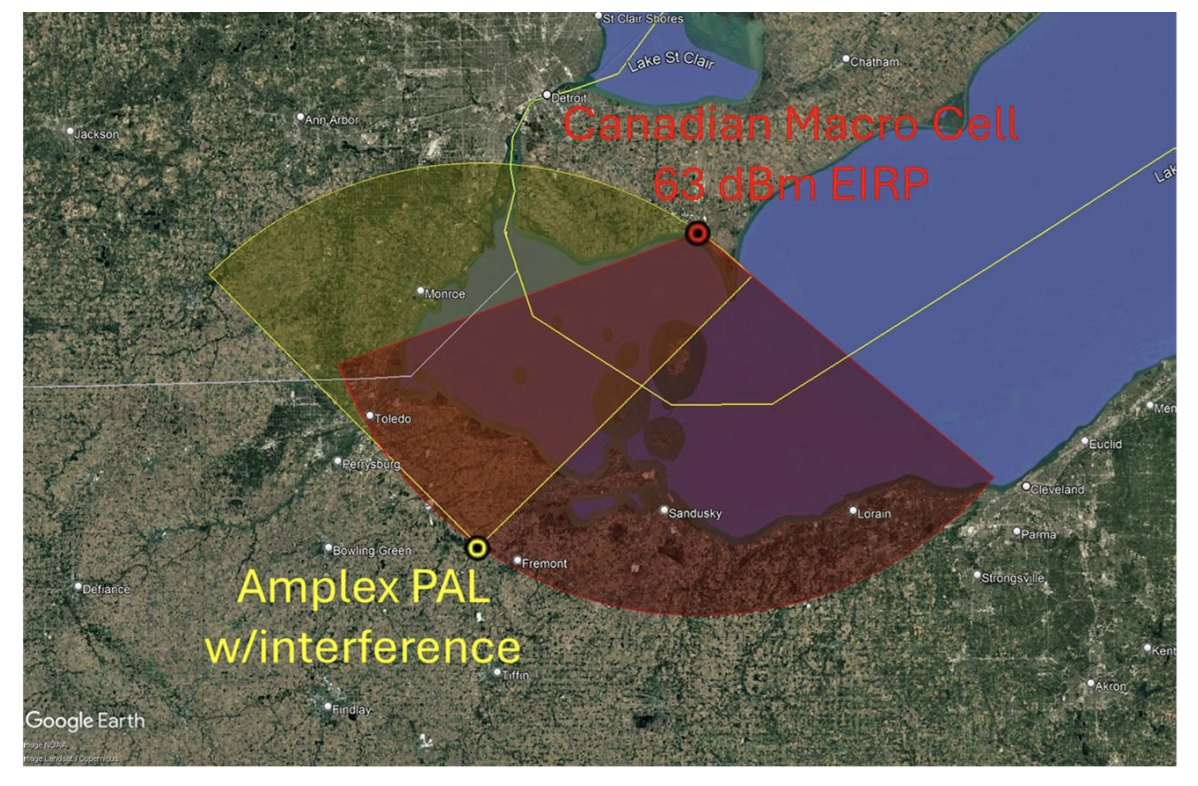
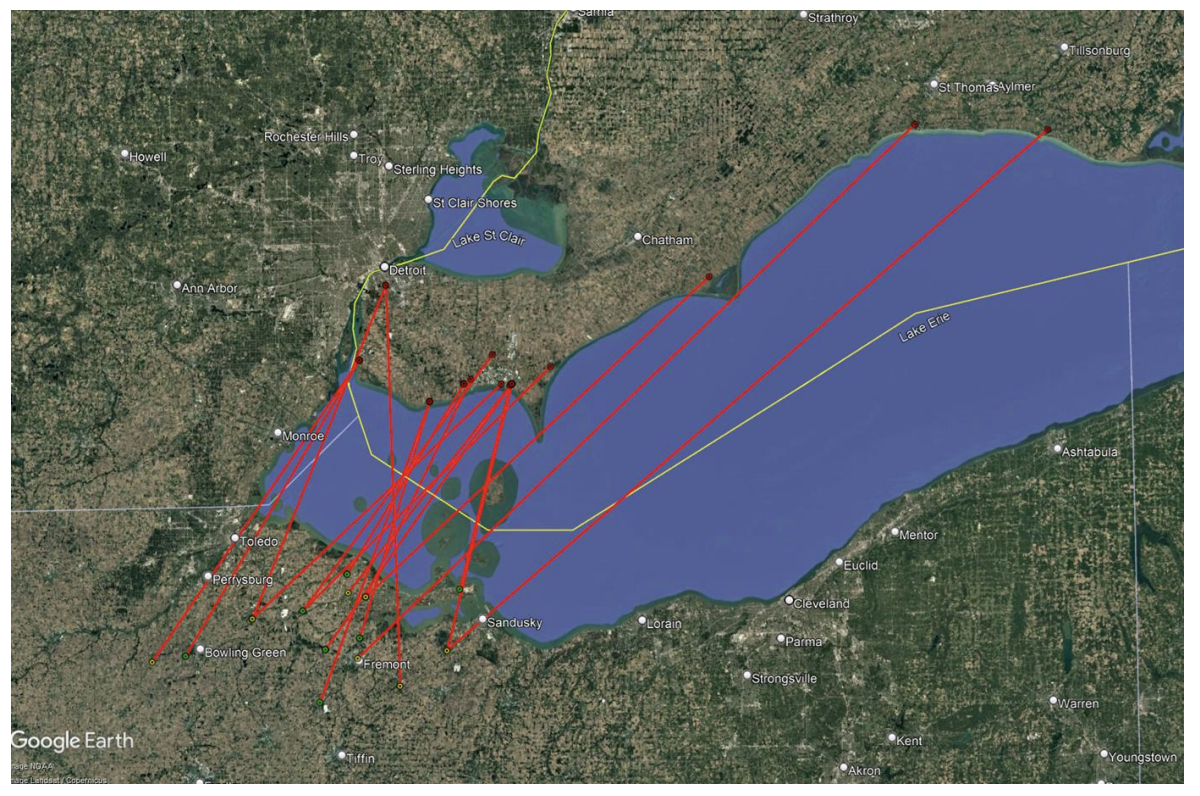
Figure 10 connects each of the Amplex base stations receiving significant interference to the closest co channel Canadian station for which the antennas are pointed towards each other.29 The distances between the CBSDs and closest interferer range from 58 km to 220 km, with an average distance of 97 km. The indicated Canadian base stations have transmit powers (EIRPs) that average 62 dBm per 10 MHz, which is equivalent to the proposed high-power Category C CBSD.
29 All of the links are across Lake Erie, which is expected given the local geography. The interference could be related to anomalous propagation across the large body of water, but such circumstances also exist within the U.S., including East, West, and Gulf coasts, Alaska, Hawaii, Puerto Rico, U.S. Virgin Islands, Chesapeake Bay, San Francisco Bay, the Great Lakes, and several other large bodies of water. Therefore, if this is anomalous propagation of strong signals, this situation will exist in many places in the U.S. if high-power deployments are allowed.
4. Quantitative Analysis of Impacts Caused by Higher-Power Operation
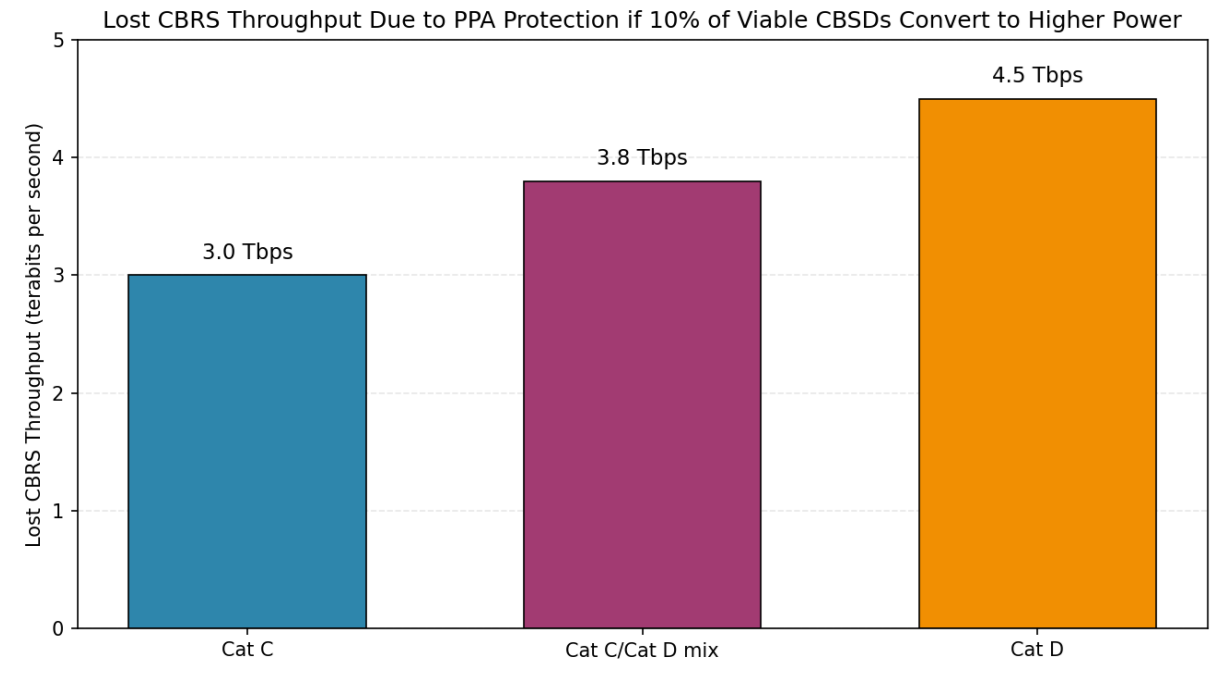
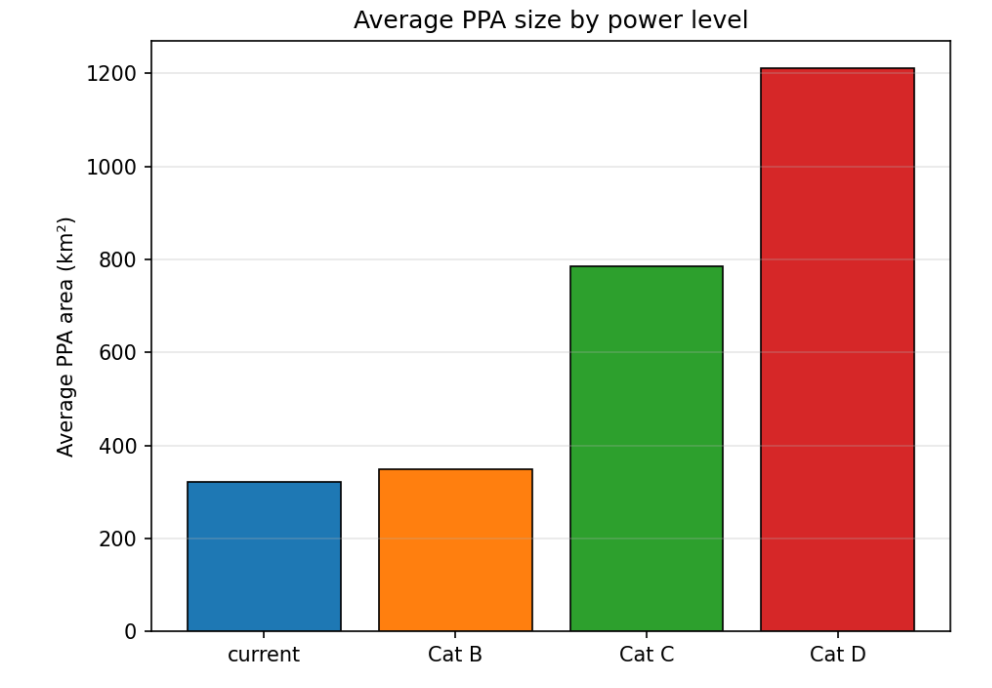
Bottom line: Analysis of a random sample of current deployments show that if as little as approximately 1.3% of current CBSDs convert to Category C or D operation, the CBRS ecosystem will suffer a combined throughput loss of approximately 3-4.5 terabits per second. The impact is due to a combination of grant terminations for devices inside of larger PAL Protection Areas (PPAs), and power reductions for devices outside the PPAs that are required to meet interference protection requirements inside the PPAs. On average, PPAs for Category C devices will be more than twice as large as today’s average PPA, while Category D PPAs will be more than three times as large. Because both PAL and GAA operators rely on GAA spectrum to meet their bandwidth requirements, these impacts will be felt across the entire CBRS ecosystem.
Higher-power operation will impact spectrum access and network performance across the CBRS ecosystem for both PAL and GAA operations. The fundamental CBRS framework was not designed to support ballooning coverage areas created by high-power macro-type cell sites.30 Trying to retrofit such operations into this carefully crafted CBRS framework severely disrupts the flexible, localized, small-cell nature of the band and will negatively impact many of the over 430,000 deployed CBSDs – operating on both PAL and GAA spectrum – and the multitude of private networks, manufacturing facilities, enterprises, and consumers that rely upon CBRS. And the negative consequences of higher-power operation will not only impact the current CBRS deployments, but they will also limit future uses of the band.
PAL operation is impacted by the requirement to respect co-channel PPAs established for PAL operations belonging to other licensees in adjacent license areas. When computing aggregate interference protections into PPAs, SASs must consider the contributions from both PAL and GAA, as required by FCC rules.31 Based on the output of that calculation, which fairly allocates interference contributions across all co-channel CBSDs within 40 km of the PPA, transmit power for particular CBSDs may be limited so that the aggregate interference from all included CBSDs does not exceed the -80 dBm per 10 MHz threshold established in the rules.
This calculation, called the Iterative Allocation Process (IAP),32 can result in substantial power reductions below nominal levels to keep aggregate interference power into the PPA within FCC-prescribed limits. IAP applies to both PAL and GAA transmissions in the area, with no favorable treatment of PAL over GAA (other than PALs belonging to the same licensee as the PPA are not subject to IAP). These power restrictions on existing CBSDs can be quite substantial. As PPAs grow in size, the area encompassed by the 40 km limit for IAP also grows in size, capturing a greater number of co-channel CBSDs to include in IAP and which therefore face potential power restrictions. These restrictions will have a significant effect on network throughput and in some circumstances, even the ability to provide service at all if power is restricted to very low levels.
Because GAA operations are included in IAP, they face similar threats from expanding PPAs. But they face another threat too: the risk of having their grant (i.e., the right to transmit on a particular channel) terminated altogether if the CBSD is located inside of a PPA. Therefore, GAA grants that are co-channel with a PAL and located within the PAL’s PPA are automatically terminated (or never granted at all) by the SAS.
Lastly, GAA operations face the threat of interference from co-channel PAL and GAA. SASs do not provide any interference protection for GAA, either from PALs or from other GAA. Because the distance over which a co-channel CBSD can cause interference increases with power (as seen in the case of interference from Canadian macro sites), higher-power Category C and D, would cause greater levels of interference to GAA than is experienced today.33
While denial of co-channel GAA grants in a PPA is within the established rights of PAL operators and consistent with the use-or-share philosophy of the CBRS band, current GAA operators rely on the fact that most CBRS use (including PAL), is localized, leaving reasonable amounts of spectrum and geography available for use on a GAA basis. This concept is important not just to GAA operators, but PAL as well: virtually all PAL CBSDs use GAA spectrum too, and approximately one-third of the overall number of CBSDs use both PAL and GAA spectrum to meet their bandwidth requirements. Overall, over 96% of CBSDs use GAA, and over 80% of all spectrum assignments (including assignments to complement PAL spectrum use) are GAA.
Estimating Impacts Based on Actual Deployment Data
For this study, we used the Shadow SAS to investigate the impacts of converting some current CBSDs to Category C or D power. We used a random draw of CBSDs that met the following criteria:
- Outdoor
- Category B (all of which are outdoor)
- One or more PAL grants
- Height greater than or equal to 10 m above ground
We believe CBSDs that meet these criteria are more likely to convert to high power than CBSDs that are at lower heights. We refer to these CBSDs as “conversion viable.” We believe that this is a conservative criterion as there are likely some Cat B CBSDs below 10 m or operating with only GAA grants that would convert.
PAL grants that convert to high power will create larger PPAs and therefore create more impact through potential IAP power reduction applied to PAL and GAA operations in the area, and grant terminations of GAA operations that are within the expanding PPA geography. We find that there are over 56,000 CBSDs currently deployed that meet these criteria, each operating with up to four PAL grants. Virtually all of them (~96%) use GAA grants also.
We used our SAS implementation to generate WInnForum-compliant PPAs for each of the randomly chosen devices using the following powers:
- Current operating power as registered in the SAS
- Category C (62 dBm/10 MHz)
- Category D (72 dBm/10 MHz)
We examined the following effect on other CBSDs:
- Existing co-channel PALs owned by different licensees in adjacent markets that would have to reduce transmit power to meet aggregate interference limits in the PPA (IAP analysis)
- Existing co-channel GAA that are outside the current PPA, but that would be inside the PPA if the PAL converted to Cat C or Cat D, and therefore have their GAA grant terminated. (PPA analysis)
- Existing co-channel GAA that are outside of the Cat C or Cat D PPAs, but would have to reduce transmit power to meet aggregate interference limits in the PPA (IAP analysis)
- Existing co-channel GAA that are outside of the Cat C or Cat D PPAs, but may suffer significant co-channel interference from PALs that convert to Cat C or D.
We ran our analysis against actual CBSD deployment data, and using the criteria outlined above, drew a random selection of CBSDs to sample the impact of higher-power operation on real deployments. For PPA analysis, we used a sample size of 6,000 conversion-viable CBSDs and calculated WInnForum compliant PPAs assuming conversion to Category C and Category D power. The results indicate the following:
- Number of GAA grants terminated based on conversion to Cat C = 3,938
- Number of GAA grants terminated based on conversion to Cat D = 7,898.
Some of the grants are exposed to termination caused by higher-power PPAs from more than one PAL. This suggests that even if one PAL doesn't convert, a neighbor might, making the GAA grant's current authorization tenable only if all nearby PALs stay at lower power.
To normalize these values to a “per converted CBSD” basis, we use a scaling factor of 3,938/6,000 = 0.65 GAA grant evictions per Cat C conversion, and 7,898/6,000 = 1.32 GAA grant evictions per Cat D conversion. Note that individual PALs have a wide range of impact. Some cause no GAA grants to be terminated upon conversion to high-power, while others can cause several dozen GAA grant terminations. The scaling factors used here are an average over all 6,000 CBSDs that were analyzed.
We also conducted a study of the impact of grant power reduction required to meet aggregate interference protection limits inside PPAs. This analysis is based on the application of the WInnForum compliant IAP process for a random sample of devices meeting the same criteria as those for the PPA analysis. The IAP calculation is very time consuming due to the combination of the number of protection points and the number of devices that must be considered as potential interferers, leading to a very large number of propagation loss calculations for each PPA to be protected. The sampling methodology evaluates the potential impact on hundreds of CBSDs, and the application of the standard IAP calculation produces a realistic and repeatable outcome.
The results show that the average number of GAA power reductions per PAL converted to Cat C is 12.8, and the average number of GAA power reductions per PAL converted to Cat D is 18.6. The power reductions range from small (1 dB) to very large (44 dB), based on the IAP algorithm. The impact of power reductions on viable operations depends on many factors. We selected 10 dB here to simplify the discussion, assuming that a 10 dB (10x) required power reduction results in non-viability of a link. By that metric, the average numbers of impacted GAA devices per Cat C or Cat D conversion are 6.9 and 10.4, respectively.
In our limited sample size, we did not find any significant impacts to co-channel PALs through the enforcement of PPA protection for adjacent-license-area PALs. This is likely due to PAL deployments currently being “self-organized” to avoid mutual interference at license area boundaries (PPA boundaries are automatically truncated at license area boundaries per FCC rules and WInnForum standards). Higher power operation will likely complicate this balance.
We can combine these metrics of potential impacts to estimate the overall impact of higher-power operation on the CBRS ecosystem. The table below summarizes the estimated total scaling:
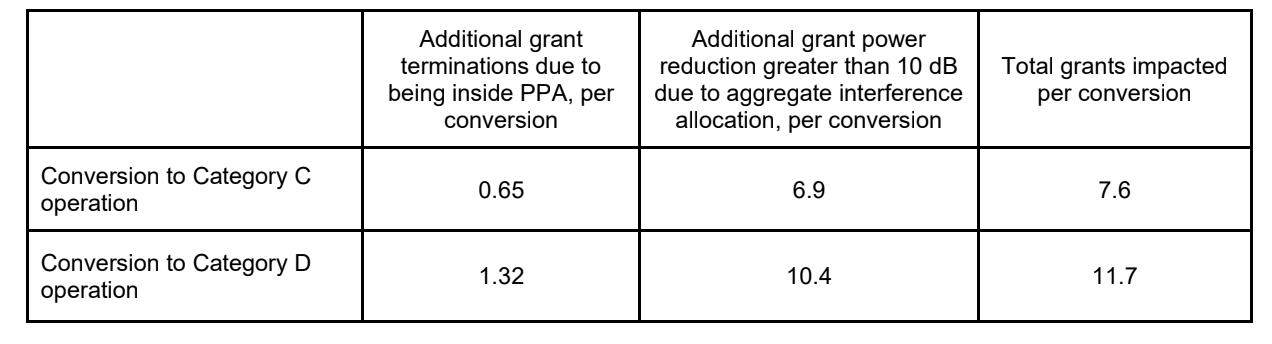
We can use these scaling factors to estimate the total impact on the CBRS ecosystem caused by high power operation by considering the impact of the loss of grants to the total available throughput available in the CBRS band. Each grant is a bandwidth of 10 MHz. Assuming an overall spectral efficiency of 7 bits per second per Hz, each lost grant represents a lost throughput of about 70 Mbps. If we assume that 10% conversion-viable devices do convert, that equals approximately 5,600 converted devices. If those devices convert to Category C, there will be approximately 7.6 x 5,600 = 42,560 lost grants. At 70 Mbps lost throughput per grant, that represents a total loss of nearly 3 terabits per second (Tbps) of capacity in the CBRS band. If half of those 10% convert to Category C and half convert to Category D, the calculated loss is 3.8 Tbps. If all 5,600 devices convert to Category D, the total lost throughput is approximately 4.5 Tbps. For context, this is equivalent to roughly 180,000 simultaneous 4K Ultra-HD video streams at 25 megabits per second each. Note that the number of devices we assume convert (5,600) represents about 10% of what we consider “conversion-viable,” 3.6% of the total deployed base of PAL CBSDs, and 1.3% of all CBSDs.
The assumed spectral efficiency factor (7 bits per second per Hz) is relatively conservative. 5G systems, for example, can readily achieve efficiencies more than three times as much.34 A lost grant represents the total loss of spectrum efficiency, across both uplink and downlink. While terminated GAA operations can conceivably find another channel to operate on, this drives increased GAA-to-GAA interference, which creates further loss in effective ecosystem throughput.
With mild deviations from the 10% conversion rate (i.e., up to 20-30% conversion), the total loss will scale approximately linearly with the percentage of devices that convert. For example, if 20% of conversion viable devices convert (which amount to about 7.2% of overall PAL CBSDs), the impacts will be approximately 85,000 or 131,000 lost grants due to Category C or Category D conversion, respectively, representing lost throughput of 6 - 9 Tbps. As the percentage of conversions gets higher, the loss will saturate as overlapping PPAs start to consume most or all populated geographic areas and channels. At that point there is no more “use-or-share” spectrum left, and all CBRS users will feel the impact, since 96% of CBSDs currently use GAA spectrum, including almost all PAL devices. The impacts will be felt across all the sectors enumerated in section 6.
As a gauge on the geographic impact of higher-power operation, during the analysis we kept statistics on the average size of PPAs by category. As Figure 12 shows, compared to current PPAs, Category C PPAs are, on average, more than twice as large as current existing PPAs, while Category D PPAs are more than three times as large. This underscores the potential impact on GAA, as no co-channel GAA use would be possible within the larger PPAs.
Current SAS algorithms for calculating PPA size limit the PPA radius in any direction to 40 km, based on WInnForum standards. Our calculations comply with this standard, even though the 40 km limit is based on current max allowed power (Category B) and would likely have to be revisited by the FCC and standards bodies, so the average PPA sizes for Category C and D as shown in Figure 12 are likely underestimated.
5. Anticipated Ancillary Impacts of Higher-Power Operations
Bottom line: Beyond the quantifiable impacts identified in the prior sections, there are additional impacts that higher-power operations are anticipated to have on the existing CBRS ecosystem. These ancillary impacts are a matter of aggregate interference and therefore highly situation dependent.
The introduction of higher-power Category C and D CBSDs would fundamentally alter the interference landscape of the 3.5 GHz band. Because the current CBRS ecosystem relies on a "dynamic protection" architecture, the inclusion of high-power nodes creates a ripple effect that penalizes existing Category A and B operators.
- Amplified Impacts of Incumbent Radar Activation. The SAS manages interference via Dynamic Protection Areas (DPAs). When a radar is detected, the SAS must immediately silence any CBSDs that contribute to a co-channel aggregate interference threshold. This could result in the following:
- Expanded Neighborhoods: The "neighborhood" of a DPA is defined by the distance at which a device's signal could realistically reach the radar and therefore the device is considered in aggregate interference calculations. It is not necessarily impacted during incumbent operations, but it must be considered in the calculations. Higher-power Category C and D devices have a much larger propagation footprint, significantly expanding these neighborhood boundaries. Although DPA neighborhoods are calculated by NTIA independently on a per-category basis, the mere existence of higher-power CBSDs may cause NTIA and DoD to re-assess all neighborhood sizes, since aggregate interference is their ultimate concern. These calculations are conducted by the government and are outside the scope of industry standards bodies, and are also not a part of the FCC consultation process. The CBRS community may not necessarily be consulted or be provided with a chance for input if existing neighborhood sizes for Category A and B devices are reassessed.
- The Aggregate Limit Problem: The aggregate interference limit is a fixed "budget." Because Category C and D devices consume a disproportionately large share of this budget, the SAS must account for more devices over a larger geographic area. Since all devices are considered together in computing aggregate interference into DPAs, there could be situation-specific circumstances where a higher-power Category C or D device located at a significant distance from the coast “bumps” a lower-power Category A or B device located closer to the coast onto the move list, but that would be highly situational, depending on a very large number of factors.
- ESC Sensor “Whisper Zones” and Aggregate Interference. Environmental Sensing Capability (ESC) sensors are the "ears" of the system, tuned to detect faint incumbent radar signals. The ESC system notifies the SAS of incumbent activity, and the SAS then reconfigures CBSDs in the area to avoid interference. To function, ESC sensors require a "Whisper Zone"—a localized area where the aggregate noise floor from CBSD operation is strictly controlled. There are approximately 300 ESC sensors located along the U.S. coastline, mostly along the coast of the contiguous U.S.
- Sensitivity Constraints: ESC sensors are designed with a stringent protection criterion to protect the sensors from the hum of CBRS activity. Adding Category C or D devices increases the aggregate interference potential at the sensor site. Currently, all Category A devices within 40 km of the ESC sensor are considered, and all Category B devices within 80 km are considered. The IAP process is used to manage aggregate interference to the ESC sensor. IAP calculates a "fair share" interference quota for every device, dividing the total allowable interference (Q) by the number of CBSDs (N), resulting in a threshold of Q/N. Higher-power CBSDs logically contribute more interference to the allowable limit than lower power CBSDs. A high-power emitter will inject a massive amount of interference into the aggregate total. But because IAP reduces all unsatisfied devices simultaneously by 1 dB per iteration, the high-power emitter forces the algorithm to run through many continuous reduction loops to clear the excess interference, disproportionately punishing lower-power CBSDs for the excess interference from the higher-power CBSDs. If a moderately-lower-powered device happens to be just above its Q/N quota, it gets dragged into these loops. The SAS will persistently drop the low-power device's power by 1 dB right alongside the high-power device until the low-power device drops below its Q/N threshold or the aggregate limit is met.
- Impact to PAL and GAA: ESC sensors operate over the range 3550-3650 MHz (with limited adjacent-channel protections enforced up to 3680 MHz). The operating range covers the section of the CBRS band available for use by PALs (PALs do not use 3650- 3700 MHz). Therefore, whisper zone enforcement will impact PALs, and any GAA devices making use of available spectrum in the 3550-3680 MHz band.
- Neighborhood Bloat: To maintain the same protection levels for the sensor at Category C or D power levels, the SAS would have to calculate interference from a much wider radius. The protection radius for Cat C and D would likely extend beyond 80 km from the sensor, but the exact values must be determined by the standards committees.
- Expansion of DPAs and Tightening of ESC Protection Criteria. The current physical dimensions of DPAs and the operational parameters of ESCs are calibrated to the power of Category A and B devices and their propagation over the water.
- DPA Geographic Extension: If the maximum interference distance increases due to higher-power limits, the physical boundaries of DPAs (not their neighborhoods, but the DPAs themselves) could extend farther offshore.
- Tightening Protection Criteria: To detect radars at the greater distances necessitated by the expansion of DPAs, ESC sensors would require even higher sensitivity. This creates a feedback loop: more sensitive sensors require even lower aggregate interference thresholds (larger "whisper zones").
- Widespread Impact: This tightening would not just affect the new high-power units; it would impose stricter power constraints on all categories of devices, potentially rendering some existing deployments, including PAL, non-viable.
- Power Flux Density (PFD) Limits at Earth Stations. CBRS must protect designated Earth Stations from excessive interference.35 The SAS manages this by ensuring the Power Flux Density (PFD) at the earth station site does not exceed a set limit.
- The 150 km Radius: All CBSDs within a 150 km radius of these stations are subject to SAS-managed aggregate interference limits. Higher-power CBSD operation may require this 150 km distance to be revisited.
- Crowding Out Low-Power Users (PAL and GAA): Because PFD is an aggregate calculation (the sum of all signals), a single Category C or D device operating at high power consumes a massive portion of the allowed PFD "allowance," potentially even at large distances. As for whisper zone protections, the SAS uses IAP to protect FSS, with the same resulting potential impact on all devices contributing to the IAP calculation. Some FSS earth stations operate down to 3600 MHz, so some PAL (3550-3650 MHz) would be impacted in addition to GAA.
- Cross-border coordination with Canada. SAS administrators have been working together with the FCC to update Arrangement R which addresses cross-border coordination distances between U.S. CBSDs and Canadian cellular systems. Arrangement R only considers devices operating in the 3650-3700 MHz band, and does not currently impact devices in the 3550-3650 MHz portion of the CBRS band.36
- While this work is still ongoing, preliminary analyses have arrived at potential coordination distances for Cat A and B CBSDs, throughout the CBRS band (3550-3700 MHz). This work would have to be revisited to address Cat C and D CBSDs, potentially restricting CBRS deployments over significant distances from the Canadian border.
- Revisiting Protection and Exclusion Zones. The FCC established 80 km protection zones for three federal radiolocation sites and 150 km protection zones for incumbent earth stations.37 These are areas where CBSDs may operate only with the permission of an approved SAS.38
- These rules were developed considering a maximum Cat B EIRP. The FCC may need to revisit the sizes of these protection zones considering a potential maximum Cat D EIRP.
- More Contention for Less Spectrum. The displaced GAA operations will have to move to the remaining GAA channels, creating more contention for a smaller pool of bandwidth.
- This will create more contention and more interference within the GAA tier. The FCC’s rules and SAS implementation do not provide any protection for GAA-to-GAAinterference, and therefore the increased interference (further exacerbated by higher allowed power for all, including GAA) will become another “whack-a-mole” challenge.
- GAA-to-GAA interference was the top complaint in a survey of midband coexistence challenges conducted by the Wireless Innovation Forum.39 It will become worse with higher-power operation.
The transition to Category C and D represents a shift from a "neighborhood" model to a "regional" interference model. By increasing the power of individual nodes, the system inherently prioritizes high power macro-coverage at the direct expense of the density, reliability, and uptime of the existing lower power Category A and B ecosystem.
6. General Impacts Across CBRS Sectors
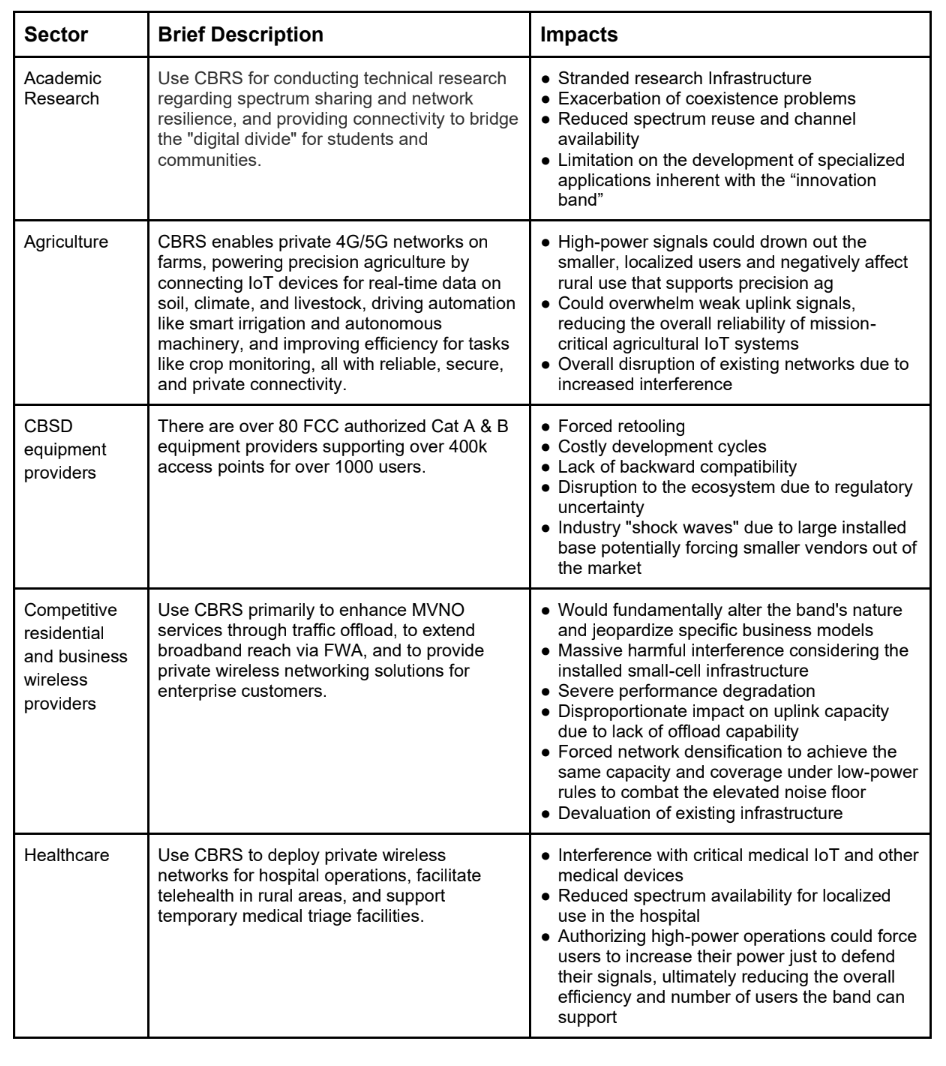
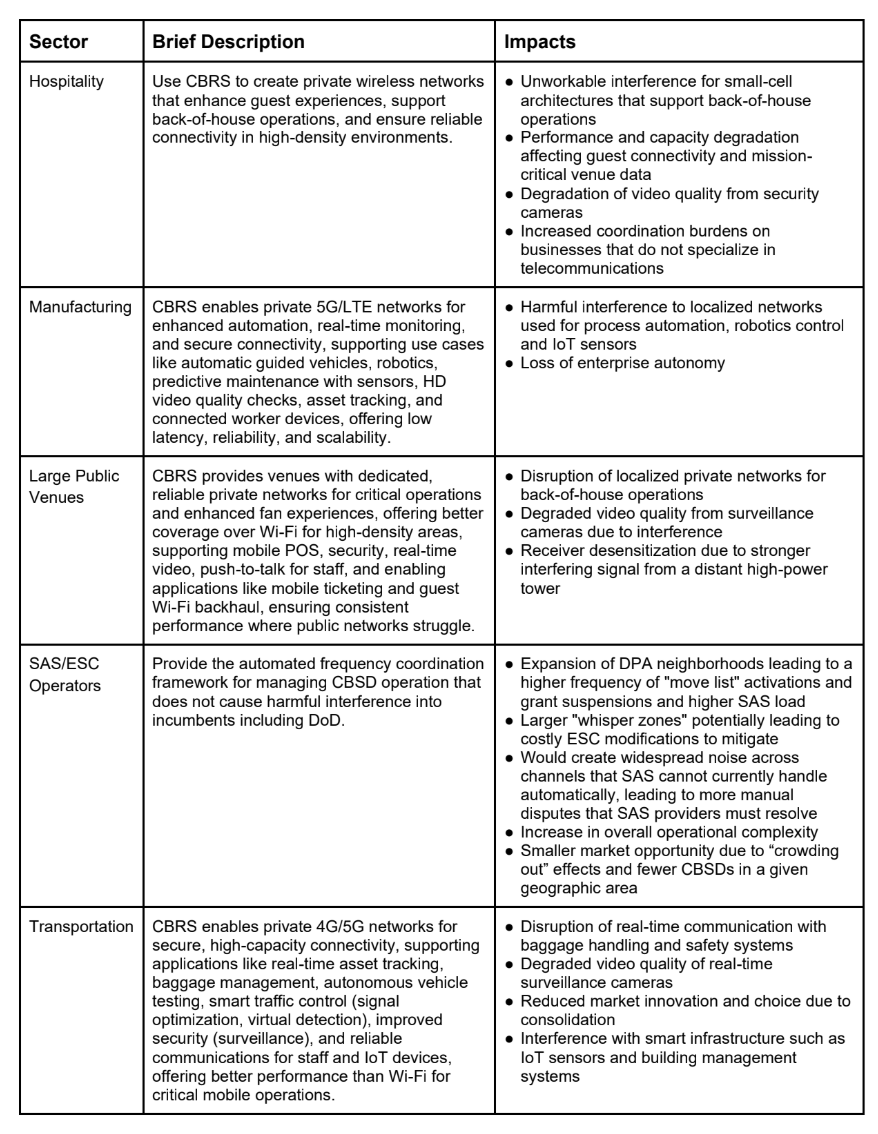
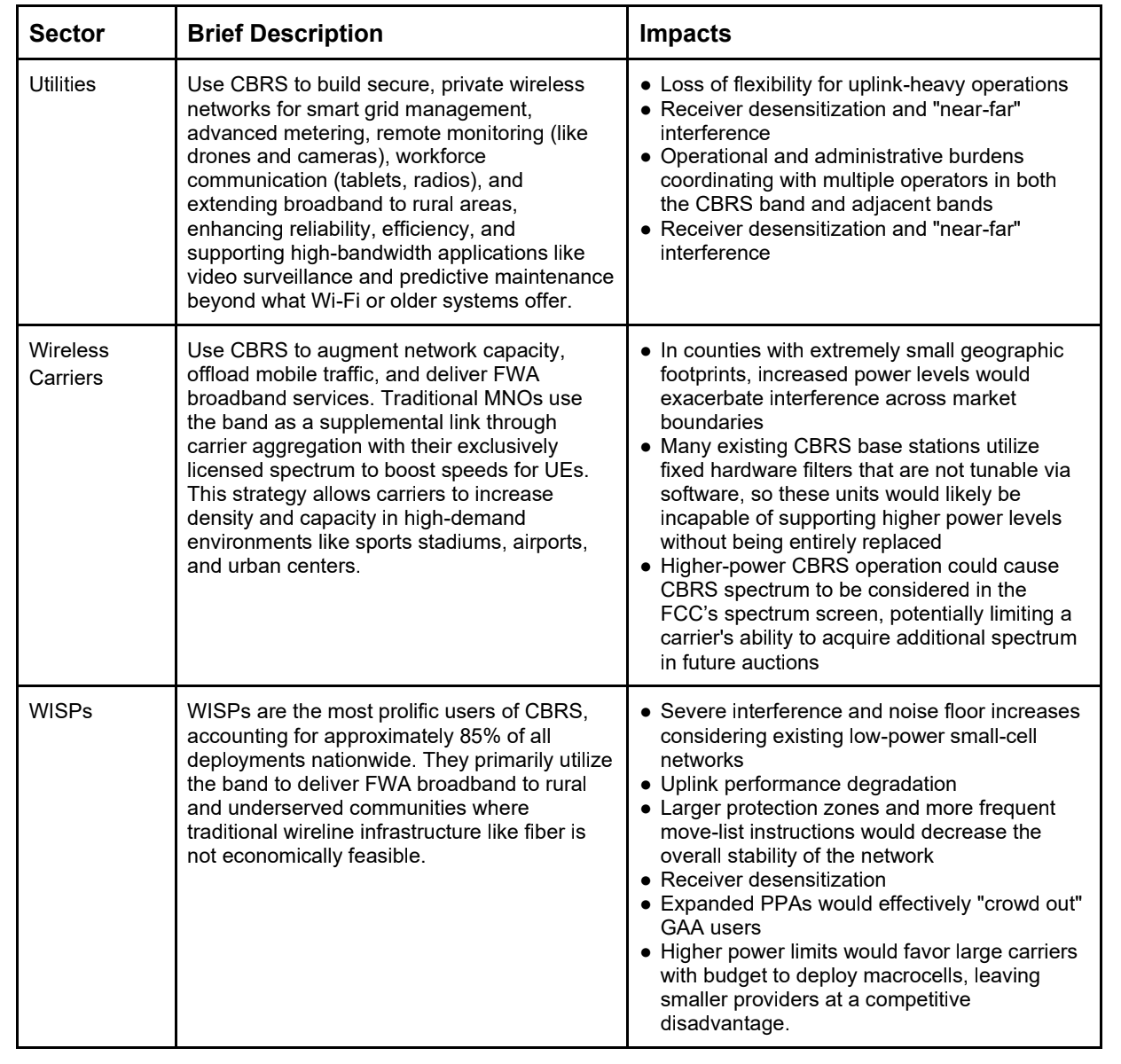
Bottom line: By design, the CBRS ecosystem serves a much wider variety of operators than any other licensed band. More than 430,000 base stations are registered by more than 1,000 different operators serving an untold number of users, supporting a vast array of products and services. Higher-power operations should be expected to disrupt and fundamentally change the nature of all deployed (and planned) CBRS systems. To better provide the wide-ranging negative impact of higher power beyond simply the illustrative case studies in this report, we’ve provided a concise survey of several high-level sectors that rely on CBRS, and the potential impacts that higher power operation in the band would potentially have on their use of CBRS.
Table 2 below identifies the key sectors that comprise the CBRS ecosystem and identifies general impacts of higher-power CBRS operation. The impacts identified are based on comments and filings provided by representatives of these sectors on the FCC’s rulemaking proceedings under GN Docket No. 17-258.
Some common impacts across multiple sectors include:
- Increased risk of harmful interference, thereby diminishing network reliability and function
- Reduced spectrum availability and reuse especially for GAA users
- Stranded investment and infrastructure
7. Conclusions
This study has used case studies and a high-fidelity “Shadow SAS” simulation operating on actual CBRS deployment data to examine the potential impacts of higher-power CBRS operations (i.e., 32 to 320 times greater power than presently allowed) on existing CBRS deployments and on the CBRS ecosystem as a whole. We examine three specific case studies as well as consider broader impacts. It’s clear from discussions with operators as well as statistical analysis of current CBRS deployments that CBRS users (including PALs) rely heavily on GAA spectrum and that higher-power operation will significantly reduce the amount of spectrum available for GAA applications. Conversion to higher-power CBRS will even cause disruption to PAL operations due to the need for PALs to protect other PALs in adjacent markets, and through possible strong adjacent-channel interference that is not protected by FCC rules or enforced by SASs.
With regard to the three case studies, we found:
- Manufacturing: John Deere uses CBRS extensively for manufacturing, logistics, and office operations. They hold PAL licenses and, like most PALs, also utilize GAA. Their network engineers have seen 1000x throughput and latency degradation due to external co-channel interference under existing CBRS power limits. They have managed to engineer around such problems, but if the external interference were increased in power by up to 320 times, the situation becomes intolerable. Analysis shows that any Category C CBSD within approximately 10-20 km of their manufacturing facility would terminate their co-channel GAA grants outright. For Category D, this distance increases to 20-30 km, encompassing most of the surrounding populated area. In a specific current case of a high-site CBSD near their headquarters facility, if the device were converted to Category C power, Deere’s co-channel private network’s coverage would shrink to a range of between 44-103 feet, and would no longer be able to cover Deere’s relatively compact office campus. If the interfering CBSD converted to Category D power, Deere’s co-channel network coverage shrinks to an area smaller than the reach of wireless earbuds. Even worse, the interfering signal exceeds blocking and adjacent channel protection levels, potentially causing interference to Deere’s “protected” operations on its PAL channel due to adjacent channel GAA interference. There is no regulatory or SAS-enforced remedy for adjacent channel interference. Higher-power operation would likely unleash a multitude of adjacent channel and blocking interference cases throughout the CBRS ecosystem, in addition to co-channel interference.
- Commercial Aviation: If high-power CBRS is allowed, Miami International Airport’s private CBRS network will lose almost one-third of its network capacity, thereby jeopardizing its existing (and planned) operations for video surveillance, baggage screening and handling, public safety communications, Customs and Border Protection operations and other functions. In addition, it will jeopardize – if not outright cancel – current plans to expand CBRS use in nearby passenger cruise terminals.
- Wireless Internet Access: Operating a CBRS network near the Canadian border has provided Amplex with a unique "stress test" for high-power interference scenarios because the band is used for high-power macro cells in Canada. Specifically, portions of the Amplex CBRS network (both PAL and GAA) with equipment directed toward Canada experience periodic signal disruption today from Canadian macro cells operating in the same frequency band. These Canadian cells utilize power levels comparable to those proposed for Category C and D CBSDs, frequently causing interference into Amplex's network operations and causing disruption (and complete outages) to Amplex's customers close to the Canadian border. Amplex's experience in these border locations where Canadian high-power operations exist serves as a practical cautionary tale of the broader interference challenges U.S. operators will face if Category C or D power levels are authorized domestically and more widely.
On a broader scale, we identified the following considerations:
- Larger PAL Protection Areas (PPAs) created by higher-power PAL operations will consume a considerable amount of spectrum that is currently being used, or available for use, by GAA. 3 - 4.5 terabits per second of CBRS GAA throughput would be lost by either grant terminations or co channel interference if even 3.6% of devices operating under PAL (or 1.3% of all CBSDs) decide to convert to Category C or D operation. Because nearly all PALs also rely on GAA spectrum to meet their bandwidth requirements, all sectors of the CBRS ecosystem will be impacted.
- Beyond the quantifiable impacts identified in the prior sections, there are additional impacts that higher-power operation will have on the existing CBRS ecosystem. These ancillary impacts are a matter of aggregate interference and therefore highly situation-dependent. They also depend on future regulatory and standards decisions that must be made as a result of input to a proceeding or discussions in standards bodies. The potential impacts are therefore essentially impossible to quantify with any certainty at this time. But these impacts are no less real than those quantified in the previous sections.
- By design, the CBRS ecosystem serves a much wider variety of operators than any other licensed band. More than 430,000 base stations are registered by more than 1,000 different operators serving an untold number of users, supporting a vast array of products and services. We’ve provided a concise survey of multiple high-level sectors that rely on CBRS, and the potential impacts that higher-power operation in the band would potentially have on their use of CBRS.
In summary, a low-power small-cell model allows for hundreds of independent networks to operate in a single city. Each network "whispers," so its neighbor can also speak. A macro-cellular tower is like a megaphone in a crowded restaurant – while one person can be heard very clearly, everyone else must stop talking because the background noise becomes overwhelming. Shifting to high-power would transform a band that supports a thousand diverse operators into a band that can only support a few dominant players, essentially ending the experiment in spectrum democracy that CBRS represents.
Annex A: Understanding PAL Protection Areas
When an operator that holds a Priority Access License (PAL) registers a CBSD in their licensed area (i.e., a county or a collection of neighboring counties) and that CBSD obtains one or more grants on the operator’s assigned PAL channel(s), a “PAL Protection Area”40 (PPA) surrounding that CBSD is established, protecting devices within the PPA from interference on the PAL channel(s) due to co-channel operations.41 These protections are enforced by the SAS against both GAA and other PALs (in adjacent license areas) operating on the same channel(s) as the PPA. Their co-channel aggregate received signal strength (i.e., the total interference level) at a height of 1.5 m above ground cannot exceed - 80 dBm/10 MHz at any point in the PPA, unless the affected PAL agrees to an alternative limit.42
PPAs are fundamental to the CBRS concept of “use-or-share.” Even if a PAL owns a license in a particular license area, GAA operators can use the PAL’s channel(s) anywhere in that license area unless and until the PAL operator brings a CBSD into use, at which time the GAA’s operations (i.e., maximum allowed power) may have to be adjusted to avoid the interference level in the PAL from being exceeded. If the GAA is inside the PPA, its grant is automatically terminated (or not allowed in the first place) as there is no way for it to meet the interference protection requirement. Otherwise, GAA operators are allowed to operate anywhere in the PAL’s license area on the PAL’s channel(s) as long as they are able to meet the PPA protection requirements. A simplified illustration of the concept is illustrated in Figure A 1.
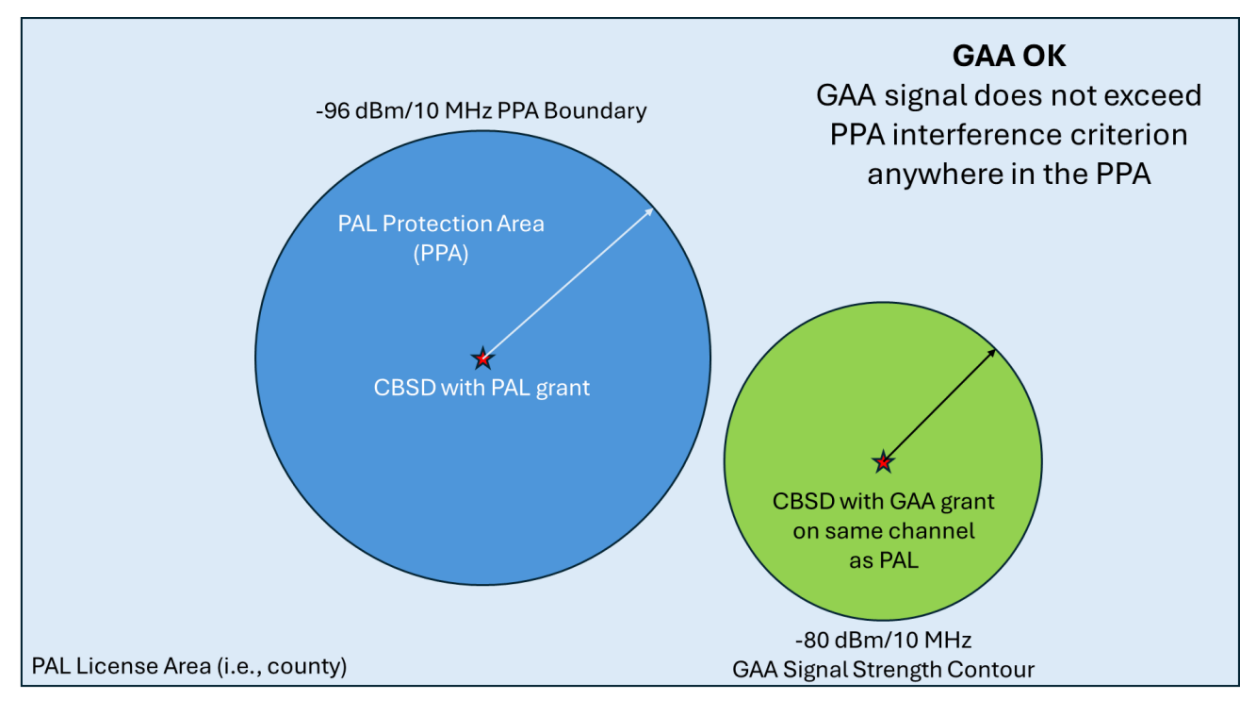
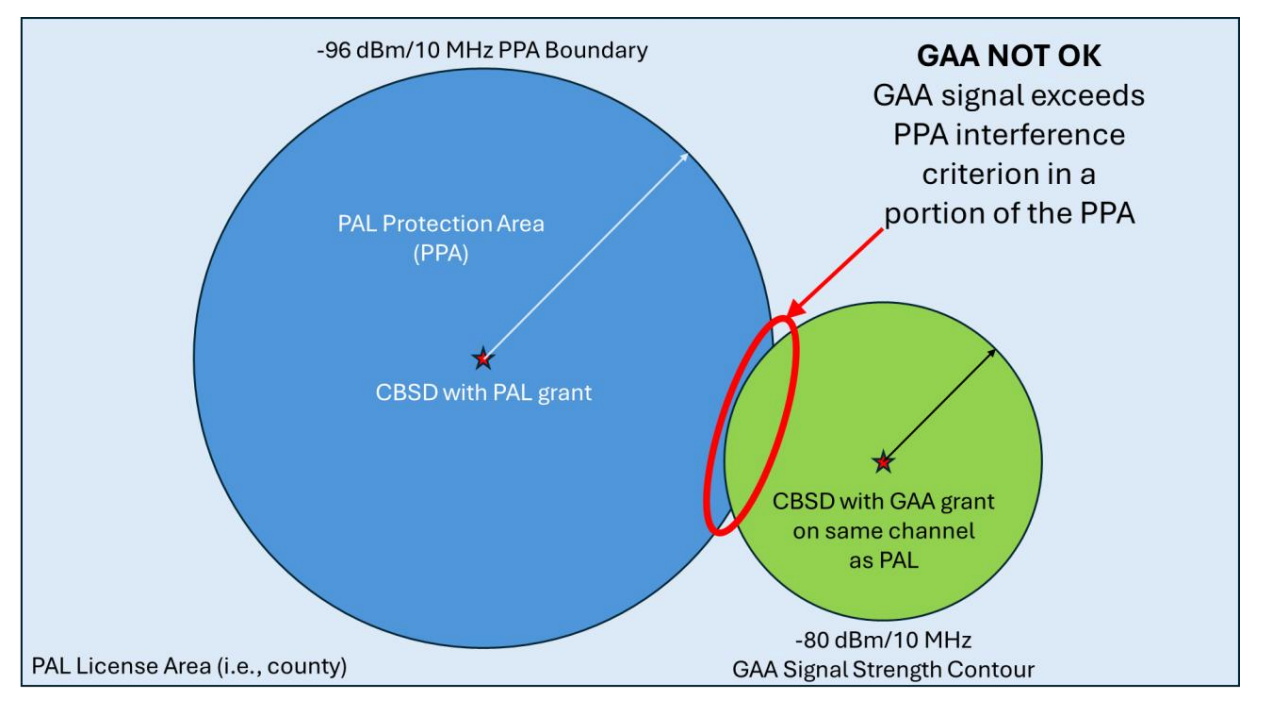
The default PPA boundary is defined by the FCC’s rules as a -96 dBm/10 MHz contour. If there is a cluster of CBSDs in a particular area and their contours overlap, the PPA is created from the boundary of the combined contours. PAL operators are allowed to self-report PPA protection contours that are smaller than the default. The PPA cannot extend beyond the PAL operator’s service area, keeping in mind that the PAL operator may be assigned the same PAL channel(s) in contiguous license areas, allowing their PPA to extend across license area boundaries if the PAL operator owns the channel(s) in all of the involved license areas. Also, a PAL’s signal, exceeding -96 dBm/10 MHz, may extend across license area boundaries to the extent that the signal does not contribute to exceeding the -80 dBm/10 MHz aggregate interference protection criterion in another operator’s co-channel PPA.
Details of how PPA contours are calculated have been established in the WInnForum CBRS standards.43 The contour is calculated at 1 deg increments in azimuth at a radial step size of 200 m, out to a maximum distance of 40 km. Due to terrain irregularities along the path, the predicted signal strength may go above and below the -96 dBm/MHz threshold as distance increases. The PPA distance along a particular radial is therefore calculated using a cumulative counting method, which sets the distance as the step size (200 m) times the number of radial points for which the signal is predicted to exceed the threshold. Finally, the PPA contour is smoothed in azimuth using a 15-point Hamming filter.
WInnForum standards call for the use of a hybrid propagation model for the calculation of PPAs and interference into PPAs from other CBRS operators. The hybrid model was created with the input of the NTIA Institute for Telecommunication Sciences, and is a combination of the Irregular Terrain Model (ITM) and the extended Hata (eHata) model, blended in a manner that depends on distance and retains a smooth loss profile (i.e., no discontinuities with distance). Besides frequency, the model also depends on the land-use classification of the CBSD and PPA, with three distinct categories defined: urban, suburban, and rural, Generally, the model predicts lower loss (therefore larger PPAs) for rural compared to suburban, and for suburban compared to urban, due to the expectation that there is less clutter in the form of buildings as land use transitions from urban through suburban to rural. The result is that the amount of geography in which another operator is predicted to be a possible interference source to a PPA is greatest in rural areas, all else being equal.
For the purpose of this study, it is important to note that the existing PPA calculation method as defined by WInnForum standards limits the PPA radial distance calculation for a given CBSD to a maximum distance of 40 km. This value is based upon the current maximum CBRS power limit. If CBRS power limits were increased, WInnForum would need to revisit the 40 km maximum distance for PPA calculations, which would have the effect of potentially allowing PPAs for higher-power devices to exceed 40 km in radius, and may increase the size of PPAs even for devices operating under the current power limits if their calculated PPA distance along one or more radials exceeds 40 km if a larger distance was allowed. Absent discussions within the relevant WInnForum standards bodies and subsequent approved revisions to the standards (and of course subject to any future FCC rules), the revised maximum distance for higher-power operations is unknown.
Annex B: Incumbent Protections
A SAS becomes aware of when and where incumbent military systems are operating in the 3550-3650 MHz band primarily by way of a coastal network of radar sensors referred to as an Environmental Sensor Capability (ESC), which notifies the SAS when it senses military radar activity. Although the SAS becomes aware of military radar operations by way of an ESC, in no way does the SAS manage military radar activity. The SAS simply becomes aware of such activity and manages CBSDs so as not to interfere.
Due to operational security concerns, ESCs do not identify the exact location of military radars. Instead, ESCs identify radar operation within a defined area called a Dynamic Protection Area (DPA). Most DPAs begin just off-shore. Associated with each DPA is a neighborhood where CBSDs are managed to prevent aggregate interference with military radar operations. There are 106 coastal DPAs and associated neighborhoods covering the entire CONUS and OCONUS coastline as shown in Figure B-1. Note there are also DPAs for certain inland ground-based radars which are activated using a notification portal.44
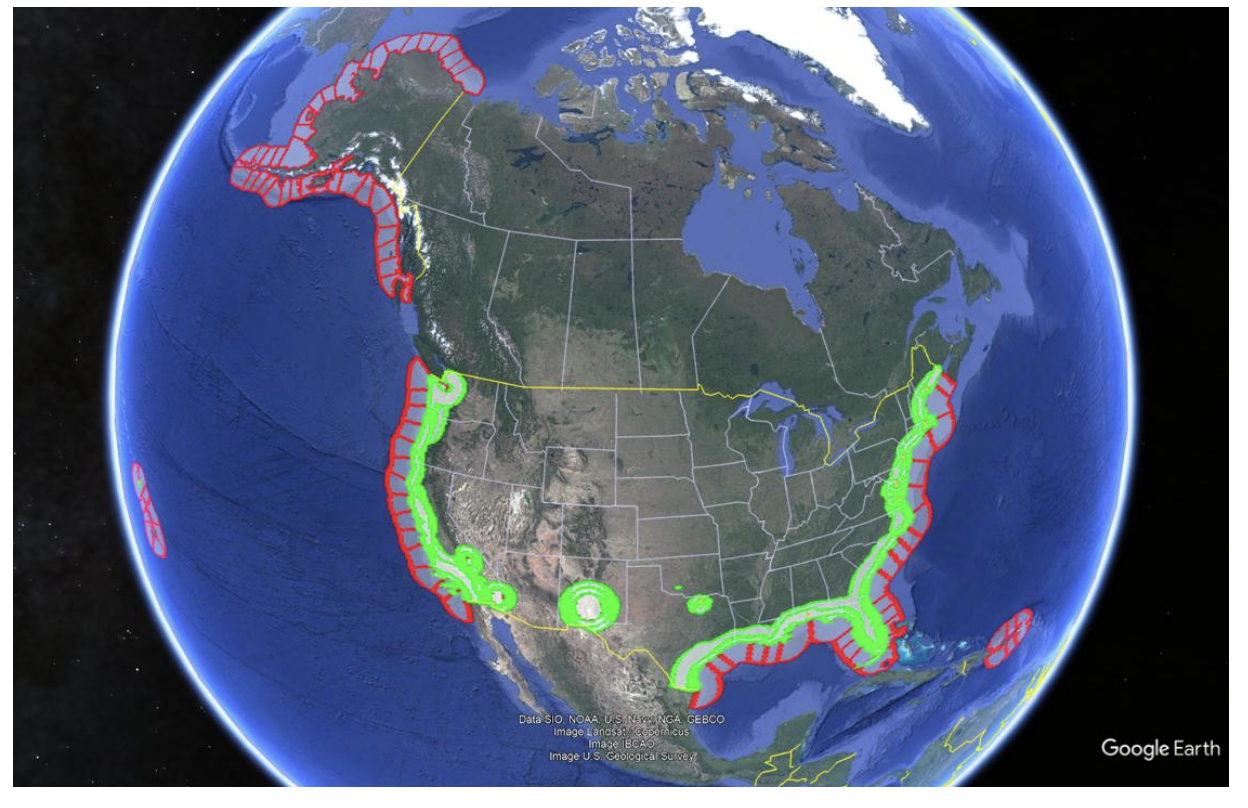
Incumbent radars are protected from aggregate co-channel interference from CBSDs that are within the defined neighborhood distance of the boundary of the corresponding DPA. The neighborhood distances depend on the CBSD Category (A or B), whether it’s indoors or outdoors (for Category A), and whether its antenna is above or below 6 m above ground level. Neighborhood distances also depend on DPA, because the radio propagation environment (i.e., terrain) differs for different areas of the country. The distances range from a few km (for indoor Category A below 6 m) to hundreds of km (for outdoor Category B above 6 m in areas with little terrain blockage toward the ocean). By industry standards, the incumbent radar is protected at all points within the DPA (on a 2 arc sec grid) for all pointing azimuths of the radar antenna (at 1.5 deg increments). Combined with the number of co-channel CBSDs that must be considered, the combination of factors (protection points, radar pointing angles, CBRS channel, and CBSDs), tens of millions of calculations must be performed to determine protections for a particular DPA.
To allow ESC sensors to detect potentially distant radar signals, the sensors are protected from interference by considering aggregate interference from all CBSDs in the 3550-3680 MHz range,45 in an area as far as 40 km from the sensor site (for Category A) and 80 km from the sensor site (for Category B). Aggregate interference from all CBSDs in the so-called “whisper zone” is maintained below the interference protection threshold of the corresponding sensor. If higher-power CBSDs are allowed, the standards bodies would need to assess the necessary whisper zone distances for those categories, which would be greater than 80 km.
CBRS must also protect some in-band and adjacent band commercial fixed-satellite service (FSS) earth stations in the 3600-3700 MHz band from interference (see Figure B-2).46 Protected earth stations must register with the FCC yearly and are protected using coordination contours based on whether they are within the CBRS band (“in-band FSS”) or immediately adjacent (“adjacent-band FSS”). In-band earth stations are protected from blocking interference and co-channel aggregate interference over a 150 km coordination contour. Earth stations in the adjacent 3700-4200 MHz band that are used for Telemetry, Tracking, and Command (TT&C) are protected from out-of-band and blocking interference within a 40 km coordination contour, although the number of adjacent-band earth stations is decreasing due to the deployment of the 3.7 GHz Service in 3700 - 3980 MHz. CBRS operators and FSS operators may jointly agree on interference protections different from those prescribed by FCC rules.47
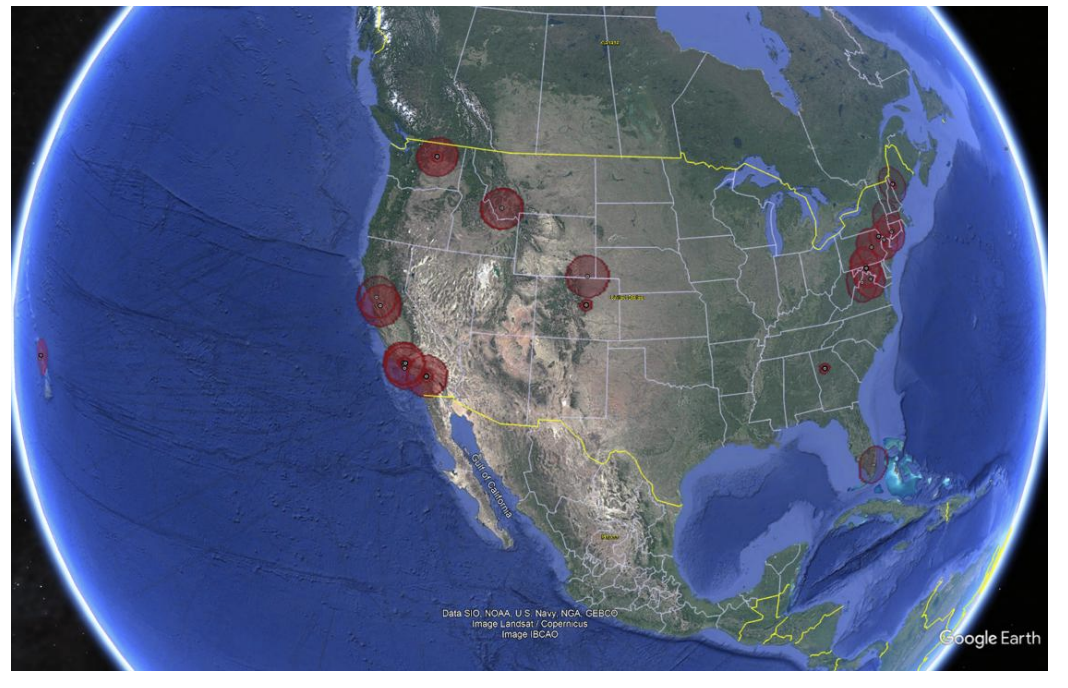
Annex C: Interference Protections in CBRS
The following matrix summarizes the various combinations of protections (or lack of protections) based on the FCC’s CBRS rules and industry standards.
Three key take-aways relevant to this study:
- PALs are protected from co-channel interference through the use of PPAs;
- There are no adjacent channel protections between CBSDs (PAL and/or GAA); and
- The SAS does not enforce co-channel protections among GAA.
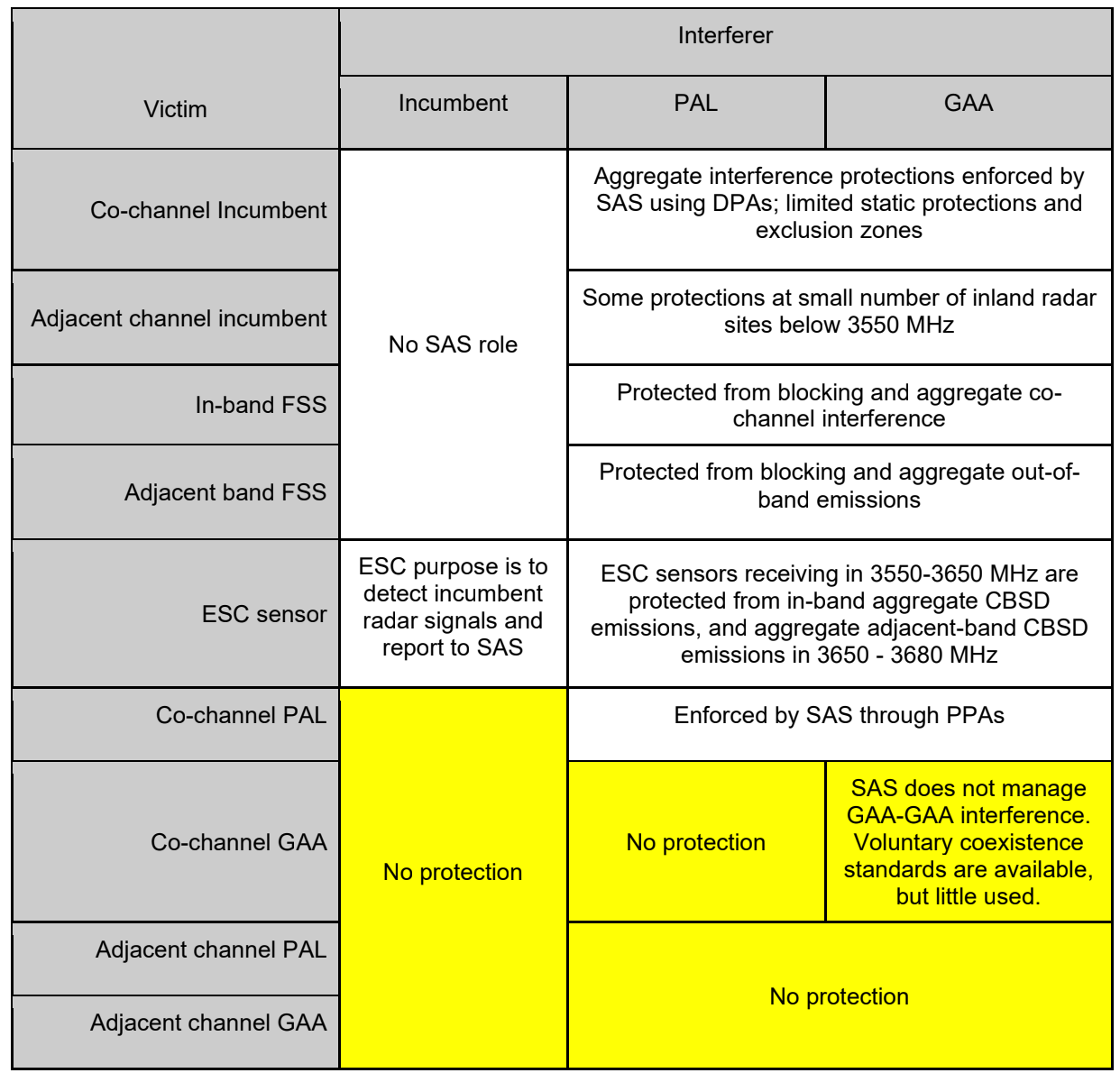
Annex D: Link Budget for Interference Analysis from Nearby CBSD
The details in this annex are with respect to the analysis of interference to John Deere’s CBRS installation at his headquarters office building as described in section 3(A).
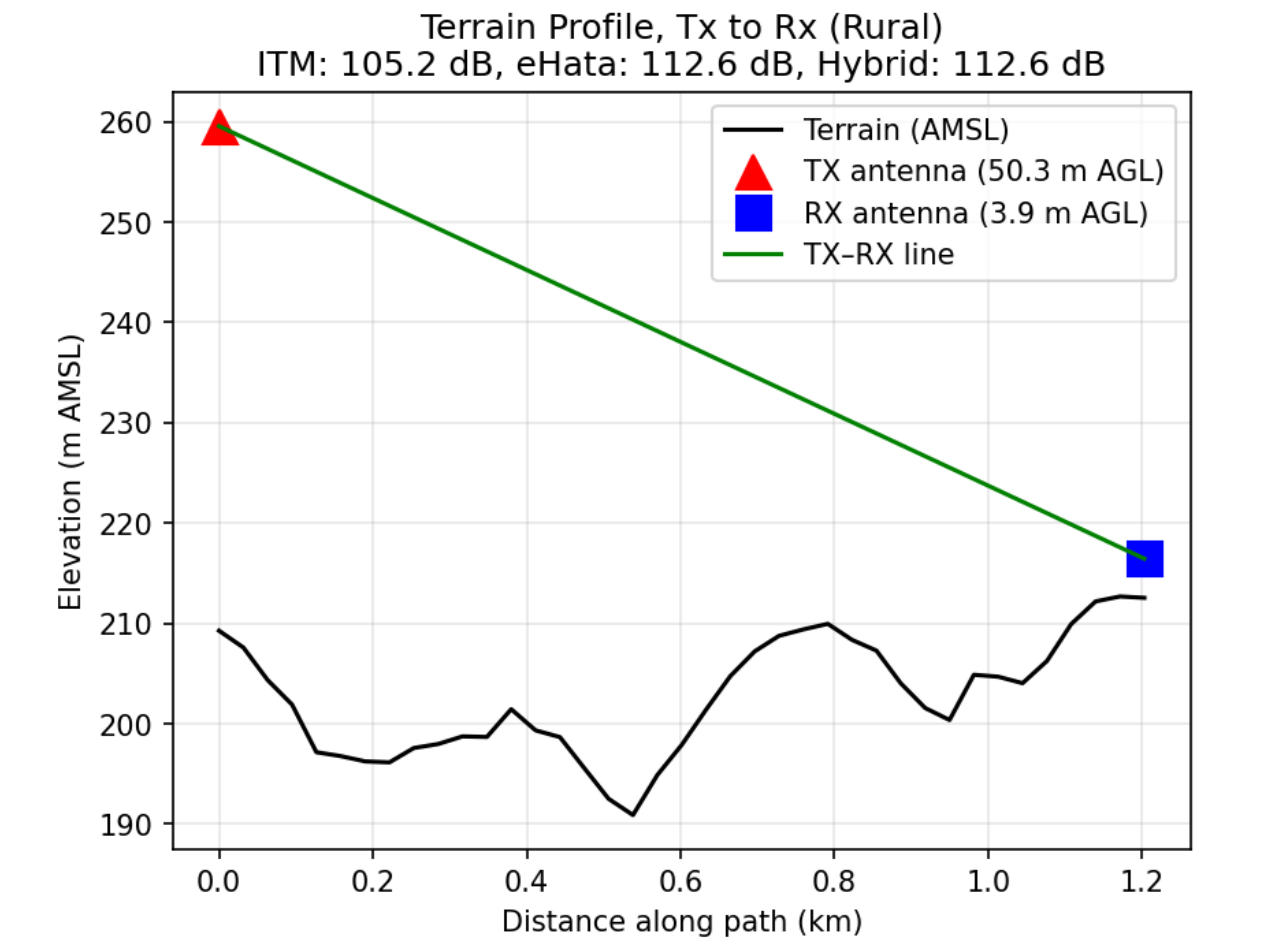
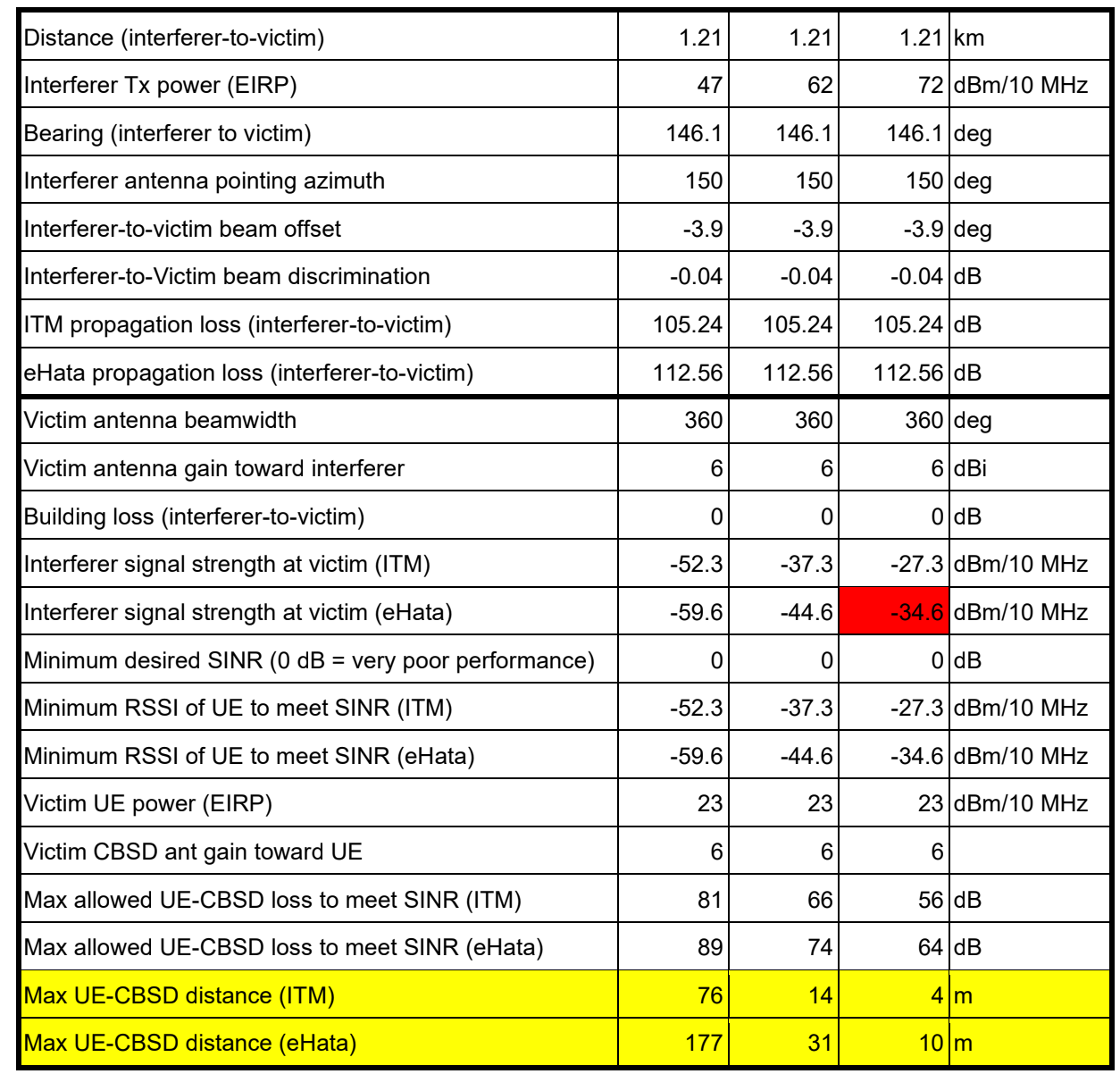
The link budget assumes two different scenarios for propagation loss from the interfering CBSD to the victim CBSD: ITM and eHata. ITM is essentially free space loss (see the path profile in Fig. D1), while eHata has a generic allowance for additional clutter loss. Based on Fig. D1, free space loss probably applies and has the worse outcome of the two, but both scenarios are shown for completeness. The calculation of the max distance from UE to victim CBSD (yellow highlight) to meet the minimum SINR criterion assumes free space loss between the UE and victim CBSD. The received interference signal strength highlighted in red exceeds adjacent channel protection criteria as well as FCC requirements for blocking performance for CBRS PAL48 even assuming the greater loss of the eHata model, and therefore is expected to cause interference even if the victim and interferer are not co-channel
Annex E: Reverse PPA Methodology
In some places, this report utilizes a "reverse PPA" methodology to estimate the potential interference footprint of a Citizens Broadband Radio Service Device (CBSD).
The Core Concept: Reciprocity
The model is based on the principle of radio wave propagation reciprocity. A standard PPA defines the service area where a CBSD signal is at least -96 dBm/10 MHz. By "reversing" this, we assume that if a device within that boundary transmits back toward the CBSD, its signal will arrive with at least that same -96 dBm strength—identifying it as a potential source of interference.
Variable Factors and Offsetting Risks
While no prediction model is perfect, this methodology accounts for several technical nuances that generally balance each other out:
Conclusion
On balance, the factors that underpredict the boundary (antenna height and victim gain) are roughly mitigated by the factors that overpredict it (interferer beam pointing and antenna suppression). Consequently, we believe the reverse PPA method serves as a useful tool for estimating co-channel interference zones.
Annex F: For Additional Information
Listed below are several references that can be used to find additional information.
1. Next Steps for Innovative Spectrum Sharing, Remarks of Sarah Morris, Deputy Assistant Secretary of Commerce for Communications and Information (Acting), NTIA, Washington, D.C., June 18, 2024, https://www.ntia.gov/speech/testimony/2024/next-steps-innovative-spectrum-sharing
2. CBRS Is Powering America's Wireless Future - NCTA, accessed February 25, 2026, https://www.ncta.com/news/cbrs-powering-americas-wireless-future
3. ICYMI: Power Level Changes Would “Kill Spectrum Efficiency” Says SFTF Policy Director, accessed February 25, 2026, https://spectrumfuture.com/power-level-changes-would-kill-spectrum efficiency-says-sftf-policy-director/
4. Helping Feed the World Requires Better Rural Connectivity - John Deere, accessed February 25, 2026, https://www.deere.com/en/stories/featured/rural-connectivity/
5. Shared Commercial Operations in the 3550-3650 MHz Band - Federal Register, accessed February 25, 2026, https://www.federalregister.gov/documents/2015/06/23/2015-14494/shared commercial-operations-in-the-3550-3650-mhz-band
6. Raising CBRS power levels would undermine its vital spectrum sharing capabilities (Reader Forum) - RCR Wireless News, accessed February 25, 2026, https://www.rcrwireless.com/20241108/reader-forum/raising-cbrs-power-levels-reader-forum
7. ICYMI: Rural Broadband Experts Warn CBRS Power Changes Would Disrupt Internet Access - Spectrum for the Future, accessed February 25, 2026, https://spectrumfuture.com/icymi-rural broadband-experts-warn-cbrs-power-changes-would-disrupt-internet-access/
8. WISPs to the FCC: Preserve Current CBRS Rules to Maintain Affordable, Reliable Service for Rural Communities - Spectrum for the Future, accessed February 25, 2026, https://spectrumfuture.com/preserve-current-cbrs-rules-to-maintain-service-for-rural-communities/
9. Ericsson comments to FCC NPRM 17-258, https://www.fcc.gov/ecfs/document/1107211735364/1
10. CBRS coalition sees growth – and need for more spectrum - Fierce Network, accessed February 25, 2026, https://www.fierce-network.com/wireless/cbrs-coalition-sees-growth-and-need-more spectrum
11. Dean Bubley: CBRS Shared Spectrum Critical for U.S. Wireless Innovation - Broadband Breakfast, accessed February 25, 2026, https://broadbandbreakfast.com/dean-bubley-cbrs-shared-spectrum critical-for-u-s-wireless-innovation/
12. Commission rules to make 150 megahertz of spectrum available for wireless broadband and other innovative uses, Report and Order and Second Further Notice of Proposed Rulemaking, GN Docket No. 12-354 https://docs.fcc.gov/public/attachments/FCC-15-47A1.pdf
13. FCC Seeks Comment on Updates to Citizens Broadband Radio Service Rules, Notice of Proposed Rulemaking and Declaratory Ruling, GN Docket No. 17-258 https://docs.fcc.gov/public/attachments/FCC-24-86A1.pdf
14. Upper C-band (3.98-4.2 GHz) Notice of Proposed Rulemaking – WT Docket No. 25-59 - Federal Communications Commission, https://docs.fcc.gov/public/attachments/DOC-415193A1.pdf
15. ICYMI: Tech Expert Warns Weakening CBRS GAA Would Undermine U.S. Wireless Innovation - Spectrum for the Future, accessed February 25, 2026, https://spectrumfuture.com/tech-expert warns-weakening-cbrs-gaa-would-undermine-u-s-wireless-innovation/
16. CBRS and Wi-Fi: Which Is Best For Your Organization? - Celona, accessed February 25, 2026, https://www.celona.io/cbrs/cbrs-vs-wifi
17. ICYMI: John Deere Leverages CBRS-Powered 5G to Revolutionize American Manufacturing, accessed February 25, 2026, https://spectrumfuture.com/icymi-john-deere-leverages-cbrs powered-5g-to-revolutionize-american-manufacturing/
18. CBRS spectrum helps US manufacturing grow (Analyst Angle) - RCR Wireless News, accessed February 25, 2026, https://www.rcrwireless.com/20250728/analyst-angle/cbrs-us-manufacturing
19. John Deere Wins FCC CBRS Auction to Deploy 5G in Manufacturing Facilities, accessed February 25, 2026, https://www.prnewswire.com/news-releases/john-deere-wins-fcc-cbrs-auction-to-deploy 5g-in-manufacturing-facilities-301175952.html
20. How Miami International Airport is Using a CBRS Private Network to Transform into a Smart, Connected Aviation Hub - CBRS Alliance, accessed February 25, 2026, https://ongoalliance.org/wp-content/uploads/2024/06/OnGo-Alliance-MIA-Case-Study-20240604.pdf
21. CBRS at Work: Miami International Airport - NCTA, accessed February 25, 2026, https://www.ncta.com/news/cbrs-at-work-miami-international-airport
22. CBRS: Powering the Next Wave of Private Network Growth - Spectrum for the Future, accessed February 25, 2026, https://spectrumfuture.com/cbrs-powering-the-next-wave-of-private-network growth/
23. January 28, 2026 FCC FACT SHEET* Review of the Commission's Rules Governing the 896– 901/935–940 MHz Band Report and Order, accessed February 25, 2026, https://docs.fcc.gov/public/attachments/DOC-418283A1.pdf
24. The U.S. should defend, evolve and extend CBRS (Analyst Angle) - RCR Wireless News, accessed February 25, 2026, https://www.rcrwireless.com/20250530/analyst-angle/cbrs-analyst-angle
25. Areas with limited CBRS spectrum | Spectrum Access System | Google Cloud Documentation, accessed February 25, 2026, https://docs.cloud.google.com/spectrum-access system/docs/locations
26. 3650 - SpectrumWiki, accessed February 25, 2026, https://www.spectrumwiki.com/wiki/display.aspx?f=3650
27. CBRS Could Be Key to Scaling Fixed Wireless Broadband, accessed February 25, 2026, https://broadbandbreakfast.com/cbrs-could-be-key-to-scaling-fixed-wireless-broadband/
28. FCC wants to auction up to 180MHz in the upper C-band - Light Reading, accessed February 25, 2026, https://www.lightreading.com/5g/fcc-wants-to-auction-up-to-180mhz-via-upper-c-band-auction
29. It's easy to reassign spectrum if you're not the one using it - Light Reading, accessed February 25, 2026, https://www.lightreading.com/5g/it-s-easy-to-reassign-spectrum-if-you-re-not-the-one-using-it
30. Ookla “State of the Mobile Union Report”, 1H2025, https://www.ookla.com/research/reports/rootmetrics-us-state-of-mobile-union-1h-2025
Annex G: Authors
Andrew Clegg is a co-founder of Valo Analytica, a start-up dedicated to radio spectrum data and analytics. He also holds an appointment as senior research scientist in Baylor University's Electrical and Computer Engineering department. Previously he served as spectrum engineering lead for Google, where he was a prolific contributor to the FCC's proceeding establishing CBRS. After adoption of the final CBRS rules, he served as chair of the Wireless Innovation Forum committee that created the industry standards on which the CBRS ecosystem runs. He helped design, build, certify, and operate the Google SAS and its related ESC network. He was also the world's first CBRS Certified Professional Installer. Prior appointments include electromagnetic spectrum manager for the National Science Foundation, lead member of technical staff for Cingular Wireless (now part of AT&T), senior engineer at Comsearch, and research scientist at the Naval Research Laboratory. He holds a PhD in radio astronomy and electrical engineering from Cornell University.
Mark Gibson has over 40 years of experience working in the areas of spectrum management, spectrum regulatory policy, frequency coordination, and RF engineering. He recently retired from ANDREW (formerly CommScope), working in the Outdoor Wireless Network CTO office as Sr. Director, Business Development & Regulatory Policy. He led technical and business development efforts for numerous wireless and spectrum-related products and services, particularly the CBRS SAS and ESC and the 6 GHz Automated Frequency Coordination system. He has also led efforts to address spectrum sharing between Federal government and commercial users. He was President and Chair of the Wireless Innovation Forum and served as a board member and regulatory officer of the OnGo Alliance. He was a member of the Commerce Spectrum Management Advisory Committee (CSMAC) for 14 years, where he was CSMAC co-chair and also co-chaired working groups. He has testified before the U.S. Congress on spectrum policy and related matters. He has a BSEE from the University of Maryland and is a Life Member of IEEE.
Check out other resources from Spectrum for the Future:
 Broadband Breakfast
 Dean Bubley
 Dean Bubley