Next-Generation Wireless Access in Dense Urban Markets

From company's HQ, Tarana Wireless CEO Basil Alwan cited higher network capacity even under heavy interference

Next-Generation Wireless Access in Dense Urban Markets
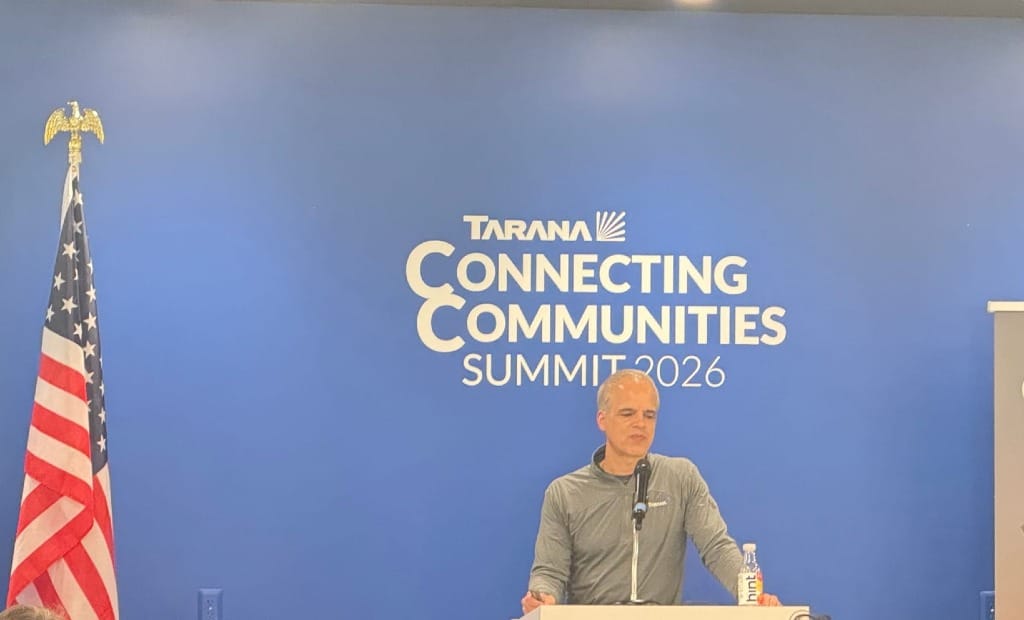
Photo of Tarana CEO Basil Alwan at the Connecting Communities Summit Wednesday, Jan. 28, 2026, in Milpitas, Calif.

MILPITAS, Calif., Jan. 28, 2026 — Tarana Wireless, a Silicon Valley fixed wireless equipment company, highlighted its new product as a primary broadband access technology built around next-generation wireless access.

CEO Basil Alwan said the company's G2 platform could support residential broadband with higher capacity and improved reliability. In particular, Tarana is engineered to function as a full-access network, not simply a niche or temporary alternative to fiber.

The system is being tested in San Jose, Calif., where fixed wireless systems mingle in dense urban neighborhoods with high levels of radio interference. And the company’s fixed wireless signals currently reach between 15 million and 20 million homes nationwide, based on coverage modeling around deployed sites. 

He cautioned that was an approximation, not a precise count of served locations.

Fixed wireless can operate in environments traditionally considered unsuitable for wireless broadband, and not just rural or lightly populated areas, Alwan said.

The G2 platform builds on those deployments by using unlicensed spectrum, the same category of public airwaves used by Wi-Fi, combined with software that actively cancels radio interference in real time, he said. 

That approach allows a single site to serve several times more households than conventional fixed wireless systems using the same spectrum.

While most residential customers still subscribe to plans in the 300 to 500 Megabit per second (Mbps) download range, providers value the added capacity because it allows them to add customers per site without degrading service, he said.

G2 has roughly double network capacity versus Tarana’s previous generation, expanding the number of locations capable of receiving gigabit-class service.

Member discussion

Popular Tags