
NTIA, Industry Eyeing 4.4 GHz for Commercial Use
There are currently 15 federal agencies using the airwaves.

Jake Neenan
WASHINGTON, Nov. 12, 2025 – The National Telecommunications and Information Administration is close to completing plans for studying two government spectrum bands for potential repurposing, a top agency official said Wednesday.
Those are the 4.400-4.940 GigaHertz (GHz) and 2.7-2.9 GHz bands, according to a top agency official, which together comprise 740 megahertz of airwaves. The agency is looking to make more spectrum available to wireless carriers.
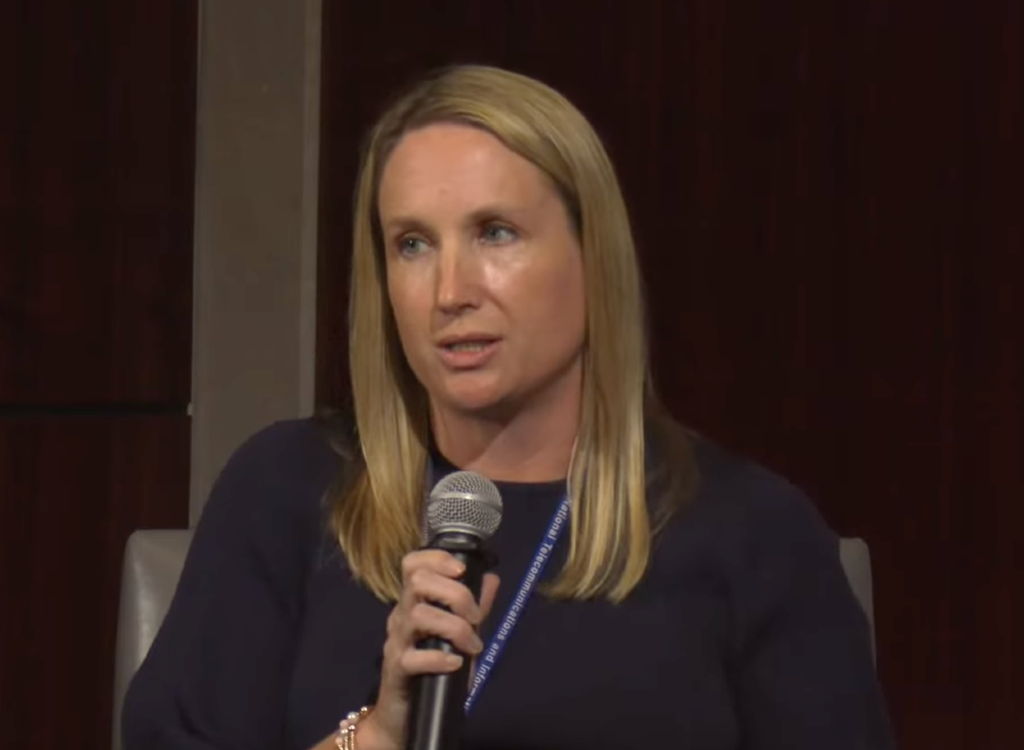
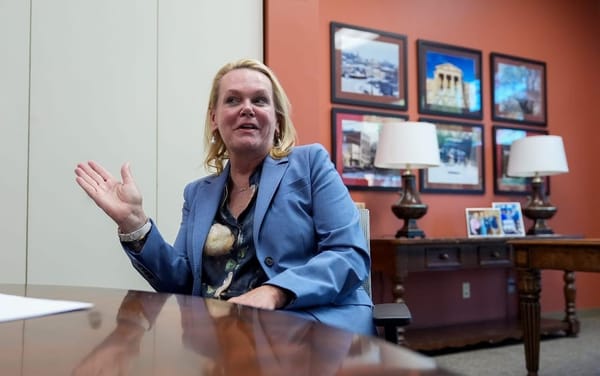
“During the shutdown NTIA has been working on band study plans for 2.7 and 4.4 so that we can quickly have those out the door when the government reopens,” NTIA Chief of Staff Brooke Donilon said Wednesday. She spoke at an event hosted by the Center for Strategic & International Studies and sponsored by CTIA, the mobile industry trade group.
She said NTIA Administrator Arielle Roth is particularly interested in opening as much of the 4.4 GHz band as possible to wireless carriers.
There are 15 federal agencies that currently use the band, Donilon noted, making the task a difficult one. She said NTIA had had “really great conversations” with the Defense Department and Justice Department, the two largest users of the band.
Budget law requires NTIA to find 500 megazhertz
The budget reconciliation bill, officially named the One Big Beautiful Bill Act, requires NTIA, which manages federal spectrum, to identify 500 megahertz of those government airwaves for auction by July 2029. At least 200 megahertz have to be identified by July 2027.
In addition to the 2.7 GHz and 4.4 GHz bands, NTIA is also planning to assess 7,125-7,400 MHz and 1,680-1,695 MHz.
“We certainly view” the 500 megahertz requirement “as a floor,” Donilon said. “We absolutely plan to meet our mandate, ideally, early. My engineers will get very mad at me for saying that, but we want to be on time and we want to overdeliver.”
The process of getting funding for agencies to do those studies can be arduous, she noted. Funding for the 7 GHz spectrum was secured under the Biden administration, which was also interested in the band, but the 2.7 GHz and 4.4 GHz “have a lot more work to do” on that front, Donilon said.
“I will say, 4 GHz is music to my ears,” said Giulia McHenry, AT&T’s senior vice president of public policy. She also spoke at the CSIS event.
A Verizon executive said the company is also interested in the band, Light Reading reported Wednesday.
Umair Javed, senior vice president and general counsel at CTIA, said the band was “very important for our industry” because it was a large, contiguous swathe of airwaves and was being studied for global uses
Lower 7 GHz, 6 GHz
The OBBBA barred the Federal Communications Commission, which handles spectrum auctions, from selling off 7.4-8.4 GHz. It also shielded the lower 3 GHz band, both concessions to get the approval of Senators not eager to auction military airwaves the wireless industry has been eyeing.
Javed said CTIA was interested in the 7 GHz spectrum that was being studied – 7.125-7.4 GHz – just so long as some of the 6 GHz band was opened up too.
The band is unlicensed in the U.S. and largely used for Wi-Fi, but Javed noted some other countries allow full-power mobile operations in the upper portion of the band
“That 7 GHz band sits right next to it,” he said. “It means that we could get into the same equipment ecosystem as those other countries. And you’re already seeing vendors produce radios that are straddling the two bands.”
Consumer advocates and the cable industry, both Wi-Fi and spectrum sharing proponents, were concerned after the OBBBA’s passage that some 6 GHz spectrum might be auctioned off, given that the FCC has to find and sell 300 megahertz of non-federal spectrum, and it’s not clear where all of that is coming from.
But a White House advisor threw cold water on the idea of a reallocation in September, noting the band was first opened up during the previous Trump administration.
“A number of us in this administration were very intimately involved in designating that band,” said Robin Colwell, deputy director at the White House National Economic Council, speaking at the 2025 SCTE TechExpo. “We fought to get it, and I don't understand why anybody would think we're trying to go back on that now.”
McHenry said Wednesday that commercial access to 7 GHz would be more of a long-term goal. She said it would require new equipment and likely take years to deploy.
“Right now is an uncertain, challenging time in the economy for everyone,” she said. “Sitting on that spectrum for a while, for us, really doesn’t make any sense.”
She said the company was still interested in making the Citizens Broadband Radio Service, a shared band at 3.55-3.7 GHz, “an effective band for carriers.”
The company has proposed relocating current users and auctioning the airwaves off for full-power use. Other mobile providers have said the FCC should allow higher power levels in the band.
Current users, largely wireless ISPs and companies deploying private networks, are strongly opposed to either of those.


Member discussion