
NTIA Looking to Speed Permitting for BEAD
The agency outlined the post-award federal permitting process in a webinar this week.


WASHINGTON, Oct. 3, 2025 – With a large number of broadband builds likely to get underway next year as part of the $42.45 billion Broadband Equity, Access, and Deployment program, the agency managing the program is preparing to process a flood of federal permits as quickly as possible.
Those include historical and environmental reviews the National Telecommunications and Information has for more than a year been working to streamline. Outside the agency’s control, there are still state and local permitting requirements and permits from other federal agencies that could be required depending on where a given project is located.
NTIA held a webinar Tuesday outlining the permitting process for ISPs after their BEAD grants are set in stone. That’s expected by the end of the year for most states.
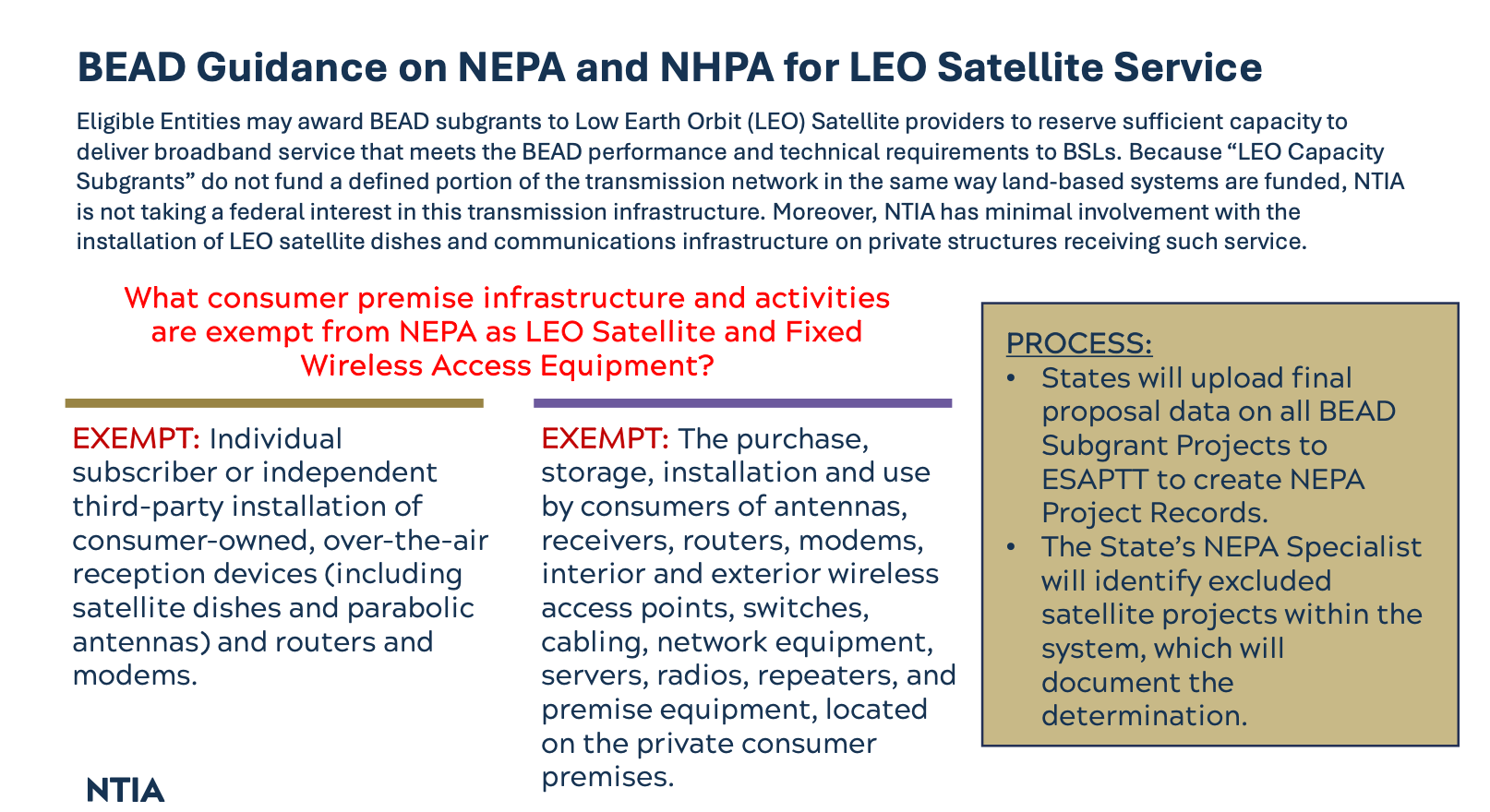
A category of project that’s entirely exempt from environmental reviews is the installation of low-earth orbit satellite dishes. About 20 percent of BEAD-eligible locations are in line for the service, based on states’ tentative awards.
On the local front, the agency recommended state broadband offices hold regular permitting roundtables with stakeholders to smooth over bottlenecks as they come up.
Scoping
For identifying which permits are likely to be necessary, NTIA has some mapping tools for grant recipients. There’s an online mapping tool the agency released in March 2024 with layers including rights-of-way, federal and state land boundaries, and other information for providers to discern what types of permits might be necessary in a given area.
It was intended to already be in use to help ISPs plan their applications or get in front of potential permit backlogs early.
The agency also has a newer tool, the ArcGIS Pro Permitting and Environmental Information Tool, or APPEIT for short, that grant winners can download. APPEIT lets users input the routes or areas they’re planning on building, and will display a host of permitting implications in the area, like wetlands, historical monuments, and endangered species, among other things.
The tool will generate a report on what permits a project is likely to need and where. That’s useful both for making the permitting schedule BEAD winners will be required to put together and for altering projects to avoid as much permitting headache as possible, said Jill Springer NTIA’s top permitting officer.
“This allows you to design projects potentially to avoid federal permits,” she said. “You could alter routes, you could also identify where federal land managing agencies have already established rights-of-way that are easier and quicker for them to permit.”
The scoping tools will be helpful for generating a comprehensive project description and map, something necessary for the NEPA permitting process.
Historical review
Federal projects also have to clear historical reviews under the National Historic Preservation Act. The process, called a section 106 review, requires consulting with Tribal governments that might have an interest in the project area, as well as state and local preservation officers.
Also in March 2024, the NTIA successfully pushed the Advisory Council on Historic Preservation, the federal entity that administers the law, to expand a set of exemptions that allow some projects to circumvent the normal section 106 review process.
If an area has been recently surveyed, has a low potential to contain historically significant properties, or has already been significantly disturbed, a project there can likely meet the exemption through documentation or “very limited” review by local preservation officers, Springer said.
ISPs will have to provide a map and description of their project and nearby historical sites to get to that point. The exemptions don’t apply by default around national monuments or on Tribal lands, but the relevant governments involved can sign on to the limited review in those cases if they choose.
If a project does need a fuller section 106 review, Springer said the expanded ACHP policy also allowed for surveys to be done during construction to save time. She said NTIA would be releasing a form to help states and grantees navigate the historical review process.
Fish and wildlife
BEAD winners will also have to check that their projects won’t jeopardize endangered species or certain habitats under the Endangered Species Act.
NTIA has a list of projects that it has determined basically never have adverse effects on wildlife, even if they’re in sensitive habitats, including hanging fiber on existing utility poles, installing fiber into existing underground conduit, and other things, with some caveats. If a project involves only those exempted activities, the ESA review can “stop there,” said Amanda Pereira, NTIA’s environment program officer.
If a project isn’t in one of the seven categories, the grant winner will have to go to an online Fish and Wildlife Service service called Information for Planning and Consultation, or IPaC. They would again input project information, and IPaC will return a list of species and critical habitats in the area.
If that’s empty, an ISP is also in the clear. If some endangered species are present, NTIA has for a long time been working with FWS on determination keys, or DKeys, sets of yes or no questions that can help get a project cleared while avoiding a FWS biologist review.
If the FWS system finds, based on the questionnaire, a project isn’t likely to affect any wildlife, the ISP is all set. Otherwise, the normal Endangered Species Act review starts, which can take 60 days or longer.
The agency said it estimated those DKeys would streamline about 70 percent of FWS consultations for BEAD projects and other broadband deployments funded by the agency, taking a typically monthslong process down to about an hour in many cases.
“It represents a massive time saving,” Pereira said. “It’s been a tremendous contribution by the Fish and Wildlife Service.”
The keys aren’t available in every state yet, although NTIA said it was working to bring more online every day.
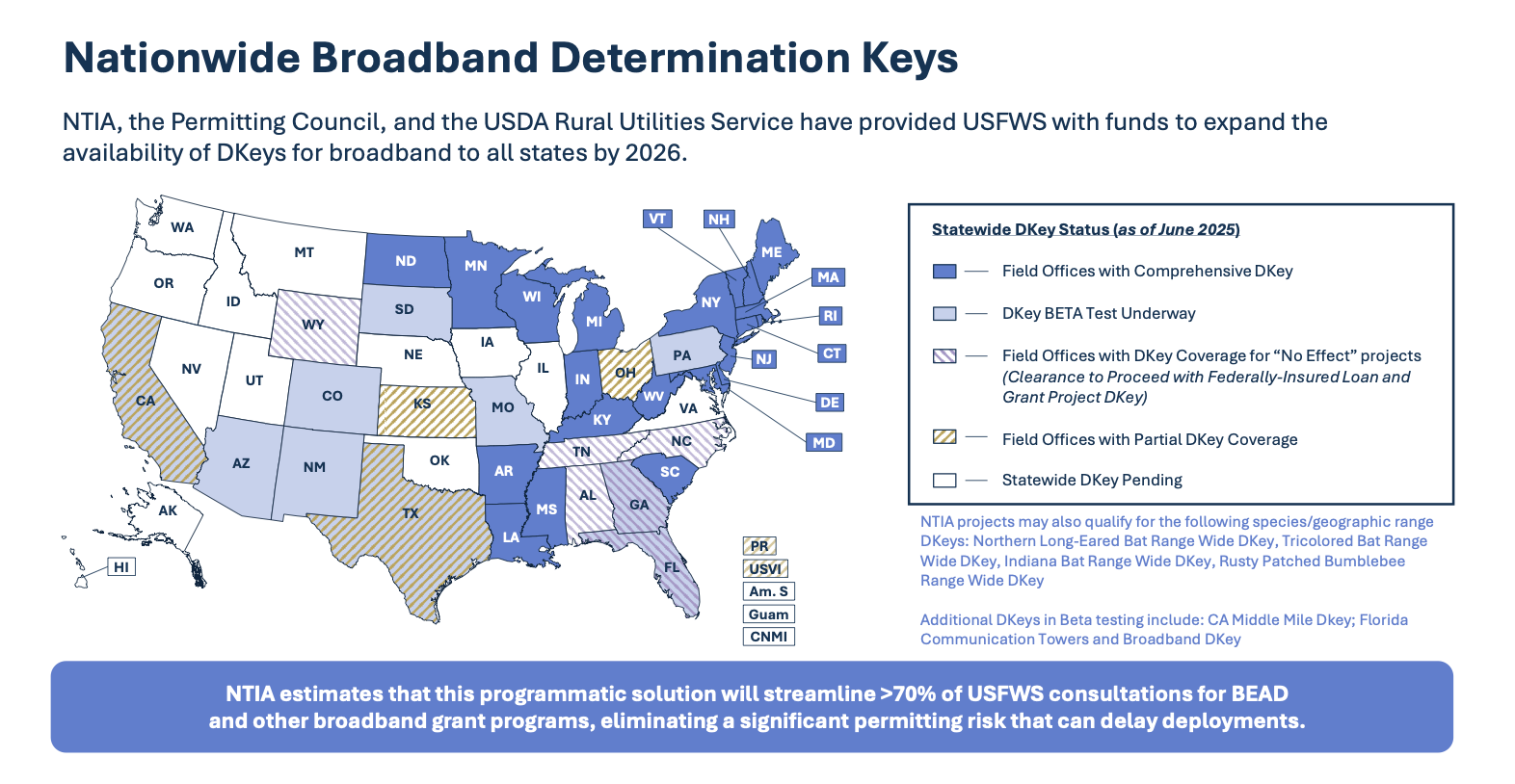
Virginia’s statewide keys, shown as pending on the map, have since been cleared for use, the agency said.
NEPA
The National Environmental Policy Act mandates assessments of the potential environmental impacts of federally funded projects. In order to cut down on those review times, NTIA last year adopted 36 new “categorical exclusions” for BEAD projects, types of builds that won’t require a lengthier assessment or impact statement.
Those are in addition to some that have been in place for NTIA projects since 2009.
Before a CATEX, as they’re called, can be applied, grantees have to check whether a set of factors are present that would prevent a normally eligible project from being able to take advantage of the exclusion. Those can include proximity to hazardous waste, effects on endangered species, and other things.
ISPs can agree to certain mitigation efforts to potentially allow some of those projects to still be excluded.
If a CATEX can’t be applied, a longer environmental review will be required. But the NTIA is allowing grant winners to re-use pieces of analysis done for the agency’s FirstNet builds to save time.
A state broadband office’s NEPA specialist, something they each need, will enter all of that information, including the historical and endangered species review information, into another NTIA tool called the Environmental Screening and Permitting Tracking Tool, or ESAPTT. If all goes well and a CATEX can be applied, the tool can quickly generate a NEPA approval from NTIA.
ESAPTT is the tool NTIA Administrator Arielle Roth was talking about at the SCTE TechExpo in Washington Monday.
“The idea was to create a one-stop shop – an automated process for companies to answer a series of questions, with the tool then able to issue a categorical exclusion, to reduce delays in processing,” she said. “We anticipate that 95 percent of BEAD projects will qualify for an exclusion under this tool.”
Historically, the agency said the process of getting everything together and clearing NEPA review, even with a CATEX, has taken three to six months, and longer if an assessment is required. That’s a process the agency is hoping to significantly speed up for most projects.
An instructional document on the agency’s website says it’s shooting for NEPA approvals within two weeks for about 90 percent of BEAD deployments.
The tool can also be used by states to track grantees’ permitting progress.










Member discussion