Roth at CES: 42 States and Territories Approved for BEAD, Including Nevada

NTIA Administrator cited cost savings, preparations for WRC-27 and future wireless networks.

Roth at CES: 42 States and Territories Approved for BEAD, Including Nevada
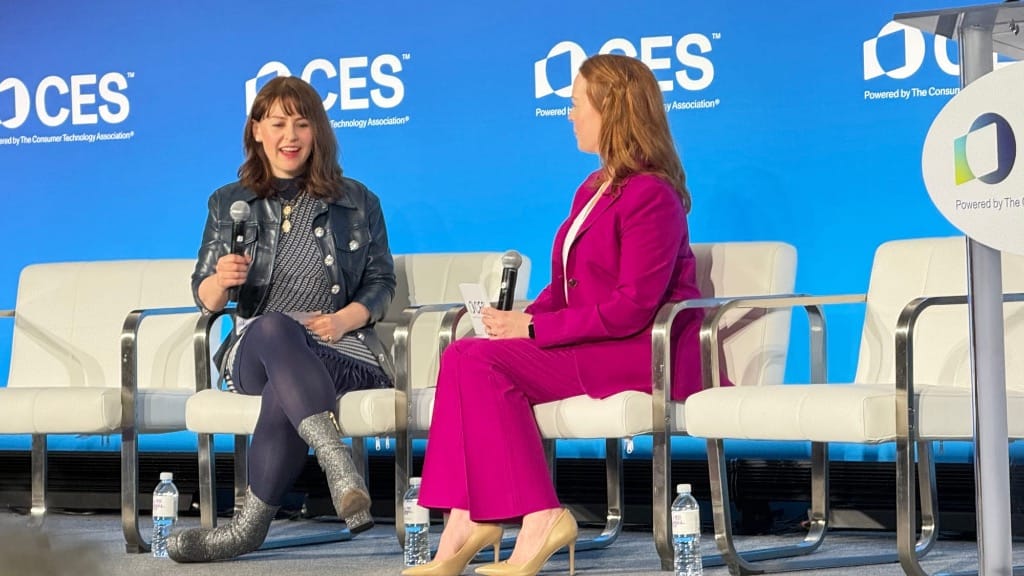
Photo of NTIA Administrator Arielle Roth (left) with Rachel Nemeth, senior director of regulatory affairs at the Consumer Technology Association, at CES2026 on Wed., Jan. 7, 2026.

LAS VEGAS, Jan. 7, 2026 — Arielle Roth, administrator of the National Telecommunications and Information Administration, said Wednesday that five additional states had been approved to begin construction under the Broadband Equity, Access, and Deployment program, bringing the total to 42 states and territories cleared to build high-speed internet networks. 

The five states announced were: Kentucky, Missouri, Maryland, Florida, and Nevada.

Roth announced the approvals during a panel at the Consumer Electronics Show, calling the milestone evidence that recent program reforms had accelerated participation, lowered costs, and restored BEAD to its statutory mission.

Roth said changes implemented over the past several months removed what she described as “extra-legal burdens” that had discouraged provider participation and driven up project costs. 

She said BEAD was now on track to save taxpayers $21 billion, citing sharp declines in per-location costs and increased private matching funds. In Louisiana, Roth said, projected costs fell from roughly $20,000 per location under earlier rules to about $7,500, while Georgia saw private matching contributions reach approximately 170 percent, reducing public exposure by hundreds of millions of dollars.

Roth said the reforms emphasized technology neutrality, accountability, and competition, principles she said were embedded in the statute but diluted in earlier program guidance.

Takes stance opposing rate regulation

Roth said the administration viewed facilities-based competition, not rate regulation, as the primary driver of broadband affordability. She warned that state-level price controls risked chilling investment, citing a case in New York where providers had exited markets after new regulatory requirements were imposed.

“Counterintuitively, policies intended to lower prices can scare away capital,” Roth said, arguing that uncertainty and regulatory risk increased the likelihood of project delays or defaults, particularly in rural areas. She said NTIA guidance now explicitly sought to protect BEAD-funded projects from regulatory burdens that could divert investment to lower-risk markets.

Spectrum, WRC-27, and the push toward 6G

Roth said NTIA was pursuing an “all-of-the-above” spectrum strategy, supporting licensed, unlicensed, and shared access as demand for wireless capacity continued to grow. She said NTIA would submit recommendations this week identifying tens of thousands of megahertz for potential reallocation, while advancing studies in key mid-band frequencies, including the 2.7 GigaHertz (GHz) and 7 GHz bands.

Roth also highlighted preparations for the World Radiocommunication Conference 2027, set to occur in Shanghai, China, calling the meeting critical for shaping global rules governing satellite and next-generation wireless networks. She said NTIA was coordinating with the White House, the Federal Communications Commission, and allied governments to ensure U.S. positions were aligned well ahead of the conference, which she said would be heavily focused on satellite systems and the foundations of 6G.

AI directive tied to infrastructure funds

Roth said NTIA’s broadband mission had become increasingly intertwined with artificial intelligence, following a December executive order directing agencies to support a unified national AI framework.

She said broadband networks were now essential infrastructure for deploying AI systems at the edge, while an inconsistent state-level patchwork risked fragmenting the market. Roth added that the  NTIA was conducting listening sessions on AI, robotics, and adoption by small and medium-sized businesses, with the goal of supporting U.S. leadership.

LA Olympics as a 6G testbed

Roth said NTIA had launched a new initiative inviting industry partners to demonstrate advanced wireless technologies at the 2028 Summer Olympics. She said the agency would help facilitate demonstrations of 6G-related technologies, including through spectrum access and regulatory coordination, positioning the Los Angeles Games as a global showcase for next-generation connectivity.

Looking ahead to 2026

Roth said NTIA’s top priorities this year included completing BEAD approvals, advancing federal spectrum identification requirements, and preparing for WRC-27.

She also pointed to a new NTIA initiative examining excessive screen use in schools, saying the agency was working with the Department of Education and the offices of the first and second ladies to assess the role of federal policy in addressing growing parental concerns.

Member discussion

Popular Tags