South Carolina Cuts BEAD Recipients in Half
State and federal American Rescue Plan Act funds take eight ISPs out of the BEAD program.

WASHINGTON, July 7, 2026 – South Carolina no longer needs half of the awards it planned under a $42.45 billion federal broadband expansion initiative.
State officials announced that eight of 16 projects initially planned last year under the federal Broadband Equity, Access and Deployment program have instead been funded with existing resources. Of the eight projects remaining in the BEAD program, four subgrant agreements have been signed, with construction expected to begin soon.
The June 30 announcement marks another reduction in South Carolina’s expected BEAD spending. After projecting in September 2025 that the state would spend $41.3 million of its initial $551.5 million BEAD allocation, the state now says it will need just $35.8 million.
The reduction follows the South Carolina Broadband Office’s completion of $400 million in broadband investments funded by the American Rescue Plan Act. Since the broadband office was established in July 2021, it has funded 277 broadband projects, with 83 percent already completed. The state has reduced its tally of homes and businesses without adequate broadband down from more than 300,000 in 2021.
As a result, fewer than 1 percent of locations statewide require BEAD funding. The remaining 19,022 eligible broadband serviceable locations include 15,132 residential locations, 3,659 business locations, and 231 community anchor institutions.
The state broadband office said the reduction was made possible by the “financially conservative” execution of ARPA projects by South Carolina internet service providers, with nearly 70 percent finishing under budget and/or ahead of the federal Dec. 31, 2026 deadline.
The remainder of the state’s ARPA projects are on track for 2026 completion, despite the federal government recently allowing providers to request a six-month extension through June 30, 2027.
“With careful stewardship of our existing state and federal funds, we’ve been able to minimize the need for BEAD funds while simultaneously accelerating construction for our citizens,” Jim Stritzinger, director of the SCBBO, said in a release. “The end of our digital divide is now clearly in sight!”
Among the state’s remaining eight BEAD subgrantees, only Amazon Leo’s award changed from the preliminary award amount, increasing slightly from $5.3376 million to $5.3418 million. All other planned awards stayed consistent.
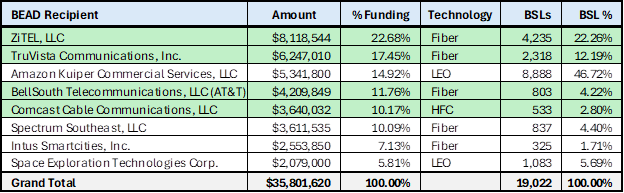
Of the remaining BEAD subgrantees, ZiTEL received the largest award at $8.1 million to deploy fiber to 4,235 locations, followed by TruVista Communications with a $6.2 million award for 2,318 fiber locations. Both providers have signed their BEAD subrecipient agreements.
Amazon Leo will receive $5.34 million to serve 8,888 locations using low-earth orbit satellite technology, while SpaceX’s Leo subsidiary Starlink will receive $2.08 million for 1,083 satellite locations.
The remaining awards went to AT&T, Comcast, Spectrum, and Intus Smartcities for fiber and hybrid fiber-coaxial deployments, each serving less than 1,000 locations.
Broadband deployment for these remaining locations is expected to begin in late 2026 after environmental permits are issued.
The eight providers originally included in South Carolina’s BEAD proposal, which were removed after the state determined their projects could be funded through existing state and ARPA resources, include:
- Aiken Electric Cooperative Inc. — $1.07 million
- Blue Ridge Electric Cooperative Inc. — 131 locations; $401,004
- Brightspeed — 118 locations; $10,400
- Comporium Inc. — 267 locations; $1.28 million
- Home Telephone ILEC LLC — 312 locations; $1.51 million
- Horry Telephone Cooperative Inc. — 100 locations; $806,400
- Newberry Electric Cooperative Inc. — 72 locations; $198,803
- Ripple Fiber Inc. — $296,227
The reduction also leaves South Carolina with an estimated $510 million in BEAD nondeployment funds. While the federal government has not yet released guidance outlining how states may use those funds since the BEAD program was restructured in June 2025, officials at the National Telecommunications and Information Administration have indicated that states will likely be able to repurpose the funds. Additional guidance is expected this summer.