
States Revise Tentative BEAD Awards
Minnesota revealed that costs per passing above $10,000 required written justification.

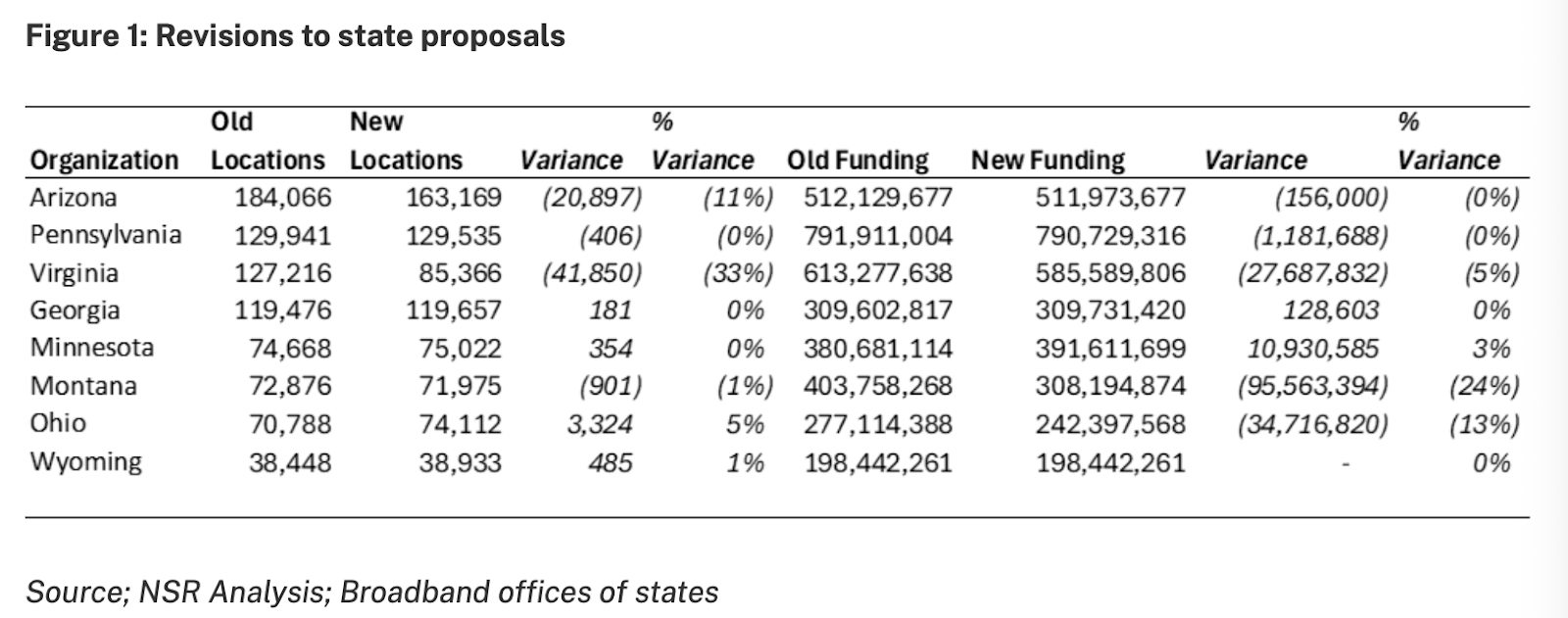
WASHINGTON, Sept. 25, 2025 – Eight states have revised their tentative awards under the Broadband Equity, Access, and Deployment program. Some made minor changes and others had material reductions in locations being served or money being spent.
Meanwhile, Minnesota revealed costs thresholds NTIA is using to push spending down: Those from $10,000 to $20,000 per passing require written justification, those from $20,000 to $23,000 have to be negotiated down to $20,000, and those above $23,000 had to be renegotiated in three days. The state said it was given official notice on Monday.
As of Thursday, Sept. 25, 2025, 46 states had reported tentative grant winners under the $42.45 billion program. Those have to be submitted to the Commerce Department for final approval, and are being further revised after submission to drive down spending, a major goal of the Trump administration for the program.
The changes were flagged in an investor note from New Street Research analyst Vikash Harlalka Thursday.
“We aren’t quite sure of the exact reasons for these revisions,” Harlalka wrote. “In some cases, we’ve seen reports that there were mistakes in the earlier proposals which have now been corrected.”
That was the case in Virginia, which, soon after publishing, revised its funded location count down by more than 40,000 before a smaller Sept. 11 update. A staffer in the state’s broadband office said last month that previously eligible locations not in line for BEAD funds, something states have to submit to NTIA, were mistakenly included in the state’s list of locations that were going to be served by BEAD projects.
Montana’s broadband office said that stakeholders noted some discrepancies in one of the state’s data submission files.
The office “reviewed these discrepancies and made the appropriate adjustments in the final submission,” a spokesperson said in an email. The changes show the state is aiming to spend about $95 million less on deployment projects.
The Arizona and Ohio broadband offices, which also had significant changes in locations or funding, did not immediately respond to requests for comment.
Across the eight states, the revisions would remove funding from 59,710 locations and reduce tentative spending by $148 million, according to New Street’s analysis.
Amazon’s nascent Project Kuiper would lose 1,400 locations and lose $10 million in funding based on the revisions, down to a national total of $185 million. SpaceX would gain a modest 591 locations and lose $81 million in funding, the biggest loss of any provider, down to $450 million nationally. The two satellite providers are in line to serve more locations than any other ISPs through BEAD.
Revisions to state proposals
While the provider is still in line to serve the most locations nationally at 340,000, its small gains after the revisions are smaller than SpaceX has been looking for. The company has challenged the results in several states, including Virginia and Louisiana, arguing it should have been awarded many more locations because of its low bids.
Multiple of the challenged states said in their plans that when evaluating whether to treat applications as priority projects, which get first consideration under BEAD, they took into account tree cover and mountainous terrain. They said that tended to cut against wireless applicants because their signal strength could be weakened or inconsistent due to the obstructions.
States' tentative results still not set in stone
Even after the revisions, states’ tentative results are not set in stone. The Commerce Department is looking for states to revise their awards to push down spending even further. That will involve negotiating awards down or potentially awarding areas to another provider for less money.
In an email to stakeholders Wednesday, Minnesota’s broadband office said the process was underway in that state, as it is in others. The state offered more confirmation the Commerce Department was using cost thresholds, which differ in each state, to determine which areas would need revising.
In the case of Minnesota's $20,000-$23,000 locations, those in that range could potentially be allowed to stand if there were “extraordinary circumstances,” the state wrote.
Nationally, fiber is in line to serve the majority of BEAD locations so far, at about 67 percent. Satellite would serve about 20 percent and fixed wireless would serve about 10 percent. The remaining locations would get cable or are still being negotiated by state broadband offices.
Editor's Note: Because of an editing error, this article was originally published under the headline "States Revise Tentative BEAD Awards Down Under NTIA Pressure," but the latter clause was dropped to more correctly reflect the changes. No changes were made to the article.






Member discussion