T-Mobile Adds More Than 500,000 Broadband Subs
The company is no longer reporting individual subscriber metrics.

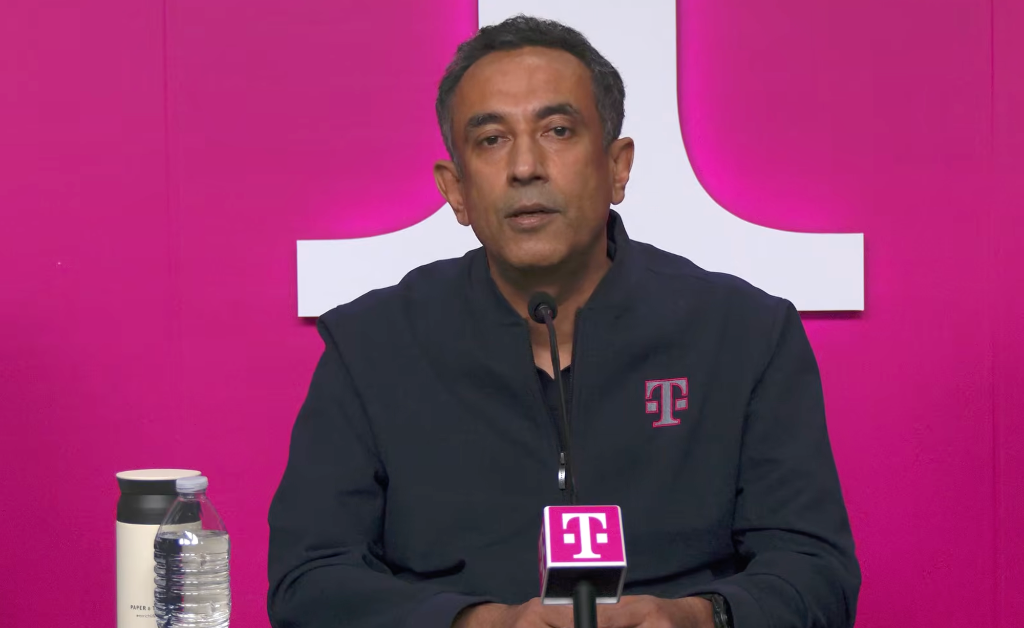
WASHINGTON, April 28, 2026 – T-Mobile added more than 500,000 subscribers between its fixed wireless and fiber broadband services in the first quarter of 2026, CEO Srini Gopalan said Tuesday.
As it announced at its capital markets day in February, the company is no longer reporting individual subscriber metrics for its services, opting instead to tally up its postpaid accounts and average revenue per account (ARPA). An account might subscribe to broadband and take multiple mobile lines, each of which would have been broken out before.
Still, Gopalan highlighted the 500,000 figure on the company’s earnings call Tuesday afternoon. He said fixed wireless net additions were “accelerating year over year.” The company added 424,000 fixed wireless subscribers in the first quarter of 2025.

He said the company was “tracking strong” toward its goal of 15 million fixed wireless customers by 2030. T-mobile had 8.45 million fixed wireless subscribers at the end of 2025.
On the postpaid account front, the company added 217,000 in the first quarter with an ARPA of $151.93. Peter Osvaldik, T-Mobile’s CFO, noted Verizon posted 127,000 lost accounts. AT&T reported adding 84,000 postpaid wireless accounts, but doesn’t report broadband-only in that figure.
As of the end of 2025, T-Mobile had nearly 1 million fiber subscribers. It’s targeting 3-4 million and, on top of that, announced Tuesday it was acquiring two additional regional fiber providers in joint ventures.
Quarterly reporting changes
Analysts were not exactly excited when T-Mobile announced the new reporting metric. Wall Street has historically used postpaid phone subscribers to compare the major wireless carriers.
“Disclosure changes to subscribers – not a lot of love for that,” New Street Research analyst David Barden wrote in a February investor note. “With competition heating up, detractors will point to this change as management trying to hide subscriber performance.”
Verizon and AT&T are continuing to disclose subscriber numbers, with some new changes to how revenues are reported.
T-Mobile executives argued at the time that most of their mobile subscribers had multiple lines, or paid for a smartwatch or home broadband connection. Thus, it made sense to focus on the accounts that generated those paying lines.
“This is the bar you should hold us to. This is the bar you should hold the rest of the industry to: Who can attract customers switch full relationships and who can grow those relationships in ARPA,” Osavaldik said at the carriers’ capital markets day.
The idea of looking at the account level isn’t totally without merit, Barden wrote.
“They will report accounts, ARPA, and churn and so the default is to model out how the business really looks one level higher above individual users into user groups,” he wrote. “This is not Netflix getting rid of subscriber reporting altogether. There is still substance here.”
MoffettNathanson founder Craig Moffett agreed to an extent, even though he lamented the carrier's updated disclosures in a March note, writing “Will we better see the forest for the trees when the trees are mostly cut down? Certainly not.”
Moffett pointed out that the careers’ postpaid phone net adds and postpaid account net adds had made little sense for a while. For example, in the fourth quarter of 2025 Verizon’s results implied it added 24 net phone lines for each new account. The number was 5.8 lines per account for AT&T and 3.7 lines per account for T-Mobile.
“There’s a credible argument to be made that phone net adds have become entirely untethered from reality,” he wrote. “ Reported net adds has become a measure of manufactured lines that all too often come with little or no accompanying revenue. Net additions are indicative of… well, almost nothing.”
He wrote the reporting changes broadly indicated the industry shift toward convergence, with major ISPs emphasizing fixed and mobile broadband bundles that keep subscribers from switching to another provider. T-Mobile has talked this up the least and downplayed it on the call, but it does have nationwide broadband service with fixed wireless and announced Tuesday it was buying two more regional fiber providers through joint ventures.