
T-Mobile Wants Rehearing in $92 Million Location Data Fine Case
There's a circuit split on whether the FCC's process for issuing fines is unconstitutional.

WASHINGTON, Sept. 22, 2025 – Judges upheld a $92 million fine against T-Mobile last month, leaving the Federal Communications Commission penalty in place and affirming the agency’s ability to levy fines. The carrier is asking judges for a new hearing.
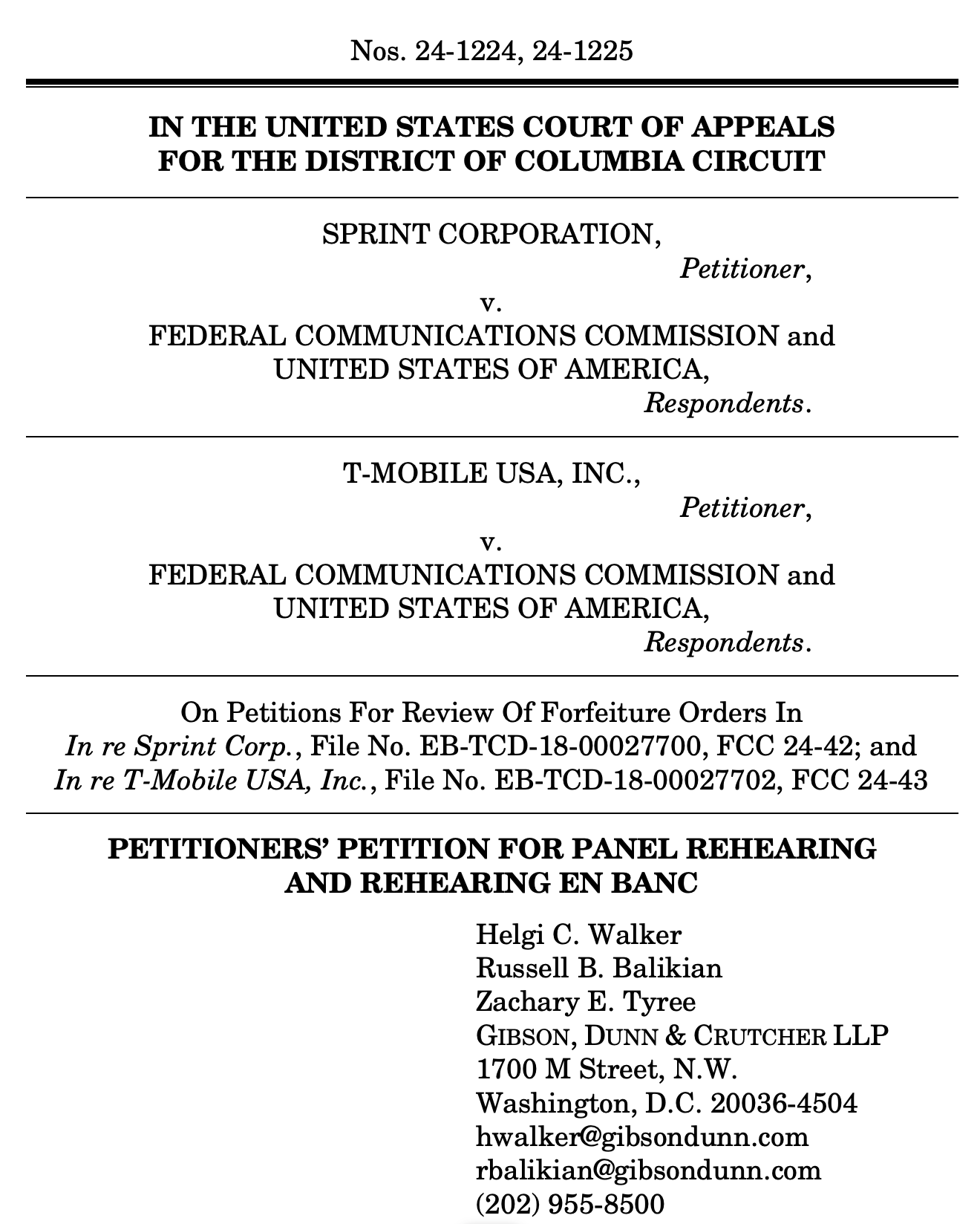
T-Mobile asked Monday for a full panel of the U.S. Court of Appeals for the D.C. Circuit to rehear its challenge to the FCC forfeiture. Each of the big three carriers was hit with a similar fine last year, and each argued in court that the agency’s forfeiture process was invalid in light of recent Supreme Court precedent.
The Second Circuit upheld the fine against Verizon earlier this month, and the Fifth Circuit tossed the fine against AT&T, determining that under SEC v. Jarkesy (2024) the FCC can’t issue civil penalties without providing companies the opportunity for a jury trial. Experts have said the 2-1 circuit split on the issue makes it very likely the agency’s ability to issue fines will be appealed up to the Supreme Court.
The three-judge D.C. Circuit panel that oversaw the T-Mobile case “sidestepped Jarkesy, which compels the conclusion that the Orders violate the Seventh Amendment and Article III” of the U.S. Constitution, attorneys wrote for the company in a Monday petition for rehearing.
“The panel concluded that the Companies ‘waived’ their jury-trial rights by seeking review of the Orders in this Court instead of refusing to pay the fine and awaiting a DOJ collection action,” the attorneys wrote. “That conclusion is incorrect, and it directly conflicts with the Fifth Circuit’s AT&T decision rejecting an identical argument.”
The FCC fined the three major mobile carriers last year nearly $200 million for not vetting third parties before selling them customer location data in 2018. T-Mobile was hit with an $80 million fine, plus a $12.2 million fine intended for Sprint, which T-Mobile acquired in 2020.
The FCC’s process allows companies to get a jury trial, but only if they choose not to pay and wait for the Department of Justice to pursue a collection action. The companies instead opted to pay the fines, giving them the chance to appeal the penalties in court.
The Fifth Circuit decided that didn’t pass muster under Jarkesy, where the Supreme Court found the Securities and Exchange Commission was violating the Constitution by not providing the chance for a jury trial when it issued civil fines. The Second and D.C. Circuits sided with the FCC, which defended its process.
“The Carriers had the right to a jury trial. They chose not to wait for such a trial and therefore waived that right,” D.C. Circuit Judge Florence Pan wrote in the court’s decision. “The Carriers may not now complain that they were denied a right they voluntarily surrendered.”
FCC Chairman Brendan Carr dissented from the fines when they first came down – before Jarkesy – and has said the agency should reform its enforcement process in light of the decision. But the agency continued defending the fines under his leadership and has itself asked the Fifth Circuit to rehear its case on the issue.
“Civil penalties are among the Commission’s most important regulatory remedies,” the agency wrote in a July petition in that court. “If the panel’s decision stands, the validity of every Commission enforcement action that seeks to impose a monetary penalty under that provision is likely to be challenged.”
Major trade groups have also separately argued to the agency that its enforcement process is now likely unconstitutional.
T-Mobile also argued Monday that the D.C. Circuit erred in ruling that telecom providers were bound by the Communications Act to protect customer location data in the first place. The company had argued that information wasn’t collected solely by virtue of providing voice service and thus shouldn’t be included in the set of information telecoms have to protect.
The petition for rehearing was led by Helgi Walker, a partner at Gibson Dunn. The petition pushed for either a three-judge panel rehearing or a hearing from the full D.C. Circuit.


Member discussion