
Trump Administration Sued Over Canceled Digital Inclusion and Skills Grants
Termination of $2.75 billion Digital Equity Act programs ‘unconstitutional and unlawful,’ attorneys argue.


WASHINGTON, Oct. 8, 2025 – A leading broadband advocacy group has sued President Donald Trump and senior Commerce Department officials, alleging they unlawfully scrapped a congressionally funded program to expand digital literacy and skills.
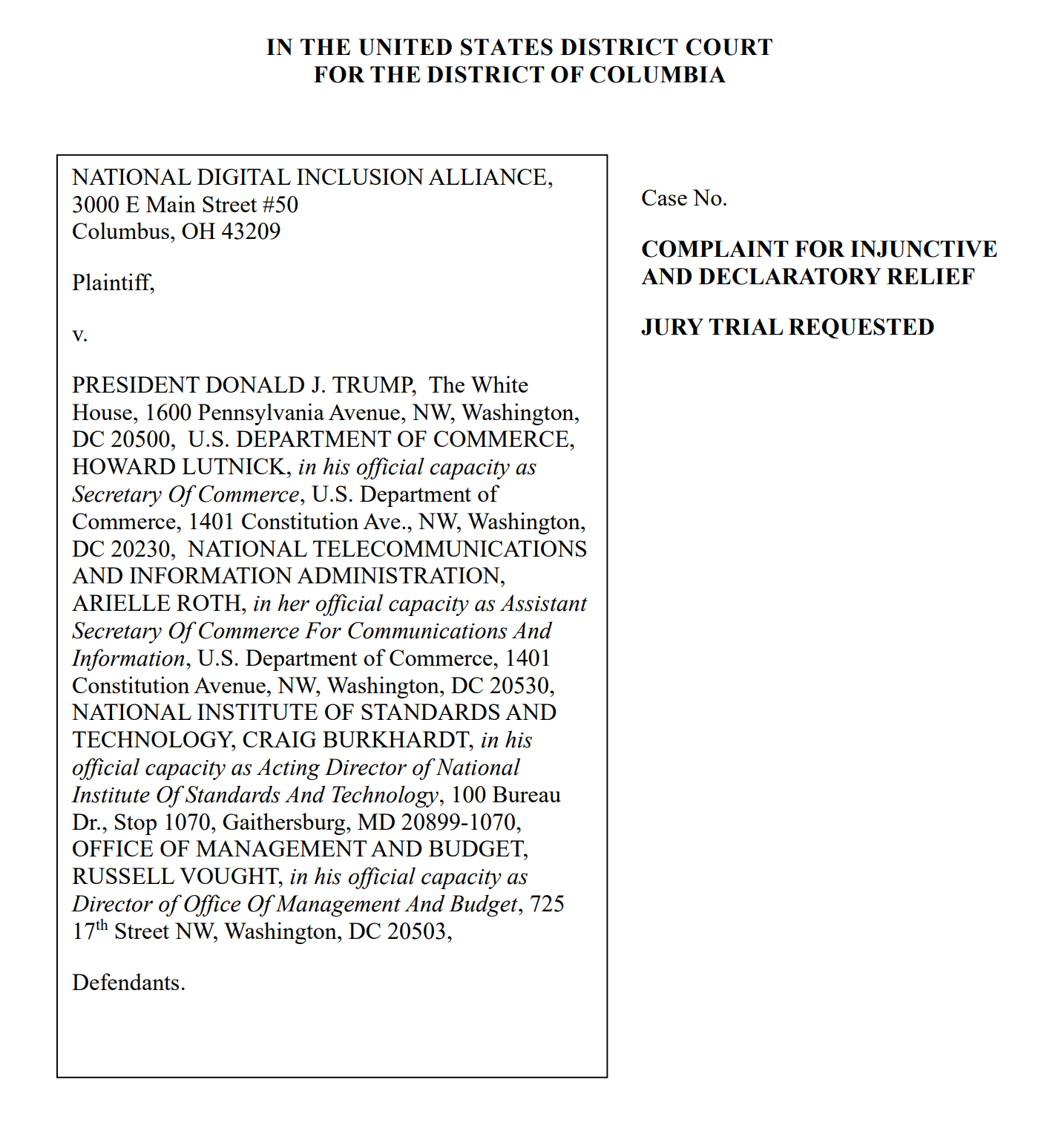
Read the Complaint for Injunctive and Declaratory Relief
The National Digital Inclusion Alliance filed suit Tuesday in the U.S. District Court for the District of Columbia, arguing the Trump administration’s unilateral decision to end the Digital Equity Act’s competitive grant program in May was unconstitutional and unlawful.
“NDIA brings this lawsuit to stop these flagrant constitutional violations that severely undermine Congress’s efforts and intent to close the digital divide in an age where internet access is a critical necessity,” the group wrote in its Oct. 7 complaint.
NDIA is represented by the Lawyers’ Committee for Civil Rights Under Law.
“We’re bringing our claim under the Constitution for a violation of the separation of powers and violation of the Spending Clause, as well as for violation of the Administrative Procedure Act,” said Gillian Cassell-Stiga, senior counsel with the organization, in an interview Broadband Breakfast.
NDIA was among 65 organizations the National Telecommunications and Information Administration recommended for funding before the administration halted the program, which had drawn more than 700 applications nationwide. In total, the government canceled $1.25 billion in competitive grant funding for nonprofits and local partners, as well as $1.44 billion in capacity grants intended for states and territories.
Speaking with Broadband Breakfast, NDIA Executive Director Angela Siefer described the abrupt termination as devastating for local programs preparing to scale their digital navigator work.
“Some of those sites have had to lay folks off,” Siefer said. “NDIA also reduced our own team capacity… when [federal investments] didn’t happen.”
Siefer said NDIA was awarded a $25.7 million federal grant in January to support 13 local digital navigator programs across 11 states. The funding would launch the group’s Digital Navigator+ initiative, expanding on an earlier effort supported by Google.org that ended in August.
“We had included some of those sites in our proposal for this competitive grant to ensure that they would be able to continue,” Siefer told Broadband Breakfast.
The projects would specifically address barriers to online participation in telehealth, education, telework and artificial intelligence, serving more than 30,000 individuals from rural Alaska to the Cherokee Nation in Oklahoma and urban programs in New York and Georgia.
But, shortly after NDIA was recommended for funding came what the organization described as “a sea of change.”
White House targets ‘equity’ programs across federal government
On January 20 and 21, Trump signed Executive Orders 14151 and 14173 characterizing “diversity, equity, inclusion, and accessibility” programs as “discriminatory” and “illegal,” and directing all executive departments and agencies to “terminate all discriminatory and illegal preferences, programs, activities, … and requirements.”
“Enforcement of the new anti-equity policy quickly followed,” NDIA told the court.
In April, the NTIA emailed nonprofit NDIA saying “any costs associated with diversity, equity, and inclusion conferences, trainings, and/or professional development are not allowable,” and would be ineligible for reimbursement.
One month later, on May 8, 2025, the President posted to the social media platform Truth Social claiming that the Digital Equity Act was an “unconstitutional” “woke handout based on race” and “a racist and illegal $2.5 billion dollar giveaway.”
The day after the president’s post declaring the Digital Equity Act unconstitutional, NDIA received a notice that its award and the competitive grant program had been terminated.
The May 9 letter offered no supporting facts or analysis, NDIA argued, asserting only that the awards “were created with, and administered using, impermissible and unconstitutional racial preferences.”
NDIA pushed back on that characterization
“Just as diversity, equity, and inclusion are not illegal, the Digital Equity Act is not racist, illegal, or unconstitutional,” NDIA wrote. “‘Equity’ as intended by the Digital Equity Act was not intended to, nor does it favor a race or a gender; its goal is to provide critical broadband internet access to Americans—all of them.”
NDIA asked the court Tuesday to declare that the Digital Equity Act’s competitive grant program is lawful and constitutional, to overturn the administration’s decision to terminate it, and to order the program’s reinstatement. The group is also seeking to block any retaliation for filing the lawsuit and to recover attorneys’ fees and costs.
“Congress exercised its Article I legislative power to require Commerce to establish and carry out the competitive grant program under the Digital Equity Act,” the group wrote. “Congress’s exercise of authority in that respect was constitutional, as is the Digital Equity Act.”
The complaint names Trump, Commerce Secretary Howard Lutnick, and NTIA Administrator Arielle Roth as defendants, along with the Departments of Commerce and the Office of Management and Budget. Also listed are OMB Director Russell Vought and National Institute of Standards and Technology Acting Director Craig Burkhardt. The administration has 60 days to respond to the lawsuit.
Separately, a coalition of 22 states and the District of Columbia is challenging the federal rule the Trump administration relied on to justify the cancellations. Filed in June in the U.S. District Court for Massachusetts, that lawsuit argues the OMB unlawfully expanded agency power by allowing grants to be revoked whenever programs “no longer effectuate agency priorities,” which was rationale used to end the Digital Equity Act’s funding.
The Digital Equity Act was legislation attached to the bipartisan infrastructure law passed in August 2021 and signed by President Joe Biden in November 2021. The law allocated $65 billion for broadband, $42.5 billion under a last-mile infrastructure program, about $2.5 billion under DEA and $1 billion for middle mile broadband projects.


Member discussion