Trump AI Advisor Touts Plan to Secure U.S. Leadership

‘Let's make sure the world is using the American [technology] stack,’ Sriram Krishnan said.

Trump AI Advisor Touts Plan to Secure U.S. Leadership
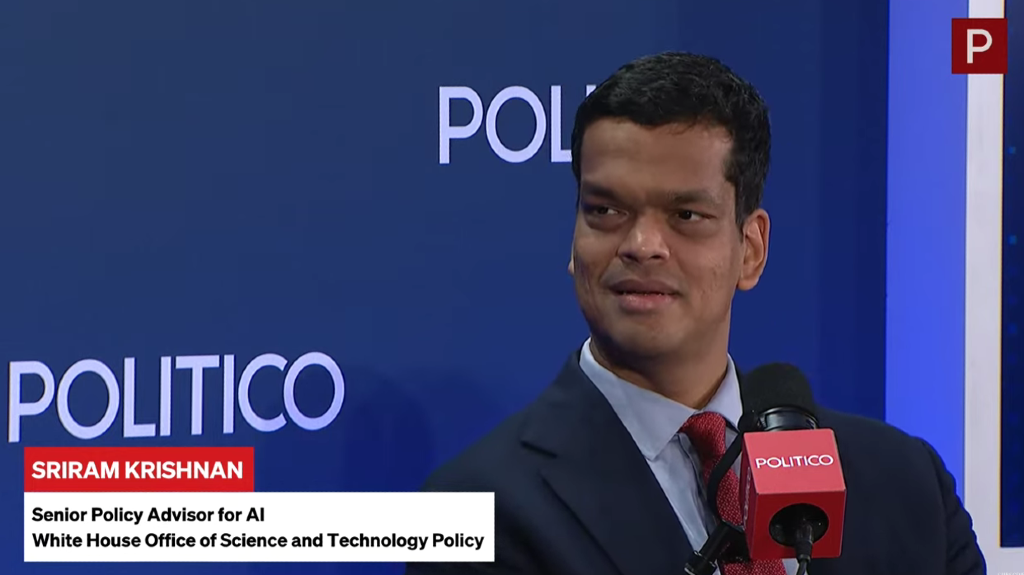
Screenshot of Sriram Krishnan, Senior Policy Advisor for AI at the White House Office of Science and Technology Policy, at Politico's AI & Tech Summit in Washington on Tuesday, Sept. 16, 2025.

WASHINGTON, Sept. 16, 2025 – Winning the artificial intelligence race comes down to market share, said senior White House policy advisor Sriram Krishnan, arguing America must ensure the world runs on U.S.-built chips and AI models.

Brushing aside fears of unchecked AI development, Krishnan told attendees of Politico’s AI & Tech Summit Tuesday that the administration sees “an insurmountable lead” for the U.S. if it builds decidedly.

“We need to make sure American AI – our stack, our chips, our models – are the ones that the world uses,” Krishnan said. “Not Chinese models or Chinese chips.

Krishnan – a longtime Silicon Valley investor and executive, who previously held roles at Microsoft, Twitter, Yahoo, Facebook, and Snap before becoming a general partner at venture capital firm Andreessen Horowitz – outlined what he called the administration’s three-part “AI action plan.”

“Build our infrastructure,” he said, meaning ensure the U.S. has sufficient data centers, computing power, and energy to train increasingly large models. 

“Second, we want innovation,” he said, “Let's make sure our model companies have the capacity and the resources” to be competitive.

“And finally, let's make sure the world is using the American ‘stack,’” he said, referring to the ecosystem of technology that underpins AI, from semiconductors to software and cloud services.

Highlighted recent U.S.-UAE pact on AI

Krishnan highlighted the White House’s recent U.S.–UAE AI pact as a concrete example of the strategy in action. The agreement commits regional partners to build U.S.-aligned data centers and purchase American-made chips, a move intended to extend Washington’s technological influence abroad.

“The partnership the President has struck in the Middle East is all about ensuring the dominance of the American AI stack,” Krishnan told the summit audience.

Asked about the administration’s decision to permit limited chip sales to China, Krishnan stressed that the U.S. was exporting only older technology – Nvidia’s H20 and AMD’s MI280 – while reserving cutting-edge processors like Nvidia’s Blackwell for domestic use.

“We’re not giving them our best. We’re not giving them these GPUs in enough quantity,” he said. “They are way less powerful than the latest and greatest America has access to.”

As an example, he pointed to Elon Musk’s plans to deploy a million Blackwell GPUs by early next year, up from about 500,000 today. “Just one of our companies alone will have that kind of scale,” he said, adding that limited exports help U.S. firms protect global market share against rivals such as Huawei.

Turning to regulation, Krishnan said the administration views AI as being in an “early era” akin to the internet in the 1990s. Heavy-handed rules, he warned, could stifle U.S. innovation. Still, he noted some areas require government oversight, such as testing standards and ensuring adversaries do not gain access to sensitive equipment like advanced cooling systems.

“We are in a race with China,” Krishnan said. “This is one of the reasons, when it comes to state legislation, we don’t want California to set the rules for AI.”

Member discussion

Popular Tags