
Trump AI Plan Spurs FCC Review of State Regulations
Chairman Brendan Carr cites Communications Act powers as a possible means to preempt state AI laws

Jericho Casper
WASHINGTON, Sept. 16, 2025 – A federal agency will soon act on a directive from President Donald Trump to review and potentially block state regulations on artificial intelligence.
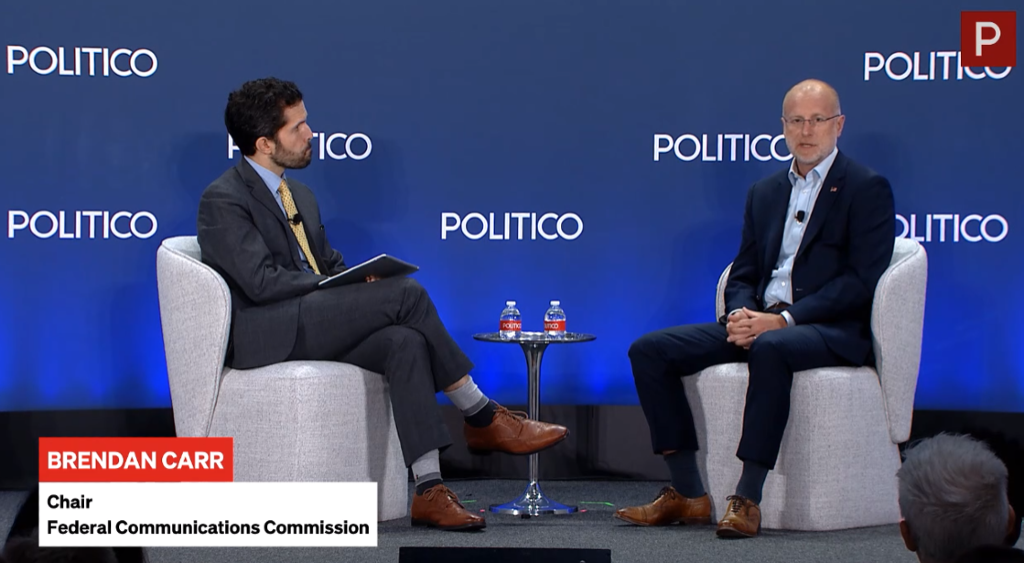
Federal Communications Commissioner Brendan Carr used the stage Tuesday at Politico’s AI & Tech Summit to float possibly preempting California- and New York-style AI rules, citing authorities under the Communications Act.
“We do have some authorities under Section 253 of the Communications Act,” Carr said. “Effectively, if a state or local law is prohibiting the deployment of ‘modern infrastructure,’ then the FCC has authorities to step in there.”
Carr mentioned the review would be housed inside one of the reforms the FCC will consider at its Sept. 30 meeting – a proposal to streamline wireline deployment by preempting state laws.
“In doing so we’re also going to see if there are laws on AI regulation that inhibit infrastructure build investment,” Carr said.
The push stems from Trump’s AI Action Plan unveiled in July, which threatened to cut off federal funding to states with strict AI rules and called on the FCC to assess whether state AI laws conflict with its mandate.
In its inquiry, the FCC asks whether it should pursue sua sponte preemption, meaning the agency would proactively strike down state or local laws it sees as conflicting with federal authority, rather than waiting for a company to challenge them.
“We are seeking comment and going to be looking out for forms of AI regulation at the state level that could be inhibiting this type of infrastructure,” he doubled down.
Carr also weighed in on content moderation by social media
While much of Carr’s focus was on infrastructure and spectrum, he also returned to a longstanding debate over whether the FCC should weigh in on content moderation by social media companies under Section 230 of the Communications Decency Act.
Carr drew particular issue with Section 230(c)(2), which he said had “been read by the courts as giving broad immunity to all sorts of content moderation and censorship.”
“The debate around Section 230 is still alive,” Carr said, describing his current stance as one of “trust and verify.”
He acknowledged the commission’s authority “other than Section 230” was limited: “The FCC regulatory authority declines when you get to social media.”
Carr contrasted today’s virtual environment with what he called the “libertarian” early days of the internet, saying it shifted toward “censorship” during the Covid era.
He said a lot of social media companies had since shifted back to embracing “free speech” citing Meta and X – both of which have rolled back moderation practices since Trump took office in January – a trend he said he was “happy to see.”
“There’s more we could do to give users the tools to curate their online experience,” Carr said.
He then turned to broadcasting, arguing that the FCC has retreated too far from enforcing the public interest standard for licensees. He pointed to complaints against outlets such as ABC, NBC, CBS, and Disney-owned stations that were dismissed in recent years, saying national programmers increasingly dictate what local broadcasters air.
“I don’t think we’re better off for it,” he said, adding that the commission intends to refocus its attention on holding broadcasters accountable.



Member discussion